Disclosure: some links in this post are affiliate links. If you buy through them, we may earn a commission at no extra cost to you. As an Amazon Associate, we earn from qualifying purchases. We only recommend gear we would put in our own trucks.
Wheel fitment is where truck builds most often go wrong, and it goes wrong expensively. The wheel that looks perfect in a rendering can rub at full lock, eat wheel bearings, or push your track width out far enough that the truck handles differently loaded than it did empty.
The vocabulary is the barrier. Offset, backspacing, bolt pattern, center bore, load rating — five numbers, and you need all five right. Once you understand what each one does, choosing wheels stops being guesswork.
Here is what each number means in plain language, and what actually happens when you get it wrong on a truck that carries weight.
In this guide
- The five numbers that matter
- Offset, explained without the diagram
- What poke actually costs you
- Backspacing
- Center bore and hub rings
- Load rating is not optional on a truck
- Fitting and living with them
- Doing it on three budgets
- Frequently asked questions
- The bottom line
Vince’s own build photos for this guide are being added.
The five numbers that matter
| Spec | What it means | Get it wrong and |
|---|---|---|
| Bolt pattern | Number of lugs and the circle diameter they sit on, e.g. 6×139.7 | It does not mount. No workaround worth using. |
| Offset | Distance from the wheel centerline to the mounting face, in mm | Rubbing, altered steering feel, extra load on bearings |
| Backspacing | Distance from the mounting face to the inner lip, in inches | Inner rubbing on suspension and frame |
| Center bore | Diameter of the hole over the hub | Vibration, and lug studs carrying weight they should not |
| Load rating | Maximum weight the wheel is built to carry | Wheel failure under load. Not a place to economize on a work truck. |
Offset, explained without the diagram
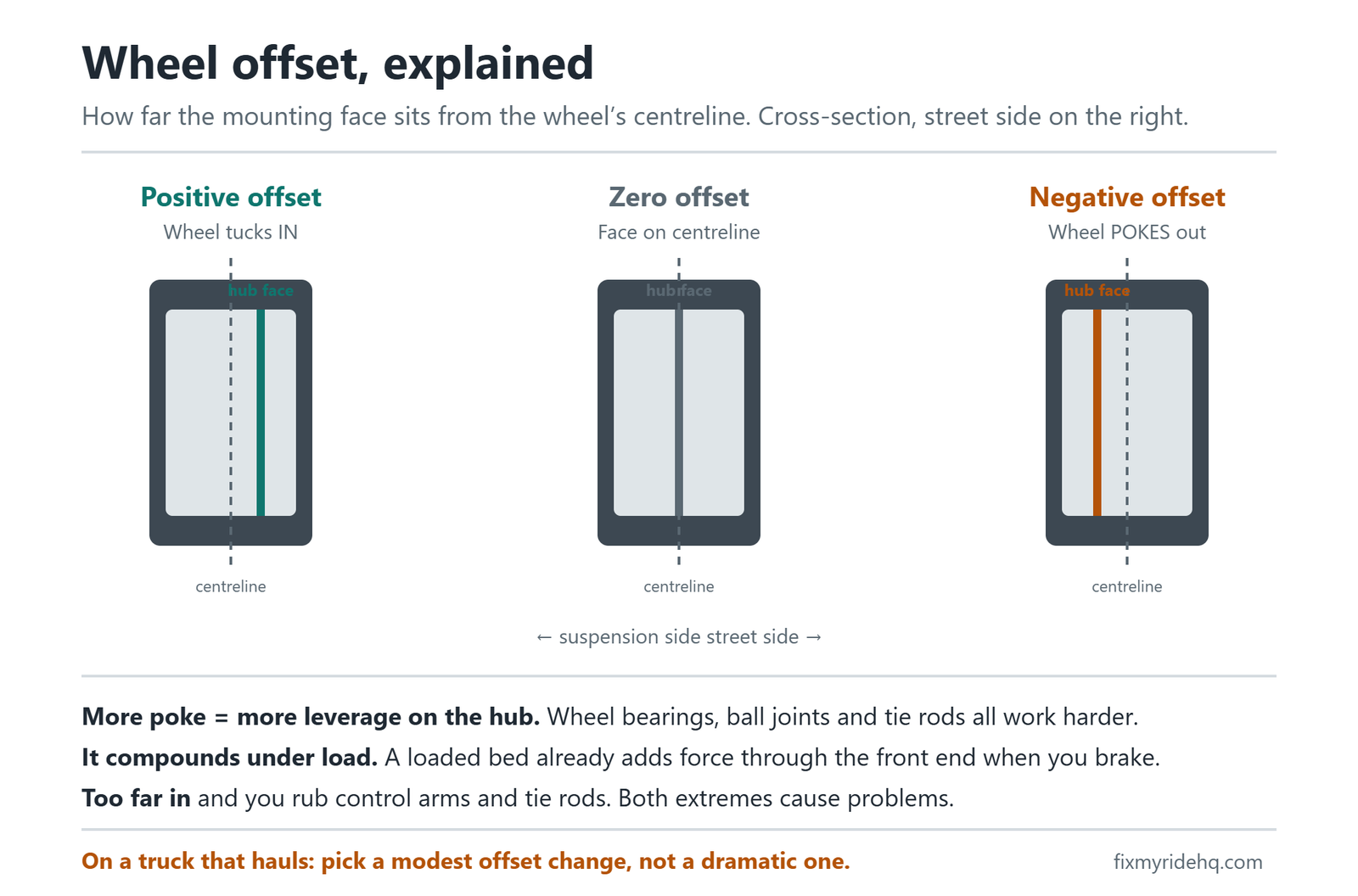
Imagine slicing the wheel exactly down the middle of its width. That is the centerline. Offset measures how far the mounting face — the flat part that bolts to the hub — sits from that line.
- Positive offset: the mounting face sits toward the outside of the wheel. The wheel tucks further in, under the fender. Most factory trucks run modest positive offset.
- Zero offset: mounting face exactly on the centerline.
- Negative offset: the mounting face sits toward the inside. The wheel pushes outward — this is what people mean by poke, and it is what produces the wide stance look.
Going more negative moves the wheel outward. Going more positive pulls it inward toward the suspension. Both directions cause problems at the extremes: too far out and you have rubbing at the fender and a wider track, too far in and you are rubbing control arms, tie rods, or the frame.
What poke actually costs you
This is the part that gets glossed over, and it matters more on a truck that hauls than on a truck that does not.
Moving the wheel outward increases what engineers call the scrub radius. In practical terms, the tire’s contact patch now sits further from the axis the wheel steers around, which means every bump and every braking input applies more leverage back through the steering and the hub.
- Wheel bearings work harder. More leverage on the hub means more load on the bearing, and bearings that would have lasted the life of the truck start failing early.
- Steering feel changes. More kickback over bumps, more tugging under hard braking, heavier effort at low speed.
- Ball joints and tie rods see more load for the same reason.
- It compounds under weight. A loaded bed already increases the forces through the front end on braking. Aggressive offset adds to that.
- Tires throw further. More poke past the fender means more rock and water thrown onto your paint and everybody behind you — and in many places, fender coverage is a legal requirement.
None of this means do not do it. It means pick a modest change rather than a dramatic one if the truck works for a living. A small step toward negative offset gets most of the stance with little of the penalty.
Backspacing
Backspacing measures the same geometry from the other side: from the mounting face to the inner lip of the wheel. It is the number that tells you whether the wheel clears your suspension.
Less backspacing pushes the wheel out. More backspacing pulls it in toward the suspension components. If you are running a wider wheel, backspacing is what determines whether that extra width goes inward into the control arms or outward past the fender.
Center bore and hub rings
Factory wheels are hub-centric: the center bore fits the hub snugly, and the hub carries the vehicle weight while the lug nuts only clamp.
Aftermarket wheels are often made with an oversized bore so one wheel fits many vehicles. Without hub-centric rings to take up that gap, the lug studs end up carrying weight they were not designed to carry, and the usual symptom is a vibration that no amount of balancing fixes.
Buy the rings. They cost very little and they solve a problem that is genuinely hard to diagnose later.
hub centric rings — Amazon link pending program approval
torque wrench — Amazon link pending program approval
Load rating is not optional on a truck
Every wheel has a maximum load rating stamped or cast into it. On a passenger car this is rarely a live concern. On a truck that carries weight, it is.
Match or exceed the factory rating. A wheel designed for a crossover can physically bolt to a half-ton truck and be completely inadequate for a loaded bed. Style-focused wheels in particular are sometimes built to lighter ratings than they look.
The same logic applies to the tire — see how to read your tire sidewall for load index, and the all-terrain roundup for choosing the tire itself.
Fitting and living with them
- Check clearance at full lock, both directions, and with the suspension compressed. A wheel that clears in the driveway can rub over a driveway lip with a loaded bed.
- Transfer or replace TPMS sensors. A new set of wheels without sensors means a permanent dashboard light — see our warning light glossary.
- Get them balanced properly. Road force balancing resolves vibrations that standard spin balancing cannot.
- Torque to spec in a star pattern, in two or three passes, with a torque wrench. Impact guns stretch studs and warp rotors.
- Re-torque after 50 to 100 miles. Wheels seat after the first drive. This is a one-minute check that prevents a genuinely dangerous failure.
- Expect your speedometer to change if overall tire diameter changed. Wheel diameter alone does not do this — tire sidewall height does.
Safety note: Wheels are a structural component. Never fit a wheel with a load rating below your vehicle’s requirement, always use the correct lug nut seat type for your wheels (conical, ball, or flat — they are not interchangeable), torque to the manufacturer’s specification, and re-torque after the first drive. If you are unsure about fitment for your specific truck, ask a tire shop before buying.
Doing it on three budgets
| Tier | What you get | Trade-off |
|---|---|---|
| $ — Entry | Keep the factory wheels, put good tires on them. Maybe a set of hub rings and proper lug nuts. | No appearance change, but the factory wheel is correctly engineered for the truck and rated for its load. |
| $$ — The sweet spot | Quality cast alloy in a conservative offset, correct load rating, hub-centric or ringed, factory-ish diameter. | Real visual change without the bearing and steering penalties. Where most working trucks should land. |
| $$$ — Premium | Forged or flow-formed wheels, larger diameter, aggressive offset, possibly new tires and fender work to suit. | Cost climbs steeply. Aggressive offset brings every penalty in this guide with it. |
Our honest take: buy the correct load rating and a modest offset, then spend whatever is left on the tire. The tire does the work. The wheel mostly holds it.
Frequently asked questions
Will aggressive offset really kill my wheel bearings?
It increases the load on them, and a big change makes early failure considerably more likely, especially on a truck that carries weight. A small change is a small effect. The failures you read about usually involve dramatic offset changes plus heavy use.
Are wheel spacers a bad idea?
A quality hub-centric spacer, correctly torqued, with studs long enough for full thread engagement, is a legitimate engineering solution. Thin slip-on spacers with inadequate thread engagement are not. The physics are identical to running negative offset — you are moving the wheel outward and accepting the same trade-offs.
Can I just go up in wheel diameter?
Yes, but keep overall diameter close to stock by dropping sidewall height to compensate, or your speedometer, shift points, and stability control calibration all shift. Bigger wheels with shorter sidewalls also ride harder and are more vulnerable to pothole damage.
What is the difference between 6×139.7 and 6×5.5?
Nothing — they are the same bolt pattern in metric and imperial. 139.7mm is 5.5 inches. Manufacturers use both, which causes needless confusion.
Do I need to re-torque if the shop installed them?
Yes. Reputable shops tell you to come back, and many people skip it. Wheels settle after the first drive regardless of who installed them.
The bottom line
Bolt pattern has to match exactly. Load rating has to meet or exceed factory. Get hub rings if the bore is oversized. Choose a modest offset change rather than a dramatic one if the truck carries weight, and torque properly then re-torque after the first drive.
If the bigger wheels are going under a lifted truck, the fitment numbers and the lift decide each other — our lift kit guide covers how much room you actually gain, and what California limits.
Next: how to read your tire sidewall, or browse all builds and mods.
If you are buying the wheels and tires together as a package, read this next — load rating, sensors and the spare are where those deals go wrong.
Written by Vince T, who runs a delivery and logistics business in Southern California — dump runs, heavy hauling, private delivery. The trucks and SUVs covered here work through the week and get loaded up for the desert on the weekend. More about the site.