Disclosure: some links in this post are affiliate links. If you buy through them, we may earn a commission at no extra cost to you. As an Amazon Associate, we earn from qualifying purchases. We only recommend gear we would put in our own trucks.
A dashboard warning light is your truck telling you something in plain sight, in a language most owners never learned. Learning to read your dashboard warning lights is the difference between a five-dollar fix and a five-thousand-dollar one, and the good news is that the system is simpler than it looks.
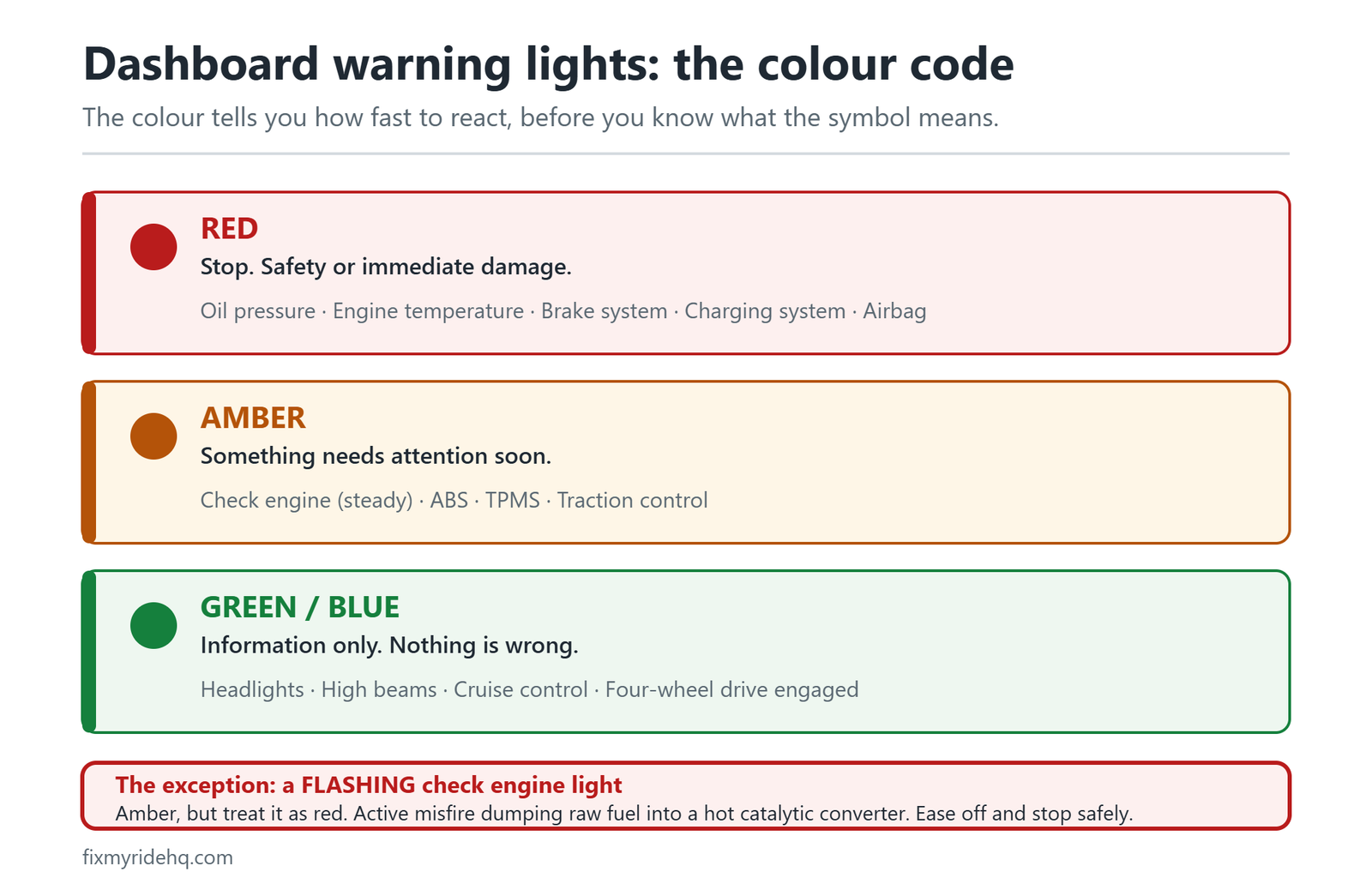
Every warning light on a modern pickup or SUV falls into one of three colors, and the color tells you how fast you need to react before you know anything else about the symbol. Red means stop. Amber means diagnose soon. Green and blue are just telling you a system is on.
This glossary covers the lights that actually matter on trucks and SUVs, what each one means mechanically, and what to do in the next five minutes when one appears.
In this guide
- The color code: what red, amber, and green mean
- The check engine light: flashing versus steady
- Red lights: stop driving
- Amber lights: diagnose soon
- Quick reference: what to do right now
- Tools worth keeping in the truck
- Frequently asked questions
- The bottom line
Vince’s own photos and field notes for this guide are being added.
The color code: what red, amber, and green mean
Carmakers agreed on this convention decades ago, and it holds across nearly every truck and SUV on the road:
- Red — a safety or immediate-damage warning. Pull over when it is safe to do so. Continuing to drive risks injury or major mechanical damage.
- Amber or yellow — something needs attention, but the vehicle is generally safe to drive to a shop. Do not ignore it for weeks.
- Green or blue — informational only. Headlights, high beams, cruise control, four-wheel drive engaged. Nothing is wrong.
There is one important exception to the red-means-stop rule, and it is the light people misread most often: the check engine light, which is amber but can mean either of two very different things depending on whether it is steady or flashing.
The check engine light: flashing versus steady
This is the single most valuable thing in this glossary, so it gets its own section.
Steady check engine light
A steady amber check engine light means the engine computer has stored a fault code. The cause ranges from trivial to serious: a loose or failed gas cap, a worn oxygen sensor, an evaporative emissions leak, a failing mass airflow sensor. The truck is usually safe to drive, but the code is not going to clear itself and emissions testing will fail while it is on.
What to do: finish your trip, then pull the code with an OBD-II scanner within the next few days. Knowing the code before you call a shop is worth real money.
Flashing check engine light
A flashing check engine light means an active engine misfire is dumping unburned fuel into the exhaust. Raw fuel hitting a hot catalytic converter can destroy it in minutes, and a catalytic converter on a full-size truck is one of the most expensive emissions parts on the vehicle.
What to do: reduce engine load immediately. Ease off the throttle, avoid hard acceleration and towing, and get off the road at the first safe opportunity. Do not try to drive it home across town because it still moves under its own power. This is the one amber light that behaves like a red one.
Red lights: stop driving
Oil pressure warning (oil can symbol)
This is the most urgent light on the entire dash. It does not mean you are a quart low; it means the engine is not building oil pressure, and an engine without oil pressure can seize in well under a minute at highway RPM.
What to do: pull over immediately and shut the engine off. Do not drive to the next exit. Check the oil level once the engine has sat a few minutes. If the level is fine and the light still comes on at start-up, the problem is the pump, the pickup, or the sensor, and the vehicle needs to be towed rather than driven.
Engine temperature warning (thermometer in liquid)
The engine is overheating. Common causes are coolant loss, a failed thermostat, a dead cooling fan, or a water pump on its way out. Overheating warps heads and blows head gaskets, and both repairs cost more than the tow.
What to do: pull over, shut it down, and let it cool. Never open a hot radiator or coolant cap — the system is pressurized and the escaping coolant is well above boiling. If you are stuck in traffic and the needle is climbing, turning the heater on full blast genuinely helps by pulling heat out of the coolant.
Charging system warning (battery symbol)
This light is widely misread as a bad battery. It usually is not. It means the charging system is not keeping up, which most often points at the alternator, the serpentine belt, or a corroded connection. The engine is now running off battery reserve alone.
What to do: shut off every load you can — radio, climate control, heated seats, accessory lights — and drive directly somewhere useful. You may have anywhere from twenty minutes to an hour before the truck stalls and will not restart.
Brake system warning (BRAKE, or an exclamation point in a circle)
Three possibilities: the parking brake is still engaged, the brake fluid is low, or there is a hydraulic pressure failure in the system. Check the parking brake first, because that is the answer more often than people expect.
What to do: if the parking brake is off and the light stays on, treat it as a hydraulic problem. Test the pedal gently at low speed. A pedal that feels soft, spongy, or sinks toward the floor means the truck should be towed, not driven.
Airbag / SRS warning
The supplemental restraint system has a fault, and the airbags may not deploy in a crash. The truck drives and stops normally, which is exactly what makes this one easy to put off for months.
What to do: it is not an emergency stop, but it is not a someday item either. The system that is supposed to save your life is offline until it is fixed.
Amber lights: diagnose soon
Tire pressure monitoring (TPMS)
A steady horseshoe with an exclamation point means at least one tire has dropped roughly 25 percent below the recommended pressure. That threshold matters: by the time TPMS triggers, the tire is already meaningfully underinflated, not borderline.
The recommended pressure is on the door-jamb placard, not the tire sidewall. The number molded into the sidewall is the maximum the tire can hold, not what your truck wants. This trips up a lot of owners and it is worth checking your own placard right now.
One more distinction worth knowing: if the TPMS light blinks for about sixty to ninety seconds at start-up and then stays solid, that is a fault in the monitoring system itself — usually a dead sensor battery — rather than a low tire.
ABS warning
The anti-lock braking system has disabled itself. Your regular brakes still work normally, but in a hard or emergency stop the wheels can lock and you lose steering control while sliding. Stability control is often disabled at the same time, since the two systems share wheel-speed sensors.
What to do: drive conservatively, leave extra following distance, and get it scanned. A single failed wheel-speed sensor is a common and not especially expensive cause.
Traction or stability control (car with squiggly lines)
If this symbol flashes while you are driving, nothing is wrong — the system is actively working, which means a tire just lost grip. If it stays on steady, the system is either switched off or has a fault.
Quick reference: what to do right now
| Light | Color | Act within |
|---|---|---|
| Oil pressure | Red | Immediately — shut the engine off |
| Engine temperature | Red | Immediately — pull over and cool down |
| Check engine, flashing | Amber | Minutes — reduce load, stop safely |
| Brake system | Red | Minutes — test the pedal, likely tow |
| Charging system | Red | Under an hour — drive straight to help |
| Airbag / SRS | Red | Days — safe to drive, not safe to ignore |
| Check engine, steady | Amber | Days — scan the code |
| ABS | Amber | Days — brakes work, ABS does not |
| TPMS | Amber | Same day — check pressures cold |
Tools worth keeping in the truck
Three inexpensive tools cover most of what this glossary asks you to do. None of them require mechanical experience.
OBD-II scanner
Plugs into the port under the dash and reads the code behind a check engine light. A basic Bluetooth dongle paired with a phone app is enough for most owners; standalone handheld units cost more but do not depend on a phone. Price tier: $ to $$.
OBD-II scanner — Amazon link pending program approval
Tire pressure gauge
The gauges built into gas station air pumps are notoriously inaccurate. A decent pencil or digital gauge is the cheapest accuracy you will ever buy, and it is the only way to act on a TPMS light correctly. Price tier: $.
tire pressure gauge — Amazon link pending program approval
Portable air compressor
Turns a TPMS warning in a parking lot into a two-minute fix instead of a detour. Look for one that clamps to the battery or runs off a 12V outlet and can actually reach truck pressures, which run higher than car pressures. Price tier: $$.
portable air compressor — Amazon link pending program approval
Safety note: This guide is general information, not a repair manual for your specific vehicle. Your owner’s manual takes precedence over anything written here — symbols and thresholds vary between manufacturers and model years. Work involving lifting, brakes, batteries, or hot engine components carries real risk of injury. If you are not confident, have a qualified mechanic do the work.
Frequently asked questions
Can I just disconnect the battery to clear a warning light?
You can, and the light will go out, but you have only erased the evidence. The fault is still there and the light returns once the computer re-runs its self-tests. Worse, you have wiped the stored freeze-frame data a mechanic would have used to diagnose it. Read the code first, then clear it.
Is it safe to drive with the check engine light on?
If it is steady, usually yes, for a short period while you get the code read. If it is flashing, no — a flashing light means an active misfire that can destroy your catalytic converter, and you should stop as soon as it is safe.
Why did my TPMS light come on when the weather got cold?
Tire pressure falls roughly one PSI for every ten degrees Fahrenheit the temperature drops. An overnight cold snap can easily push a tire that was already a little low past the warning threshold. Check the pressures cold, before driving, and set them to the door placard figure.
The light came on and then went away by itself. Do I still need to check it?
Yes. An intermittent fault is still a stored code, and intermittent faults have a way of becoming permanent ones at inconvenient times. Scan it — the code stays in memory even after the light goes out.
Does a red light always mean I have to stop right where I am?
Oil pressure and engine temperature mean stop now, as in the next safe place to get off the road. Brake system means test the pedal carefully and likely call a tow. Charging system means keep moving toward help rather than stopping somewhere useless. Airbag means make an appointment.
The bottom line
Learn the three colors and the flashing-versus-steady distinction on the check engine light, and you have covered the majority of what your dashboard is trying to tell you. Keep a scanner and a tire gauge in the truck, check your door placard pressure, and most warning lights become a manageable errand instead of an emergency.
Next, see our maintenance guides for interval-by-interval service schedules, or browse our accessory roundups for gear we have actually tested on working trucks.
Written by Vince T, who runs a delivery and logistics business in Southern California — dump runs, heavy hauling, private delivery. The trucks and SUVs covered here work through the week and get loaded up for the desert on the weekend. More about the site.