Disclosure: some links in this post are affiliate links. If you buy through them, we may earn a commission at no extra cost to you. As an Amazon Associate, we earn from qualifying purchases. We only recommend gear we would put on our own trucks.
Truck wheel and tire packages are sold as the easy button: one box, one price, mounted and balanced, bolt them on. Most of the time that works out fine. The times it does not, it is because of something nobody mentioned at checkout.
There are four of those somethings: the load rating you may have quietly given up, the sensors in your old wheels, the spare now sitting under the bed that no longer matches anything, and the question of who balanced the assembly and on what machine.
None of them are hard. They just have to happen before you order.
In this guide
- What you are actually buying
- Load rating is the number that matters
- TPMS, and what the law actually says
- The spare nobody thinks about
- Mounted and balanced, or not
- Doing it on three budgets
- The California details
- Frequently asked questions
- The bottom line
Vince’s own build photos for this guide are being added.
What you are actually buying
A package is four wheels, four tires, mounting, balancing, and usually lug nuts and a set of TPMS sensors offered as an upsell. What it is not is an engineering review of whether that combination suits your truck. The fitment guide checked that the wheels bolt on and the tires clear. Everything below is on you.
Worth knowing before you start: there is no federal safety standard that an aftermarket light-vehicle wheel has to be certified to. The industry standard is SAE J2530, which covers radial fatigue, cornering fatigue and lateral curb impact. It is a recommended practice, not a federal requirement, and it is a strength standard, not a fitment one. A wheel can pass it and still be the wrong offset for your truck. That part is covered in our offset and backspacing guide.
Load rating is the number that matters
Start with the thing most packages get casual about. Federal standard FMVSS 110 requires that the sum of the maximum load ratings of the tires on an axle be at least that axle’s gross axle weight rating. That requirement is written on the vehicle manufacturer at first sale, not on you, but it is the right benchmark: whatever the truck left the factory able to carry, the replacement should still carry.
Load range letters are not ply counts
Load Range E is “10-ply rated.” It does not have ten plies. Toyo puts it plainly in its own technical literature: load range is “merely a letter used to correspond with a ply rating,” and that rating “is an index of tire strength and does not necessarily represent the number of cord plies in the tire.” A modern Load Range E light-truck radial typically has two steel belts and one or two body plies.
Federal regulation proves the point by accident. FMVSS 139 requires a tire to be marked with the load range letter and separately with the actual number of plies in the sidewall and tread. Two different markings, because they are two different things.
Load index is the number with pounds behind it
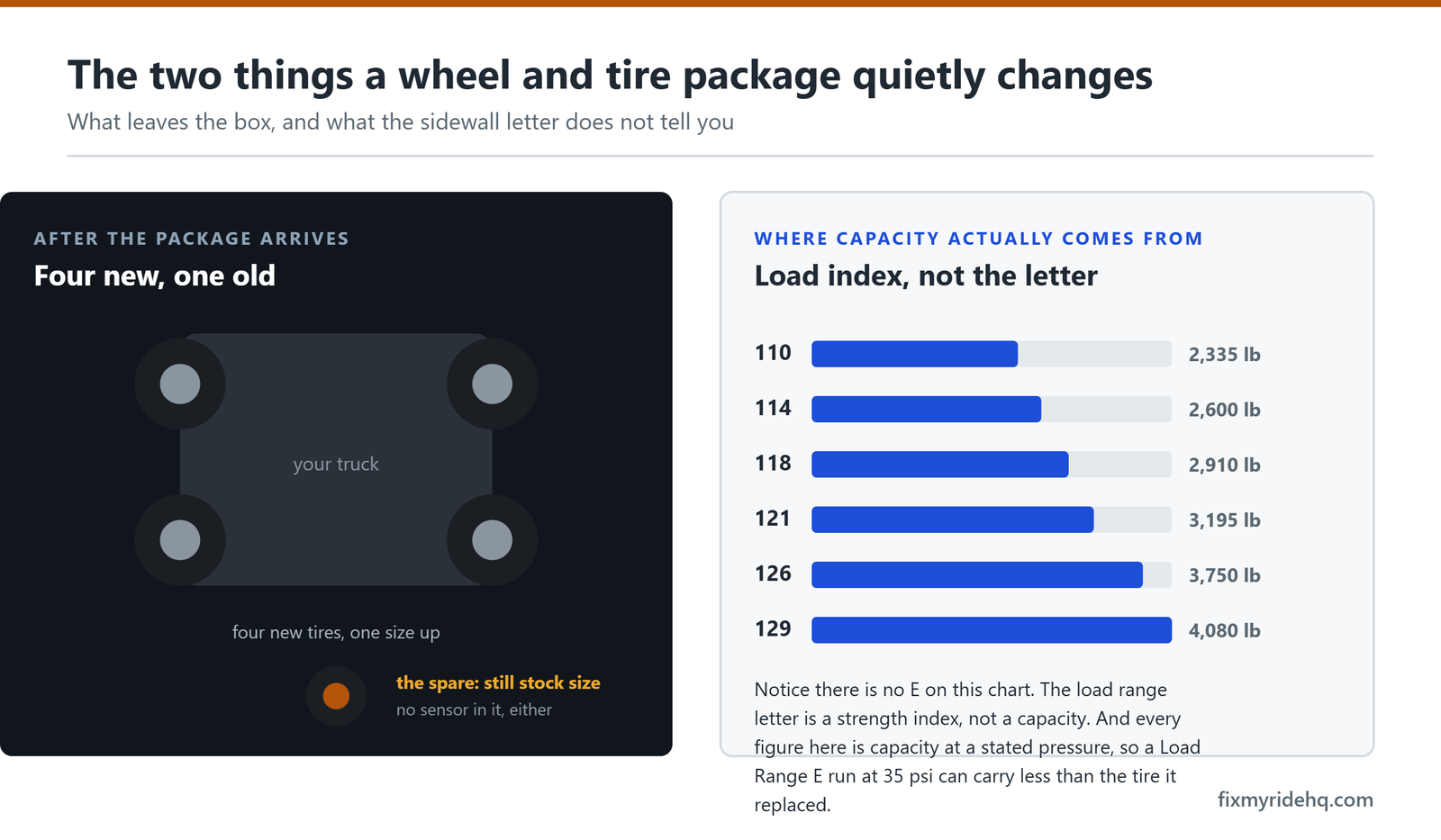
| Load index | Capacity | Load index | Capacity |
|---|---|---|---|
| 110 | 2,335 lb | 121 | 3,195 lb |
| 114 | 2,600 lb | 123 | 3,415 lb |
| 118 | 2,910 lb | 126 | 3,750 lb |
| 120 | 3,085 lb | 129 | 4,080 lb |
On an LT tire you will often see two numbers, like 121/118. The first is the single-wheel rating, the second is for dual-wheel applications. Use the one that matches your truck.
The trap: capacity is a function of pressure, not of the letter
This is the part that catches people who did their homework. A tire’s load capacity is its capacity at a given inflation pressure. A Load Range E tire run at 35 psi can carry less than the P-metric tire it replaced at the pressure on your door placard. The letter on the sidewall does not guarantee you kept the original capacity. The load and inflation table does.
One more wrinkle: when P-metric passenger tires are fitted to a truck or SUV, FMVSS 110 requires their load rating be divided by 1.10 before it counts. So going from a P-metric to an LT tire in the same nominal size is not automatically a capacity upgrade, and going the other way costs more than it looks like.
And the 80 psi printed on a Load Range E sidewall is a ceiling, not a target. Inflation pressure is set by the vehicle placard, never by the tire.
TPMS, and what the law actually says
Federal standard FMVSS 138 requires a tire pressure monitoring system on vehicles with a GVWR of 10,000 pounds or less. Two exclusions people forget: it does not apply above 10,000 pounds, and it does not apply to vehicles with dual wheels on an axle. So a dually is outside the rule on both counts.
The phase-in finished with all light vehicles manufactured on or after September 1, 2007. Practically: essentially every 2008-and-later truck has it, many 2006 and 2007 trucks do, some do not.
Who the law actually binds
Here is the piece almost every article gets wrong. The prohibition on disabling safety equipment, 49 U.S.C. 30122(b), binds manufacturers, distributors, dealers and motor vehicle repair businesses. It does not name vehicle owners.
NHTSA spelled out what that means for this exact situation in a 2011 letter to the Tire Industry Association: “a service provider would violate the make inoperative prohibition of 49 USC 30122(b) by installing new tires and wheels that do not have a functioning TPMS system.” The same letter says a shop does not violate it by removing an already-inoperative sensor, and that the warning lamp merely being lit when you drive away is not itself a violation.
Translated: a shop cannot fit your new package without working sensors. You, working on your own truck, are not covered by that federal prohibition. Whether you want to drive around with the light on is a separate question, and the answer is probably no, because you then have no warning when a tire actually goes down.
Can you reuse your old sensors?
Sometimes. Whether the sensor physically suits the new wheel’s valve hole, in diameter, angle and stem style, is wheel-specific. Ford states flatly in its owner literature that “the tire pressure sensors mounted in the wheels (originally installed on your vehicle) are not designed to be used in aftermarket wheels.” Nobody publishes a rule that holds across all vehicles, so do not let anyone tell you it always works or never works.
Budget for a relearn either way. GM’s service documentation is explicit that “each tire monitor sensor is learned to a specific vehicle corner,” and that the relearn should be done with a scan tool where possible. And if your truck uses an indirect system that works off wheel-speed sensors rather than sensors in the wheels, you need no new sensors at all, just a recalibration.
The spare nobody thinks about
You just bought four tires. You have five wheels on the truck. The fifth one is now a different diameter from the other four, and on a four-wheel-drive truck that is a real problem, not a cosmetic one.
Ford addresses it directly: “On four-wheel drive vehicles, the size of the spare tire can affect the four-wheel drive system. If there is a significant difference between the size of the spare tire and the remaining tires, you may have limited four-wheel drive functionality.” With a mismatched full-size spare fitted, Ford says do not exceed 50 mph with a four-wheel-drive mode engaged, do not engage it unless the vehicle is stationary, and do not run it on dry pavement.
How much difference is too much? There is no industry number, and anyone who gives you one is repeating something. The one hard figure that exists in a manufacturer document is a Subaru service bulletin for the 2015 WRX STI, which says that tires differing by more than a quarter inch in circumference may require replacement and that continued operation “may result in damage to the vehicle’s drivetrain and/or clutch components.” That is one bulletin, one model, with a driver-controlled center differential. It is where the widely repeated quarter-inch rule comes from, and it was never a general standard.
The honest advice: look up your own vehicle rather than trusting a universal figure, and price a fifth wheel and tire into the package from the start. It is the single most commonly skipped line item.
One more: FMVSS 138 does not require the spare to be monitored, stowed or fitted. So a matching fifth wheel usually has no sensor in it, and mounting it will light the dash.
Mounted and balanced, or not
The strongest technical argument against mail-order packages is one almost nobody makes, and it is not about the balancing weights.
Conventional balancing corrects weight distribution. It cannot detect radial force variation, which is non-uniform stiffness in the tire itself. A GM service bulletin on road-force balancing puts it this way: static balance “is the first step,” but modern vehicles “also need the Road Force checked,” which measures sidewall stiffness and how much the assembly is out of round under load.
Infiniti publishes actual limits: roughly 20 pounds of road force for a passenger car tire, 26.5 pounds for a light-truck tire on a mid to large SUV, with a note that some vehicles need lower. When an assembly is over, the fix is not more weight. It is match-mounting: deflate, break both beads, rotate the tire 180 degrees on the rim, reseat and reinflate.
So the real trade-off is this. A package arrives balanced by whatever machine the warehouse runs. If an assembly has high road force, no amount of added weight fixes it, and you end up taking a brand-new set to a local shop with a road-force machine anyway. If you have a good tire shop nearby, buying the parts and having them mounted locally is worth considering on those grounds alone.
What the warranty does and does not cover
Tire manufacturer warranties cover defects in workmanship and materials. They specifically exclude road hazards, and they exclude “incorrect mounting of the tire, tire/wheel imbalance or improper repair.” Road hazard coverage is a separate program sold by the retailer, never part of the tire warranty. So “does this include road hazard” is a question for whoever is selling the package, and mounting quality is on whoever mounted it.
Also check rim width. FMVSS 110 requires a rim to be built to dimensions the tire manufacturer lists as suitable for that tire. Every tire maker publishes an approved rim width range. A package pairing a tire with an out-of-range wheel is a genuine defect, and it takes two minutes to check.
Doing it on three budgets
| Tier | What it gets you | The trade-off |
|---|---|---|
| $ | Keep your factory wheels. Buy four tires in the stock size, have a local shop mount and balance them, reuse your sensors. | No fitment risk, no sensor cost, spare still matches, placard still accurate. You get new tires and nothing else. For a truck that works all week, that is often the correct answer. |
| $$ | Wheel and tire package one size up, new sensors, relearn, plus a matching fifth wheel and tire for the spare. | The real cost is about twenty percent more than the advertised package once the spare and sensors are in. Budget it up front rather than finding out later. |
| $$$ | Larger diameter package, road-force balanced locally, speedometer corrected, spare matched, placard updated. | Now you are also into gearing and alignment. If the tires are going under a lifted truck, read the lift kit guide first, because the two decisions set each other. |
Our honest take: the middle tier is where most working trucks should land, and the fifth wheel is the line nobody wants to pay for and everybody should. A package without a matching spare is not a finished job, it is a job with a known failure point parked under the bed.
The California details
- Lead wheel weights are illegal here. California has banned the sale, manufacture and installation of wheel weights containing more than 0.1 percent lead since January 1, 2010, with penalties up to 2,500 dollars per day per violation. The ban reaches weights removed and put back during a balance. Any shop in the state should already be using steel or zinc.
- Your invoice should show your tire pressures. CARB’s tire inflation regulation requires automotive service providers to check and inflate every tire to the recommended pressure during any maintenance or repair service, to record the resulting pressures on the invoice, to use a gauge accurate within 2 psi, and to keep the invoice three years. If your invoice after a fresh install does not show pressures, the shop skipped a step the state requires.
- Splash protection has to be as wide as the tread. Vehicle Code section 27600 requires fenders, covers, flaps or splash aprons, or a body that itself gives adequate protection, to minimize spray and splash to the rear, and whatever you use must be at least as wide as the tire tread. Aggressive offsets that push tread outside the fender line run into this one.
One federal housekeeping note while you are here. Once you change sizes, the tire placard on your door jamb is describing tires you no longer have. NHTSA has said a modifier is not legally required to replace it, but warns that owners relying on a stale placard can buy the wrong replacement tires or overload the truck. Write your actual size and pressures on a label and stick it next to the original.
Frequently asked questions
Do I need hub-centric rings?
Probably not, and the wheel manufacturers say so themselves. American Racing’s own technical guidance is that rings “are not necessary” in most cases and “not required if you are not experiencing any ride disturbance,” and that proper star-pattern torquing does the work. We could find no test data showing lug-centric mounting causes vibration or that rings prevent it. Treat “you must buy rings” as an upsell unless you actually have a symptom.
Will a dealer recalibration fix my speedometer?
Not necessarily, and these are two different jobs. GM states that changing tire size in the ABS module “will only affect ABS wheel speed sensor calibration” and “will not correct or calibrate the speedometer’s accuracy.” Ask specifically which one is being done.
Why do my new LT tires have no treadwear rating?
Because UTQG grades do not apply to them. The federal rule covers new tires for passenger cars; light-truck tires are exempt. An LT tire is not ungraded because it is worse, it is ungraded because it is outside the scheme. Comparing a graded P-metric against an ungraded LT is not a comparison.
How old is too old for a tire?
There is no federal expiration date, and the people who should know disagree. Ford’s manual says replace at six years from manufacture regardless of tread. Michelin recommends replacing tires in service ten years or more. Read the date code yourself: the last four digits of the DOT number are the week and year, so 0109 means the first full week of 2009. Note the full code is required on only one sidewall, so check both sides before deciding it is missing. Details are in our sidewall guide.
Can I mount them myself?
Seating a stubborn bead is where people get hurt. Ford’s guidance is that when mounting pressure would need to exceed the maximum sidewall pressure by more than 20 psi, the work belongs with a professional, and that during inflation you should stay 12 feet back with eye and ear protection. A tire that will not seat is telling you something; it is not asking for more air.
The bottom line
Check four things before you order and the rest takes care of itself: that the new tires carry at least what the old ones did at your placard pressure, that you have a sensor plan, that the spare is in the budget, and that someone with a road-force machine is within driving distance if the set comes out rough.
Then read up on offset and backspacing so the tread ends up inside your fenders, and on what the tread pattern costs you on pavement. The rest of our exterior work lives in Exterior Mods.
— Vince T