Disclosure: some links in this post are affiliate links. If you buy through them, we may earn a commission at no extra cost to you. As an Amazon Associate, we earn from qualifying purchases. We only recommend gear we would put in our own trucks.
Every tire sidewall carries a complete spec sheet molded into the rubber, and almost nobody reads it. Learning the code takes about ten minutes and tells you the size, load capacity, speed rating, age, and tread life expectations of every tire you will ever consider buying.
It also settles the single most common tire pressure mistake on trucks and SUVs, which costs owners fuel economy, tread life, and occasionally a tire.
Here is what every marking means, in the order you will find it.
In this guide
- The size string: P265/70R17 115T
- Load index: the number that matters most on a truck
- Speed rating
- The DOT code: how old is this tire?
- Maximum pressure is not recommended pressure
- UTQG: treadwear, traction, temperature
- M+S versus the three-peak mountain snowflake
- What else you will find on the sidewall
- Tools worth keeping in the truck
- Load range letters and ply rating
- Where to find each marking
- Frequently asked questions
- The bottom line
Vince’s own photos and field notes for this guide are being added.
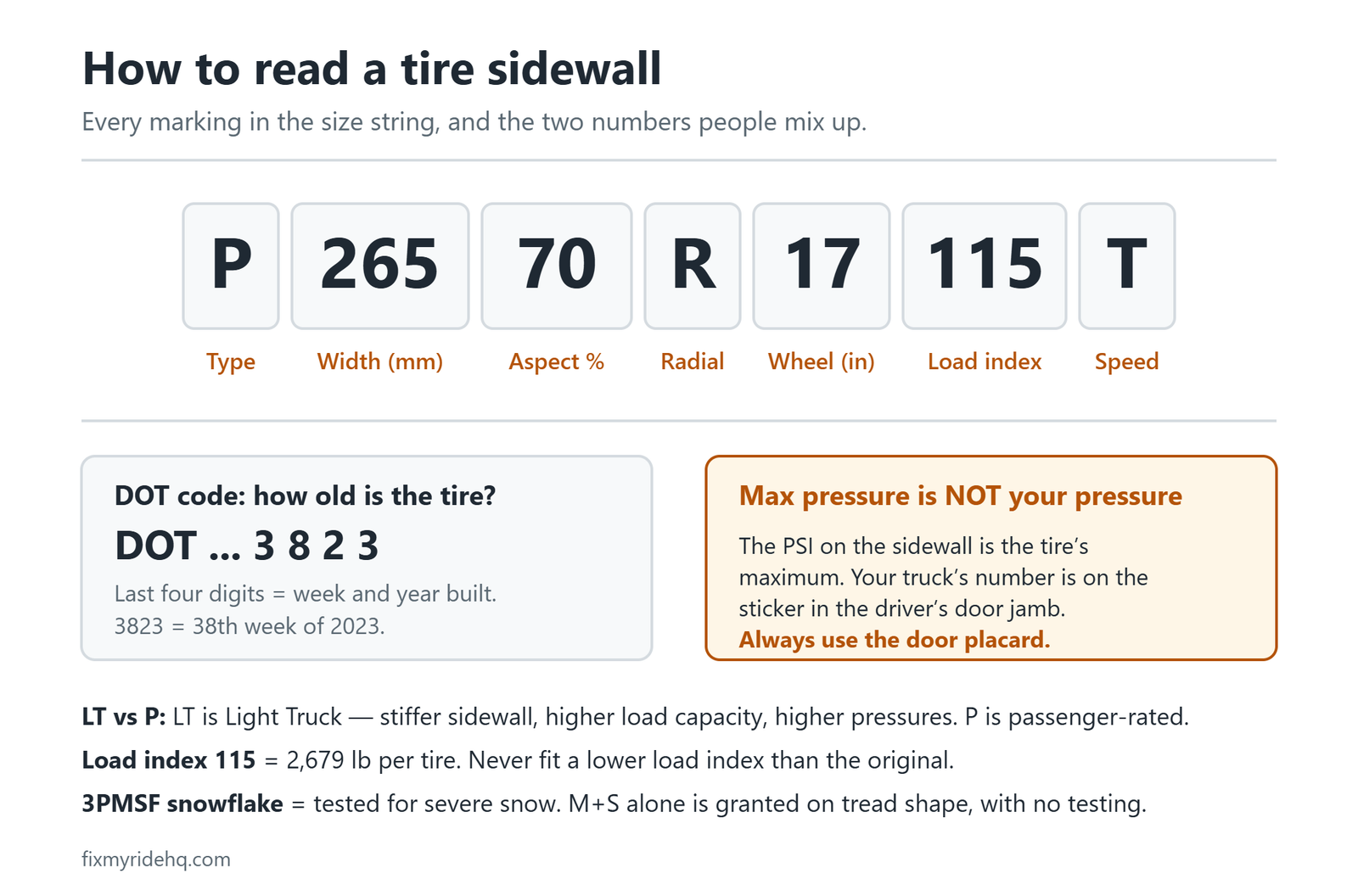
The size string: P265/70R17 115T
This is the block most people recognize without knowing what it says. Taking it piece by piece:
- P — service type. P is P-metric, a passenger-rated tire. LT means Light Truck, built with stiffer sidewalls and higher pressure capability for hauling and towing. No letter at all usually indicates Euro-metric. On a working truck, LT versus P is a meaningful difference, not a badge.
- 265 — section width in millimeters, sidewall to sidewall.
- 70 — aspect ratio. The sidewall height is 70 percent of the section width. Lower numbers mean shorter, stiffer sidewalls.
- R — radial construction. Essentially every modern tire is radial.
- 17 — wheel diameter in inches. This one must match your wheel exactly.
- 115 — load index. A lookup number, not pounds.
- T — speed rating.
Load index: the number that matters most on a truck
The load index converts to a maximum weight per tire. A few common values:
| Load index | Max load per tire |
|---|---|
| 105 | 2,039 lbs |
| 110 | 2,337 lbs |
| 115 | 2,679 lbs |
| 120 | 3,086 lbs |
| 126 | 3,748 lbs |
Multiply by four for the theoretical vehicle capacity, then remember that the truck’s own payload rating is the real limit. Never fit a replacement tire with a lower load index than the original. On a truck that hauls, that downgrade is the kind of saving that ends with a sidewall failure under load.
Speed rating
A letter indicating the maximum sustained speed the tire is built for. Common truck ratings run S (112 mph), T (118), H (130), and V (149). Most all-terrain truck tires land at S or T, which is far above any legal speed — the rating matters mainly because it correlates with heat tolerance and construction quality.
The DOT code: how old is this tire?
Every tire carries a DOT code ending in four digits. Those four digits are the week and year of manufacture. A tire marked 3823 was built in the 38th week of 2023.
This matters more than most buyers realize. Rubber ages whether or not the tire is used, and a tire can sit in a warehouse for years before it is sold as new. Many manufacturers recommend replacement at six years and consider ten years an absolute limit regardless of tread depth.
Check the date code before you pay, especially on a closeout or clearance set. Tread depth tells you nothing about age.
Maximum pressure is not recommended pressure
This is the mistake, and it is worth stating plainly.
The PSI number molded into the sidewall is the maximum cold inflation pressure the tire can safely hold. It is a limit of the tire, not a recommendation for your vehicle.
The pressure your truck actually wants is on the placard in the driver’s door jamb. It is calculated for your vehicle’s weight, suspension, and load rating. On a typical half-ton it might be 35 PSI even though the tire sidewall reads 44 or higher.
Inflating to the sidewall number gives you a harsh ride, a narrow contact patch, accelerated center-tread wear, and reduced grip in an emergency stop. Going by the placard instead is free and takes thirty seconds. See our dashboard warning light glossary for what the TPMS light is actually telling you when it triggers.
UTQG: treadwear, traction, temperature
Three more markings, usually grouped together:
- Treadwear — a relative number, where higher suggests longer life. Useful for comparing tires within one brand, unreliable across brands, since each manufacturer grades its own.
- Traction — AA, A, B, or C, measured as straight-line wet grip on specific surfaces. It does not measure cornering or dry grip.
- Temperature — A, B, or C, for heat resistance at speed.
M+S versus the three-peak mountain snowflake
An M+S marking means mud and snow, and it is granted based on tread geometry alone — no performance testing is required. Most all-season and all-terrain tires carry it.
The three-peak mountain snowflake symbol is earned through an actual snow traction test and indicates severe snow service rating. If you drive in real winter conditions, that symbol is the one worth looking for. M+S by itself is a much weaker claim. More on this in our all-terrain tire roundup.
What else you will find on the sidewall
- Brand and model name
- Construction detail — the plies and materials in the tread and sidewall
- Max load in pounds and kilograms, alongside the max pressure
- Country of manufacture
- Directional arrows or an inside/outside marking, on tires that must be mounted a specific way
That last one matters at rotation time: a directional tire has to stay on the same side of the vehicle. See how often to rotate truck tires for the patterns.
Tools worth keeping in the truck
Tire pressure gauge
The only way to act on the placard number accurately. Built-in gas station gauges drift badly with use. Price tier: $.
tire pressure gauge — Amazon link pending program approval
Tread depth gauge
New truck tires run around 11 to 12/32 inch of tread. Legal minimum is 2/32, but wet traction falls off sharply below 4/32. A gauge removes the guesswork the penny test only approximates. Price tier: $.
tread depth gauge — Amazon link pending program approval
Safety note: This guide is general information, not a repair manual for your specific vehicle. Your owner’s manual takes precedence over anything written here — specifications and intervals vary between manufacturers and model years. A tire with sidewall damage, a bulge, or visible cord should be replaced, not repaired or driven on. If you are not confident, have a qualified mechanic do the work.
Load range letters and ply rating
On LT tires you will find a load range letter — commonly C, D, or E — alongside everything else. It is a descendant of the old ply rating system, from when tire strength genuinely came from counted layers of fabric.
| Load range | Equivalent ply rating | Typical max pressure |
|---|---|---|
| C | 6-ply | 50 PSI |
| D | 8-ply | 65 PSI |
| E | 10-ply | 80 PSI |
| F | 12-ply | 95 PSI |
Modern tires do not actually contain that many plies. The rating describes equivalent strength and the pressure the casing is built to hold, not literal construction.
Higher is not automatically better. A load range E tire on a half-ton truck that never carries weight gives you a stiff, harsh ride and worse fuel economy in exchange for capacity you will not use. Match the load range to what you actually haul — and remember that the higher pressures these tires are rated for are maximums, not targets.
Where to find each marking
The markings are distributed around the sidewall rather than grouped, which is why they are easy to miss:
- The size string is the largest text, usually near the outer edge of the sidewall.
- Load index and speed rating sit immediately after the size, in smaller type.
- The DOT code is often on one side of the tire only — if you cannot find it, check the inboard face.
- UTQG ratings are usually in small text near the shoulder.
- Max load and max pressure are typically near the bead, closest to the wheel.
Worth doing once with a flashlight on your own truck, so you know where to look when you are standing in a tire shop comparing options.
Frequently asked questions
Can I put a different size tire on my truck?
You can, within limits, but overall diameter changes affect your speedometer, transmission shift points, and on many trucks the stability control calibration. Staying within roughly three percent of the original diameter is the usual guidance. Never drop below the original load index.
How old is too old for a tire with good tread?
Many manufacturers suggest replacement at six years and most consider ten a hard limit. Rubber hardens and develops fine cracking with age regardless of mileage. Check the DOT code — a garage-kept truck can easily have dangerous tires with plenty of tread left.
Why does my sidewall say 44 PSI when the door says 35?
Because they answer different questions. 44 is the most the tire can hold; 35 is what your vehicle is engineered around. Use 35.
Do I need LT tires on a half-ton truck?
Only if you regularly load it heavily or tow. LT tires have stiffer sidewalls, higher load capacity, and require higher pressures — which also means a harsher ride and usually worse fuel economy when running empty. For a mostly unloaded truck, a quality P-metric is often the better tire.
The bottom line
Read the load index before you buy, check the DOT date code before you pay, and set your pressure from the door placard rather than the sidewall. Those three habits cover most of what goes wrong with truck tires.
Next: tire rotation intervals and patterns, or the full maintenance schedule.
Written by Vince T, who runs a delivery and logistics business in Southern California — dump runs, heavy hauling, private delivery. The trucks and SUVs covered here work through the week and get loaded up for the desert on the weekend. More about the site.