Disclosure: some links in this post are affiliate links. If you buy through them, we may earn a commission at no extra cost to you. As an Amazon Associate, we earn from qualifying purchases. We only recommend gear we would put in our own trucks.
A winter prep checklist is worth running even if you live somewhere that barely has a winter. Cold does predictable, measurable things to batteries, tires, and fluids, and those effects start well above freezing.
Some honesty about where this comes from: this site is written from Southern California, where a hard winter means a cold snap in the high desert or a run up into the mountains. We are not going to pretend to be experts on a Minnesota February. What follows is the physics of cold weather, which is the same everywhere, plus a clear split between what matters in a mild climate and what matters if you actually see snow and ice.
Work through it once in late fall and most cold-weather breakdowns stop being a possibility.
In this guide
- Battery: the first thing cold takes
- Tires: pressure, and whether you need winter rubber
- Fluids
- Wipers, lights, and visibility
- The emergency kit
- Rust and road salt
- A realistic timeline
- Frequently asked questions
- The bottom line
Vince’s own photos and field notes for this guide are being added.
Battery: the first thing cold takes
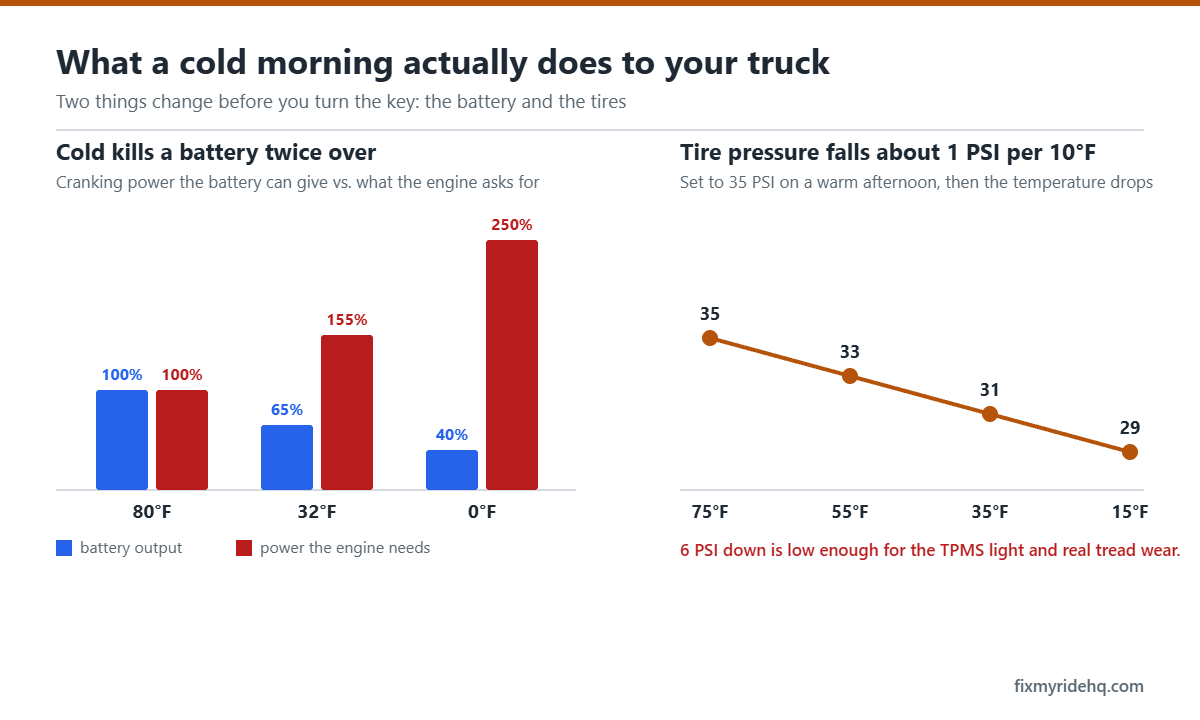
Cold attacks batteries from both directions at once. The chemical reaction that produces current slows down as temperature falls, and at the same time cold oil thickens and makes the engine harder to turn over.
The numbers are worth knowing. At around 32°F, a battery delivers roughly 65 percent of its rated capacity. At about 5°F, that falls to roughly half. Meanwhile a cold engine can demand substantially more current to crank than it does warm. You are asking for more from a battery that has less to give.
This is why batteries so often die on the first genuinely cold morning. The battery was already weak; summer heat had quietly degraded it; cold simply exposed it.
- Have the battery load-tested if it is more than three years old. Most auto parts stores do this at no charge, and the test takes minutes.
- Clean the terminals — corrosion adds resistance exactly when you have the least margin. See how to clean corroded battery terminals.
- Check that the hold-down bracket is tight.
- Know where your ground point is, so you are not hunting for it in the dark. Our jump starting guide covers the correct procedure.
Worth noting for anyone in a hot climate: heat kills more batteries than cold does. A Southern California summer is harder on a battery than a mild winter — cold just picks the moment to reveal the damage.
Tires: pressure, and whether you need winter rubber
The pressure drop is real and automatic
Tire pressure falls roughly 1 PSI for every 10°F drop in ambient temperature. A truck set to 35 PSI on an 75°F afternoon is sitting near 31 PSI on a 35°F morning, without a single thing having gone wrong.
Four PSI low is enough to trigger TPMS on some vehicles, and enough to cost fuel economy and accelerate shoulder wear on all of them. Check pressures cold, first thing in the morning, against the door placard — not against the number on the sidewall, which is a maximum rather than a recommendation. Our tire sidewall guide explains why that distinction matters.
Tread depth and the snowflake symbol
Legal minimum tread is 2/32 inch, but wet and slush traction degrade sharply below 4/32. Going into winter at 4/32 means coming out of it well below.
On the tire itself, look for the three-peak mountain snowflake symbol. That marking is earned through an actual snow traction test. An M+S marking is granted on tread pattern geometry alone with no performance testing, so it is a considerably weaker claim. If you regularly drive in snow, the snowflake is what you want. See our all-terrain tire roundup for which tires carry it.
Chains
If you drive into the mountains in California, chain controls are a fact of life and being turned around at a checkpoint is an avoidable waste of a day. Carry chains that fit your specific tire size, and — this is the part people skip — practice fitting them once in your driveway. Fitting chains for the first time on a snowy shoulder in the dark is genuinely miserable.
Fluids
- Coolant. Test the freeze protection rating rather than assuming. A cheap tester tells you in seconds. A 50/50 mix typically protects to around -34°F; a weak mix that has been topped up with water over the years may protect to far less than you expect.
- Washer fluid. Switch to a winter formulation rated below freezing. Summer fluid freezing in the lines and reservoir is a common and annoying failure, and a frozen washer system on a salted road is a visibility problem.
- Engine oil. The W number in your oil grade is its cold-flow rating. A 5W-30 flows more easily at start-up than a 10W-30. If your manual permits a lower W grade for cold conditions, it is worth using. Do not change viscosity beyond what the manual allows. See the oil change guide.
- Fuel. Keeping the tank above half reduces condensation in the tank and gives you a buffer if you end up sitting in stopped traffic. For diesel owners, winter-blend fuel and an anti-gel additive matter — untreated diesel can gel and plug the fuel filter in real cold.
Wipers, lights, and visibility
- Replace wiper blades that streak or chatter. Blades typically last six months to a year, and sun damage in a hot climate ages the rubber faster than cold does.
- Never use the wipers to break ice off the glass — it tears the rubber edge. Use a scraper, or the defroster and patience.
- Lift the wipers off the glass overnight if a freeze is forecast, so they do not bond to the windshield.
- Check every exterior light. Winter means less daylight and more weather regardless of whether there is snow in it.
- Confirm the rear defroster grid actually works across the whole window.
The emergency kit
Split this into two tiers, because the honest answer is that most drivers in a mild climate do not need the full snow-country load-out.
Everyone, everywhere
- Portable jump starter with reverse-polarity and spark protection — more practical than cables because it needs no second vehicle
- Tire pressure gauge and a 12V inflator
- Flashlight with fresh batteries, plus a spare set
- Basic tools, gloves, and a few shop rags
- Phone charger and a charged power bank
- Water and something to eat
- Reflective triangles or flares
- First aid kit
portable jump starter — Amazon link pending program approval
12V tire inflator — Amazon link pending program approval
If you actually see snow and ice
- Ice scraper and snow brush
- Small folding shovel
- Traction aid — sand, cat litter, or traction boards
- Blanket or sleeping bag, spare hat and gloves
- Tow strap rated for your vehicle’s weight
- Tire chains that fit your size
The tier-two list is the one worth being honest about. If your truck never leaves a mild coastal climate, a shovel and a sleeping bag are taking up space that could hold something you will use. If you make mountain runs, they are not optional.
Rust and road salt
This is the section that does not apply in Southern California and matters enormously elsewhere. Road salt attacks brake lines, fuel lines, frames, and body panels, and it does its worst work in the places you cannot see.
If you drive on salted roads, wash the vehicle regularly through the winter including an undercarriage rinse, and pay particular attention after the last storm of the season — salt left on a frame through spring does more damage than salt that gets washed off in February.
A realistic timeline
| When | What |
|---|---|
| Late fall | Battery load test, coolant freeze test, wiper blades, washer fluid swap |
| First cold snap | Check tire pressures cold, verify all lights |
| Before any mountain trip | Chains fitted and practiced, kit restocked, fuel above half |
| Monthly through winter | Tire pressures, jump pack charge level, fluid levels |
| End of season | Undercarriage wash if you drove on salt, reset tire pressures as temperatures climb |
Safety note: This guide is general information, not a repair manual for your specific vehicle. Your owner’s manual takes precedence over anything written here — specifications and intervals vary between manufacturers and model years. Work involving jacking, batteries, or hot components carries real risk. If you become stranded in genuinely cold conditions, staying with the vehicle is generally safer than walking for help, and you should clear the exhaust pipe of snow before running the engine for heat to avoid carbon monoxide entering the cabin. If you are not confident, have a qualified mechanic do the work.
Frequently asked questions
Do I need winter tires in Southern California?
For coastal and valley driving, no — a quality all-season or all-terrain tire is appropriate year round. If you make regular winter trips to the mountains, a three-peak mountain snowflake rated tire is a reasonable middle ground, and chains cover the rest.
Should I warm up my truck before driving in the cold?
Thirty seconds to a minute is enough on a modern engine — long enough to circulate oil. Extended idling warms the engine slowly and inefficiently. Driving gently for the first few miles warms everything, including the transmission and differentials, far more effectively.
Why does my TPMS light come on every cold morning and go off later?
Because pressure genuinely drops with temperature and then rises as the tires warm with driving. It usually means the tires were sitting slightly low to begin with. Set them cold to the placard and the light generally stops appearing.
Is it worth carrying a shovel in a mild climate?
For most people in coastal California, no. For anyone who drives into the mountains — even occasionally — yes, along with chains. Match your kit to where you actually drive rather than to the worst case you can imagine.
How cold does it have to get before a battery is at risk?
Capacity starts dropping as soon as the temperature does. Around freezing you are near 65 percent of rated capacity; near 5°F you are close to half. A healthy battery handles that comfortably. A three-year-old battery that has been through hot summers often does not.
The bottom line
Test the battery, check tire pressures cold against the door placard, verify your coolant freeze point, swap the washer fluid, and build a kit sized to where you actually drive rather than where the internet says you might. In a mild climate, that is an afternoon. In snow country, add chains, traction, and warmth — and practice fitting the chains before you need them.
Next: portable jump starters and air compressors compared, or the full maintenance schedule.
Written by Vince T, who runs a delivery and logistics business in Southern California — dump runs, heavy hauling, private delivery. The trucks and SUVs covered here work through the week and get loaded up for the desert on the weekend. More about the site.