Disclosure: some links in this post are affiliate links. If you buy through them, we may earn a commission at no extra cost to you. As an Amazon Associate, we earn from qualifying purchases. We only recommend gear we would put in our own trucks.
Knowing how to jump start a truck is a basic skill, but the details people skip are the ones that matter. Connect the cables in the wrong order and you risk a spark directly over a battery venting hydrogen. Clamp the last cable to the wrong place and that spark happens in the worst possible spot.
The correct sequence exists for one reason: it puts the only spark-producing connection as far from the battery as possible. Everything below follows from that.
Five minutes of doing this right also protects the electronics in two vehicles, which on modern trucks is not a small consideration.
In this guide
- Before you connect anything
- The correct connection order
- Why the last clamp does not go on the battery
- Starting, in order
- After it starts: the part people skip
- Portable jump packs
- Jumper cable quality matters
- Frequently asked questions
- The bottom line
Vince’s own photos and field notes for this guide are being added.
Before you connect anything
Three checks, and the first one is genuinely important:
- Is the battery frozen? Never jump a frozen battery. A discharged battery can freeze around 20°F, and the electrolyte expanding into ice can crack internal plates. Applying current to a frozen battery risks rupture. Look for a bulging or distorted case, or slushy sounds. If in doubt, let it thaw.
- Is the case cracked, bulging, or leaking? Do not jump it. Replace it.
- Is the battery actually the problem? If the headlights are bright and the starter clicks once sharply, you may have a starter or connection issue instead. If the lights are dim or dead and the dash goes dark when you turn the key, that is a battery or connection. Corroded terminals produce identical symptoms — see how to clean corroded battery terminals.
Also: both vehicles off, in park or neutral, parking brakes set, and not touching each other. Two vehicles in contact create an unintended ground path.
The correct connection order
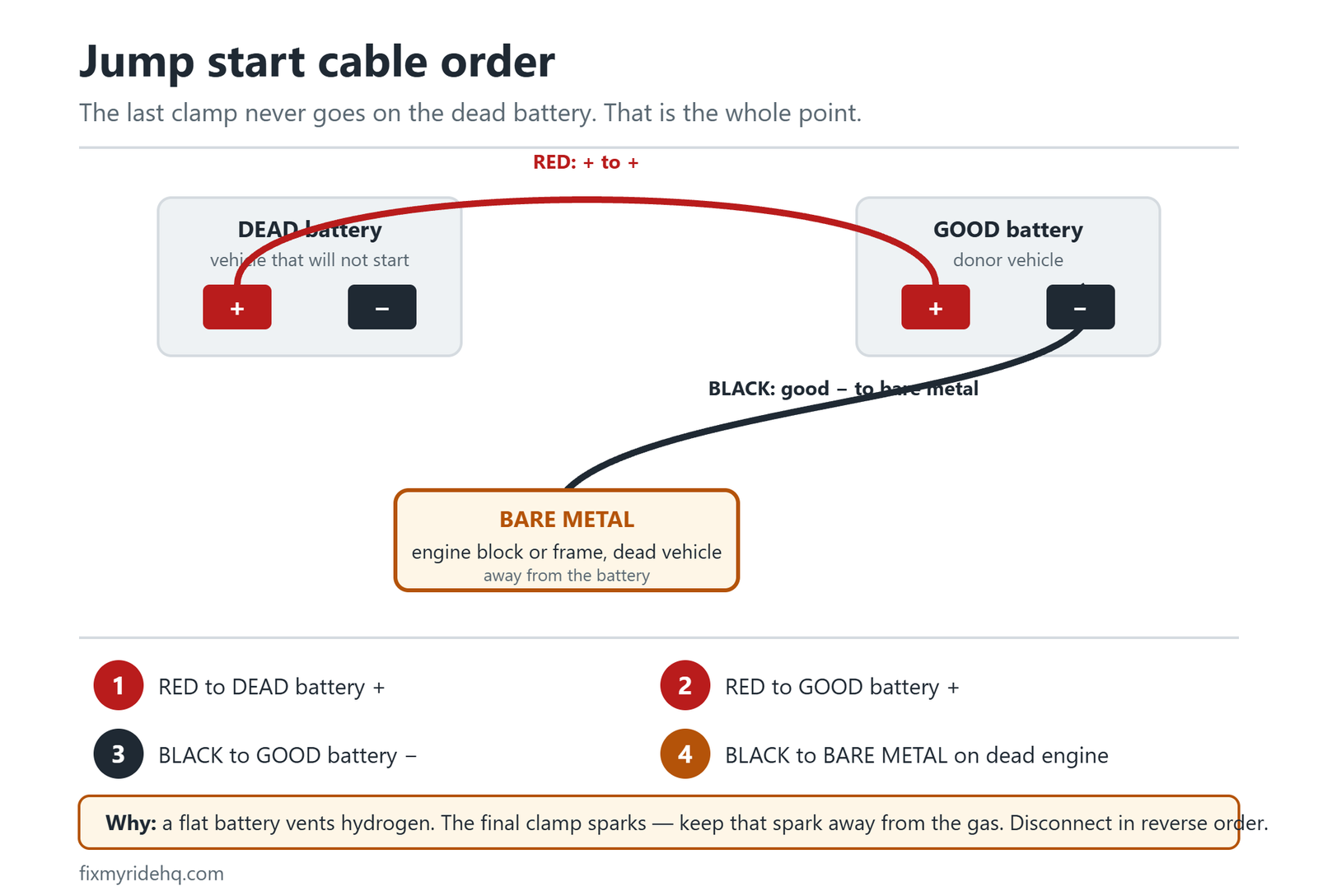
Four connections, in this exact sequence. The memory aid is that you build the positive side first, then ground, and you finish far away from the dead battery.
- 1. Red clamp to the dead battery’s positive terminal. Marked with a plus sign, usually under a red cover.
- 2. Red clamp to the good battery’s positive terminal.
- 3. Black clamp to the good battery’s negative terminal.
- 4. Black clamp to unpainted metal on the dead vehicle’s engine block or frame — not to the dead battery’s negative terminal.
That fourth connection is the one everyone gets wrong, and it is the whole point of the sequence.
Why the last clamp does not go on the battery
The final connection completes the circuit, and completing a circuit under load produces a spark. A discharged battery — especially one that has been cranked repeatedly — vents hydrogen gas, which pools around the battery and is explosive across a wide concentration range.
Grounding to the engine block or a frame bracket puts that spark a foot or two away from the gas. It is a small change in procedure and a large change in consequence.
A good ground point is an unpainted engine lifting bracket, an accessory bracket bolt, or a substantial chassis ground strap. Avoid anything painted, anything that moves, fuel lines, and anything attached to the intake or belt path. This is exactly the kind of thing worth locating on your own truck once, in daylight, rather than discovering in a parking lot at night.
Starting, in order
- 1. Start the donor vehicle and let it run for two to three minutes. On a deeply discharged battery, five minutes of charging first meaningfully improves your odds.
- 2. Try the dead vehicle. Crank for no more than ten seconds at a time. If it does not start, wait a couple of minutes before trying again — starter motors overheat quickly, and repeated long cranks can damage one.
- 3. If it will not crank at all, check your connections. Wiggle the clamps to bite through any surface corrosion, and confirm the ground clamp is on genuinely bare metal.
- 4. Once it starts, disconnect in exact reverse order: ground clamp off the engine block first, then black from the donor negative, then red from the donor positive, then red from the revived battery. Keep the clamps from touching each other or any metal while cables are still live.
After it starts: the part people skip
Drive it, do not idle it. Run the engine for at least 20 to 30 minutes, ideally at highway speed. Alternators charge poorly at idle, and a battery that was flat enough to need a jump needs sustained charging to recover.
Shut it off too soon and you will be doing this again in the same parking lot.
Then ask why it happened. A healthy battery in a healthy charging system does not go flat on its own. Common causes are a battery near the end of its three-to-five-year life, an interior or cargo light left on, a parasitic drain, corroded terminals, or a failing alternator. If your charging system warning light stayed on after the jump, the alternator is the first suspect — see our dashboard warning light glossary.
Portable jump packs
A lithium jump pack removes the need for a second vehicle entirely, and for anyone who drives for work it is one of the more obviously worthwhile things to keep behind the seat.
Two features are non-negotiable when choosing one: reverse-polarity protection and spark protection. These prevent the pack from delivering current until it detects a correct connection, which eliminates most of the risk that makes the cable procedure so order-dependent.
Sizing roughly by vehicle: a small car needs around 1,000 to 2,000 peak amps; a midsize vehicle 2,000 to 3,000; a large pickup or diesel 3,000 to 4,250. Buying undersized is the most common mistake. We go deeper in our portable jump starter and air compressor roundup. Price tier: $$ to $$$.
portable jump starter — Amazon link pending program approval
One note specific to California: heat degrades lithium cells. A pack that lives in a truck through a Southern California summer will not hold its charge as long as the spec sheet suggests, so check its state of charge every couple of months.
Jumper cable quality matters
Cable gauge is counterintuitive — lower numbers mean thicker cable. Thin 10 or 12 gauge cables from a discount bin will struggle to start a large truck, because most of the current gets lost as heat in the cable itself.
For a full-size truck or SUV, look for 4 gauge or thicker and a length of 16 to 20 feet, which gives you the reach to work with vehicles you cannot park nose to nose. Price tier: $$.
heavy duty jumper cables — Amazon link pending program approval
Safety note: This guide is general information, not a repair manual for your specific vehicle. Your owner’s manual takes precedence over anything written here — specifications and intervals vary between manufacturers and model years. Batteries vent explosive hydrogen and contain sulfuric acid. Wear eye protection, remove metal jewelry, never lean over a battery while connecting, and never jump a frozen, cracked, or leaking battery. If you are not confident, have a qualified mechanic do the work.
Frequently asked questions
Can jump starting damage the electronics in either vehicle?
It is uncommon when done correctly, but reversing polarity can cause expensive damage very quickly. Modern vehicles are more sensitive than older ones. Follow the order, double-check the plus and minus markings before clamping, and the risk stays low.
Does the donor vehicle need to be running?
It works better running, because the donor alternator supplies current rather than draining the donor battery. Some manufacturers specify turning the donor off before disconnecting to reduce voltage spikes — check your manual if you want to be thorough.
How long should I wait before trying to start it?
Two to three minutes for a mildly discharged battery, five or more for a deeply flat one. There is no benefit to rushing, and giving the dead battery a surface charge before cranking substantially improves the chance of a clean start.
Why does my truck start on the jump but die when I remove the cables?
That points at the alternator. The engine is running on the donor’s supply, and when you remove it there is nothing keeping the vehicle alive. Expect to have it towed rather than driven far.
Can I jump start a truck from a smaller car?
Usually yes, with caveats. A small car’s battery and alternator may not have the capacity for a large diesel. Let the donor run longer before cranking, and do not be surprised if a big truck needs a proper jump pack or a larger donor.
The bottom line
Red to dead positive, red to good positive, black to good negative, black to bare metal on the dead engine — never to the dead battery. Disconnect in reverse. Drive it 20 to 30 minutes afterward, then find out why it went flat, because the jump is a symptom fix and not a repair.
Next: cleaning corroded battery terminals, or the winter prep checklist.
Written by Vince T, who runs a delivery and logistics business in Southern California — dump runs, heavy hauling, private delivery. The trucks and SUVs covered here work through the week and get loaded up for the desert on the weekend. More about the site.