Disclosure: some links in this post are affiliate links. If you buy through them, we may earn a commission at no extra cost to you. As an Amazon Associate, we earn from qualifying purchases. We only recommend gear we would put in our own trucks.
A truck engine oil change is the single highest-value hour of maintenance you can do yourself. It is also the job most likely to be done on the wrong interval, because the number printed in the manual assumes driving conditions that most working trucks never see.
This guide covers how to check your oil properly, how to pick the right oil for your engine, and how to do the change yourself in about 45 minutes with basic tools.
If you do nothing else on this site, get this one right. Oil starvation and oil breakdown cause more dead engines than every other maintenance failure combined.
In this guide
- How to check your oil correctly
- How often: the interval that actually applies to you
- Picking the right oil
- What you will need
- The oil change, step by step
- Disposing of the old oil
- Frequently asked questions
- The bottom line
Vince’s own photos and field notes for this guide are being added.
How to check your oil correctly
Most people check oil wrong, and the error always reads high.
- Park level. A sloped driveway can shift the reading by a significant fraction of the dipstick range.
- Shut the engine off and wait. Five to ten minutes lets oil drain back into the pan. Checking immediately after shutdown reads low; checking with the engine running reads meaningless.
- Pull, wipe, reinsert fully, pull again. The first pull is contaminated by oil splashed up the tube. Only the second reading counts.
- Read the level and the condition. Level should sit between the two marks. Fresh oil is amber; dark brown is normal service wear; gritty, milky, or coffee-colored oil is a problem, not a reason to top up.
Milky or tan oil suggests coolant intrusion, which points at a head gasket. That is a stop-and-diagnose situation, not a change-it-and-see situation.
Check the level at least monthly. Any engine can develop a slow leak or start consuming oil, and the dipstick is the only warning you get before the oil pressure light — which, as covered in our dashboard warning light glossary, means the damage is already starting.
How often: the interval that actually applies to you
Manufacturers publish two schedules, normal and severe. Severe service means short trips, extended idling, stop-and-go traffic, towing or hauling, dusty conditions, or extreme temperatures.
A delivery route hits at least three of those on an ordinary day. So does contractor use, and so does most towing. If that describes your truck, you are on the severe schedule no matter what the salesman said, and 5,000 miles is the practical floor.
One myth worth killing: full synthetic oil does not extend your interval past the manufacturer specification for your conditions. Synthetic resists thermal breakdown better, which is why some engines are rated for longer intervals when synthetic is specified from the factory. But pouring synthetic into an engine on a severe-service schedule does not buy you extra miles — it buys you better protection across the same miles.
Also change the oil at least once a year even if you do not hit the mileage. Oil degrades by oxidation and moisture contamination as well as by use, and a truck that sits accumulates both.
Picking the right oil
Viscosity
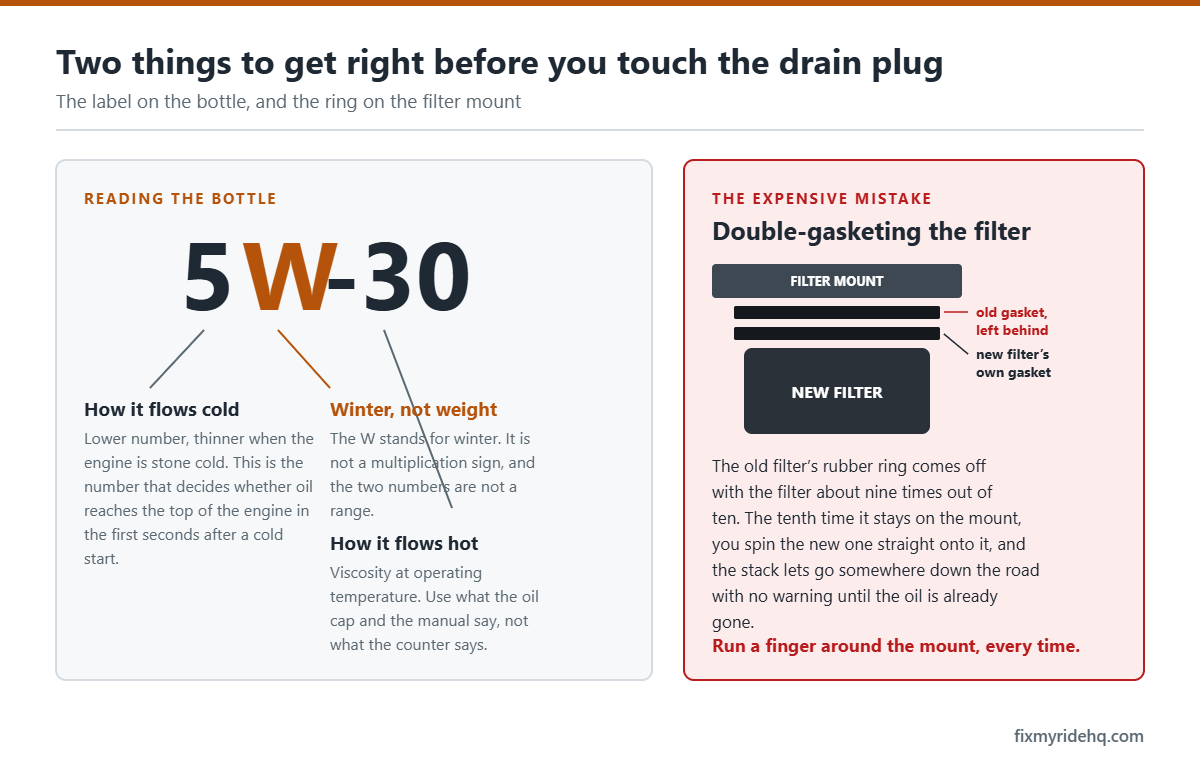
The grade on the bottle — 5W-30, 0W-20, 5W-20 — is not a preference. It is engineered around your engine’s bearing clearances and oil pump. The first number with the W is cold-flow behavior; the second is viscosity at operating temperature. Use what is printed on the oil cap or in the manual.
Running a heavier oil than specified is a common piece of bad advice, usually offered as a fix for an engine that burns a little oil. On a modern engine with variable valve timing, thicker oil can starve the phasers and set codes.
Specification, not just brand
Look for the API service rating (currently SP on most gasoline engines) and any manufacturer specification your truck requires — GM dexos, Ford WSS-M2C, Chrysler MS, and so on. These are printed on the back of the bottle. A cheap oil that meets the spec beats an expensive one that does not.
Filter
Buy a filter from a reputable manufacturer and skip the bargain bin. The filter holds oil pressure in the system at shutdown via an anti-drainback valve, and the cheapest filters are where that component gets cut. Price tier for oil and filter together: $ to $$.
What you will need
- Correct oil, in the right quantity — most half-ton V8s take 6 to 8 quarts; check the manual, do not guess
- Oil filter for your exact engine and year
- New drain plug crush washer if your truck uses one
- Socket or wrench for the drain plug, and an oil filter wrench
- Drain pan rated for more than your capacity
- Jack and jack stands, or ramps
- Funnel, gloves, and rags
oil filter wrench set — Amazon link pending program approval
low-profile drain pan — Amazon link pending program approval
The oil change, step by step
Budget 45 minutes the first time and about 25 after that.
- 1. Warm the engine briefly. Three to five minutes. Warm oil drains far more completely than cold oil. Do not run it to full operating temperature — you have to reach under there.
- 2. Lift and support the truck. Use ramps, or a jack plus jack stands on the manufacturer’s lift points. Never rely on a jack alone. Many full-size trucks have enough clearance to skip this entirely.
- 3. Position the pan and remove the drain plug. Loosen with the wrench, then finish by hand, pushing slightly inward as you unthread so the plug does not drop into the pan when it releases. Let it drain a full ten minutes.
- 4. Remove the old filter. It will hold oil, so angle it upright as it comes free and reposition the pan under it first. Confirm the old rubber gasket came off with the filter — a gasket left stuck to the mounting surface will double-gasket the new filter and dump your oil out within minutes of starting.
- 5. Prepare and install the new filter. Wipe the mounting surface clean. Smear a film of fresh oil on the new filter’s gasket. Spin it on by hand until the gasket contacts, then tighten three-quarters of a turn more. Hand tight, not wrench tight.
- 6. Reinstall the drain plug. New crush washer if applicable. Snug it to the torque spec if you have it. Overtightening strips an aluminum pan, and that repair costs more than every oil change you will ever do.
- 7. Fill with new oil. Add about a half quart less than capacity, then check the dipstick and top up to the full mark. Overfilling aerates the oil and is genuinely harmful.
- 8. Start and check. Run it 30 seconds. The oil pressure light should go out within a couple of seconds. Shut it down, look underneath for leaks at the plug and filter, wait five minutes, and recheck the level.
- 9. Reset the oil life monitor if your truck has one, and write the mileage and date somewhere you will find it again.
Safety note: This guide is general information, not a repair manual for your specific vehicle. Your owner’s manual takes precedence over anything written here — specifications and intervals vary between manufacturers and model years. Hot oil causes burns, and a vehicle supported only by a jack can kill. Always use jack stands or ramps. If you are not confident, have a qualified mechanic do the work.
Disposing of the old oil
Pour the used oil into the empty containers the new oil came in and take it to an auto parts store or municipal recycling center. Most parts chains accept used oil free of charge, and many take the old filter as well. Never pour oil on the ground or into a storm drain — beyond the obvious environmental harm, it carries real fines in California.
Frequently asked questions
How much does a truck engine oil change cost to do myself?
Typically a fraction of shop pricing, and the gap widens on trucks that take seven or eight quarts of full synthetic. The tools pay for themselves inside the first two or three changes. Price tier for a DIY change: $ to $$.
Can I switch from conventional to synthetic, or back?
Yes, freely, in either direction, at any mileage. The idea that switching to synthetic causes leaks in an older engine is a holdover from formulations sold decades ago. Modern synthetics are fully compatible.
Do I really need to change the filter every time?
Yes. The filter holds roughly a quart of dirty oil and its media is sized for one interval. Reusing it recontaminates fresh oil immediately, which defeats the point of the service.
What if I overfilled it?
Drain the excess rather than driving on it. A crankshaft churning through too much oil whips air into it, and aerated oil does not maintain pressure. A quarter quart over the mark is not a crisis; an inch above the top mark is.
My oil looks black after 1,000 miles. Is something wrong?
Almost certainly not. Dark oil means the detergent package is doing its job, suspending combustion byproducts instead of letting them varnish onto internal parts. Judge oil by the interval and the level, not the color — the exception being milky or gritty oil, which is a real problem.
The bottom line
Check the level monthly with the engine off and level. Use the viscosity and specification your manual lists. If your truck works for a living, treat 5,000 miles as the ceiling and do not let synthetic talk you into stretching it. Then put the tire rotation on the same visit and you have covered the two services that matter most.
Next: the full maintenance schedule by mileage, or how often to rotate truck tires.
Written by Vince T, who runs a delivery and logistics business in Southern California — dump runs, heavy hauling, private delivery. The trucks and SUVs covered here work through the week and get loaded up for the desert on the weekend. More about the site.