Disclosure: some links in this post are affiliate links. If you buy through them, we may earn a commission at no extra cost to you. As an Amazon Associate, we earn from qualifying purchases. We only recommend gear we would put in our own trucks.
A portable jump starter has quietly replaced jumper cables for most truck owners, and the reason is simple: it works alone. No second vehicle, no flagging down a stranger, no waiting in a parking lot at night hoping someone with cables shows up.
Pair it with a 12V air compressor and you have covered the two most common roadside failures — a dead battery and a low tire — without needing anyone else.
The catch is that these are two categories where buying too small is the default mistake, and where a missing safety feature turns a convenience item into a genuine hazard.
In this guide
- How we chose these
- Sizing a jump starter: the number that matters
- The two safety features that are not optional
- Jump starters worth considering
- Lithium and heat: the California problem
- Air compressors: what to look for
- Combination units: one device or two?
- Side by side
- What to keep alongside them
- Frequently asked questions
- The bottom line
Vince’s own photos and field notes for this guide are being added.
How we chose these
These are selected on peak current ratings, protection circuitry, battery chemistry, build quality, and the consistency of long-term owner reports. Where we have hands-on time with a unit it is noted as such. Where we do not, we say so rather than implying testing we did not do.
Sizing a jump starter: the number that matters
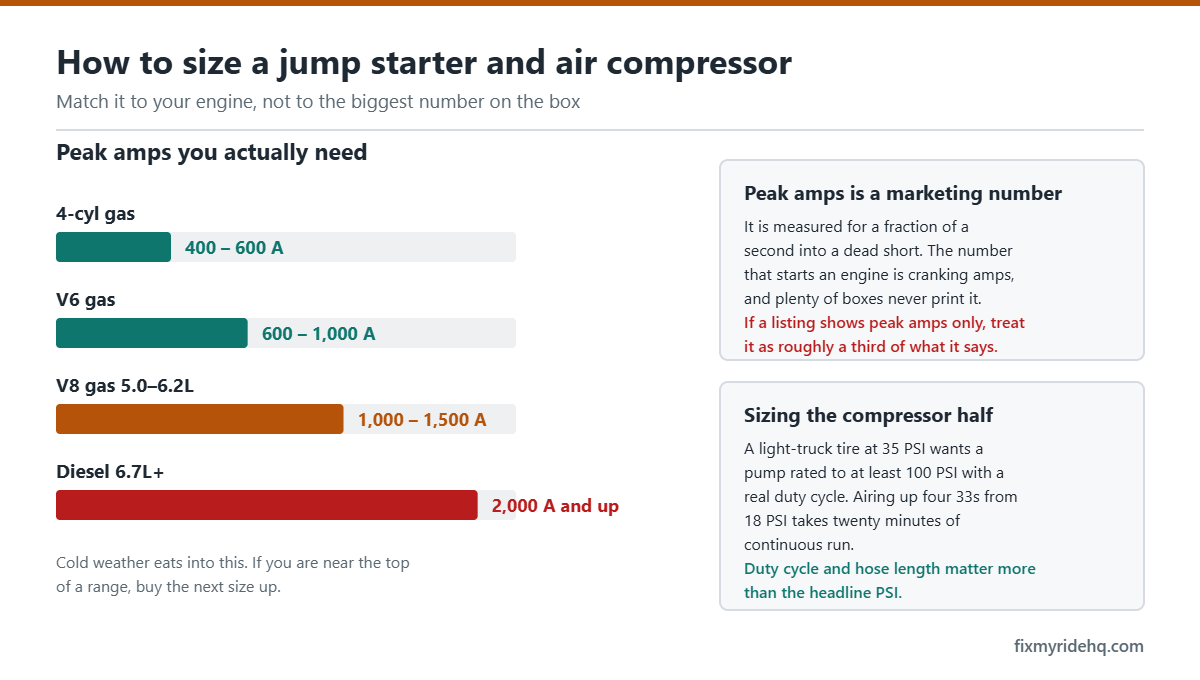
Peak amps is the headline specification, and the right figure depends on engine size, not on vehicle price.
| Vehicle | Peak amps to look for |
|---|---|
| Small car, 4-cylinder | 1,000–2,000A |
| Midsize sedan or crossover | 2,000–3,000A |
| Full-size pickup or SUV, V8 | 3,000–4,250A |
| Diesel truck | 3,000–4,250A and up, diesel-rated |
Buying undersized is the most common error. A pack rated for a compact car will crank a cold V8 reluctantly or not at all, and the failure happens at the worst possible time — which is the only time you use it.
Cold makes this worse from both directions. A battery at around 5°F delivers roughly half its rated capacity, and a cold engine is harder to turn. Size for your worst morning, not your average one. Our winter prep checklist covers the rest of the cold-weather picture.
The two safety features that are not optional
- Reverse-polarity protection. The pack refuses to deliver current if the clamps are on backwards. Reversing polarity on a modern vehicle can cause genuinely expensive electronic damage, and this feature eliminates the possibility.
- Spark protection. The pack stays electrically dead until it detects a proper connection to a battery. This matters because a discharged battery vents hydrogen, and a spark over a venting battery is the scenario the whole cable-order procedure in our jump starting guide exists to avoid.
Any unit missing either of these should be off your list regardless of price or amp rating.
Jump starters worth considering
NOCO Boost X GBX155
NOCO is the most established name in consumer jump packs, and the GBX155 sits near the top of their lineup at 4,250 peak amps. That is enough for large gas V8s and diesels, which is precisely where undersized packs fail.
Good for: full-size trucks, diesels, and anyone who wants the largest margin available in a portable unit. Includes reverse-polarity and spark protection, USB-C power delivery for charging devices, and a work light.
Trade-offs: the most expensive option here, and physically larger and heavier than the mid-range packs. Price tier: $$$.
NOCO Boost X GBX155 — Amazon link pending program approval
NOCO Boost Plus GB40
The long-running mid-size NOCO at 1,000 peak amps. It is the default recommendation for cars and small crossovers, and it has one of the longest track records in the category.
Good for: a second vehicle, a compact or four-cylinder, or as a glovebox backup. Same protection circuitry as the larger units.
Trade-offs: genuinely undersized for a full-size V8 truck. Do not buy this one for a half-ton and expect it to work on a cold morning. Price tier: $$.
NOCO Boost Plus GB40 — Amazon link pending program approval
GOOLOO GP2000
A 2,000 peak amp unit that has built a following on value. It covers midsize vehicles comfortably and many V6 and smaller V8 applications, with the protection features intact.
Good for: buyers who want adequate capacity without premium pricing, and who are not starting a diesel.
Trade-offs: less established brand history than NOCO, and long-term durability reports are more mixed. Price tier: $ to $$.
GOOLOO GP2000 jump starter — Amazon link pending program approval
WOLFBOX MegaVolt
A newer entrant in the high-output category, positioned against the larger NOCO units and generally at a lower price. Offerings in this line typically pair high peak amperage with a built-in compressor or a substantial power bank, depending on model.
Good for: buyers who want high output and combined functionality in one device rather than two.
Trade-offs: shortest track record of the units here, and combination devices mean a single point of failure for two jobs. Verify the exact model specifications before buying, as the line varies. Price tier: $$ to $$$.
WOLFBOX MegaVolt jump starter — Amazon link pending program approval
Lithium and heat: the California problem
This deserves its own section because it is the failure mode nobody warns you about at purchase.
Lithium cells degrade faster at high temperatures, and a jump pack stored behind the seat of a truck parked in Southern California summer sun is living in an environment far harsher than the spec sheet assumes. Interior temperatures in a closed vehicle can climb far above ambient.
Practical consequences: a pack that sits in a hot truck year round will lose usable capacity faster and hold its charge for less time than one kept in a garage. Two habits fix most of this:
- Check and top up the charge every two to three months rather than assuming it is ready.
- If the truck sits in the sun all day and you have the option, keep the pack somewhere cooler and move it to the vehicle when you need it — though for most working drivers, the pack being present matters more than the pack being pampered.
A jump pack you have not checked in a year is not a jump pack. It is a brick that looks like one.
Air compressors: what to look for
Truck tires need higher pressures than car tires, and many cheap inflators are sized for bicycles and compact cars. The specifications that matter:
- Maximum pressure. Confirm it comfortably exceeds your placard pressure. LT tires and temporary spares run high — many compact spares require around 60 PSI — so a unit that tops out near your target will struggle and overheat.
- Duty cycle. How long it can run before it needs to cool. Filling four truck tires is a real workload, and undersized units shut down partway through.
- Power source. Battery clamps or a 12V outlet supply more current than a USB-powered unit. Cordless rechargeable models are convenient but check whether they can actually fill a full-size truck tire from flat.
- Built-in gauge and auto shut-off. Set a pressure, walk away, come back. Still verify with a separate gauge — built-in gauges are convenient rather than precise.
- Hose and cord length. Enough to reach all four tires without repositioning the truck.
12V portable air compressor — Amazon link pending program approval
cordless tire inflator — Amazon link pending program approval
Whatever the built-in gauge says, set your final pressure with a proper gauge against the door-jamb placard, not the tire sidewall. Our sidewall guide explains why those two numbers are different and why using the wrong one costs you tread life.
Combination units: one device or two?
Plenty of products now combine a jump starter and a compressor. The appeal is obvious — one thing to store, one thing to charge.
The argument against is equally simple. A combination unit is a single point of failure for two unrelated emergencies, combination units are usually compromised at one of the two jobs, and a dead battery in the unit takes out both capabilities at once.
For a truck that works, two dedicated devices is the more robust choice. For occasional use in a second vehicle, a combination unit is a reasonable space-saver.
Side by side
| Unit | Peak amps | Best for | Price tier |
|---|---|---|---|
| NOCO GBX155 | 4,250A | Full-size trucks and diesels | $$$ |
| NOCO GB40 | 1,000A | Cars, four-cylinders, backup | $$ |
| GOOLOO GP2000 | 2,000A | Midsize, value pick | $–$$ |
| WOLFBOX MegaVolt | High output | Combined functionality | $$–$$$ |
Safety note: This guide is general information, not a repair manual for your specific vehicle. Your owner’s manual takes precedence over anything written here — specifications and intervals vary between manufacturers and model years. Jump starting involves a battery that vents explosive hydrogen gas. Only use a pack with reverse-polarity and spark protection, never jump a frozen, cracked, or leaking battery, and follow the manufacturer’s connection instructions for your specific unit. If you are not confident, have a qualified mechanic do the work.
What to keep alongside them
A jump pack and a compressor cover two failures. A few cheap additions cover most of the rest, and all of them fit in the same bag:
- A quality tire pressure gauge. The compressor’s built-in gauge is convenient, not accurate. Set final pressures with a real gauge against the door placard.
- A tire plug kit. A tread puncture is repairable at the roadside in about fifteen minutes. A sidewall puncture is not repairable at all — that is a spare-tire situation.
- Work gloves and a headlamp. Both of these failures happen in the dark more often than seems statistically fair, and a headlamp beats a flashlight when you need both hands.
- A set of jumper cables as backup. They cost little, never go flat, and give you an option if the pack has self-discharged.
tire plug repair kit — Amazon link pending program approval
Store the pack somewhere you can reach it without unloading the bed. A jump starter buried under a load is a jump starter you will not use.
Frequently asked questions
How many peak amps do I need for a V8 pickup?
Look in the 3,000 to 4,250 amp range. A 1,000 amp pack may start a warm V8 on a good day, but the day you need it will not be a good day, and cold cuts your battery’s contribution roughly in half.
How often should I charge a portable jump starter?
Every two to three months as a habit, and more often if it lives in a hot vehicle. Lithium packs self-discharge slowly, and heat accelerates it. Many people discover their pack is flat at exactly the moment they need it.
Can a jump starter damage my truck’s electronics?
A unit with reverse-polarity protection is unlikely to, since it will not deliver current on a backwards connection. That protection is the main reason to buy a reputable unit rather than the cheapest available.
Will a cheap tire inflator fill a truck tire?
Often slowly, and sometimes not at all from flat. Check the maximum pressure rating and the duty cycle. A unit that overheats after one tire is not useful when you need to bring all four up after a temperature drop.
Should I get a jump starter or just carry cables?
Cables are cheaper and never need charging, but they require a second vehicle and a cooperative stranger. For anyone who drives alone for work, a pack is the better tool. Carrying both is not unreasonable — good cables cost little and have no battery to go flat.
The bottom line
Size the pack for your engine and your coldest morning, insist on reverse-polarity and spark protection, and check the charge every couple of months — especially if it lives in a hot truck. For the compressor, confirm it exceeds your placard pressure with margin and can run long enough to do all four tires.
Next: how to jump start a truck safely, or all accessory roundups.
Written by Vince T, who runs a delivery and logistics business in Southern California — dump runs, heavy hauling, private delivery. The trucks and SUVs covered here work through the week and get loaded up for the desert on the weekend. More about the site.