Disclosure: some links in this post are affiliate links. If you buy through them, we may earn a commission at no extra cost to you. As an Amazon Associate, we earn from qualifying purchases. We only recommend gear we would put in our own trucks.
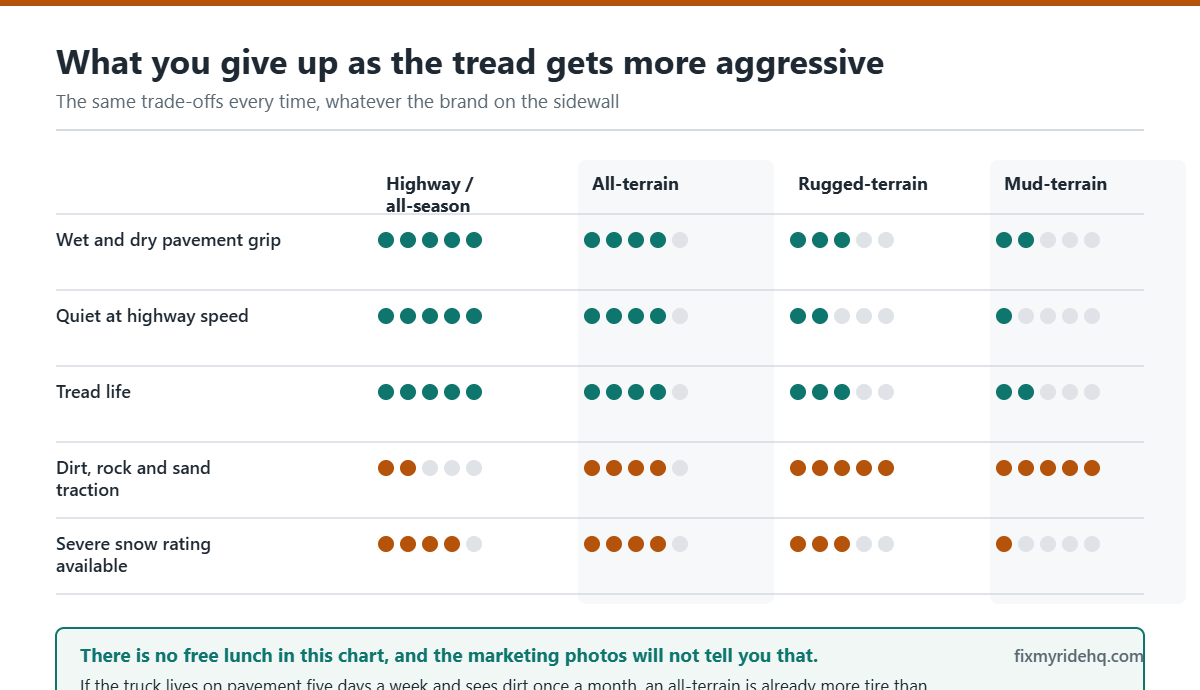
The best all-terrain tires are a compromise, and understanding which compromise you are buying matters more than which brand you pick. An all-terrain tire trades some highway quietness, some fuel economy, and some tread life for meaningfully better traction on dirt, gravel, mud, and snow.
If your truck spends its life on pavement, an all-terrain tire will cost you money without giving much back. If it sees job sites, fire roads, trailheads, or winter mountain passes, the trade is usually worth making.
Below are the criteria that actually separate these tires, followed by five strong candidates and what each one is genuinely good at.
In this guide
- How we chose these
- What actually separates all-terrain tires
- The five worth considering
- Side by side
- Do you actually need all-terrains?
- Buying and fitting notes
- Going bigger: what it actually costs
- Break-in, balance, and getting the life you paid for
- When to replace them
- Frequently asked questions
- The bottom line
Vince’s own photos and field notes for this guide are being added.
How we chose these
Being straight about methodology: these five are selected on published specifications, load and speed ratings, snow certification, warranty terms, and the long-running consensus among truck owners who put serious mileage on them. Where we have direct experience with a tire, it is called out as such in the notes. Where we do not, we say so rather than implying a test we did not run.
Always verify the specific size you need. Load index, warranty mileage, and even snow certification can differ between sizes within the same tire model.
What actually separates all-terrain tires
The three-peak mountain snowflake
This is the single most useful marking on an all-terrain sidewall. The three-peak mountain snowflake symbol is awarded after an actual snow traction test against a reference tire.
An M+S marking is not the same thing. M+S is granted on tread geometry alone, with no performance testing required, and nearly every all-terrain tire carries it. If you drive in real winter conditions, the snowflake is the claim with substance behind it.
Fuel economy
Expect to give up roughly 1 to 3 MPG moving from a highway tire to an aggressive all-terrain. The causes are higher rolling resistance, more weight, and in many cases a taller overall diameter.
On a truck covering high annual mileage, that difference is real money over the life of the set. It is a legitimate reason to buy the least aggressive tire that meets your actual needs rather than the most aggressive one that looks right.
Noise
Larger, more open tread blocks move more air and make more noise. Most modern all-terrains are far quieter than their predecessors, but noise also grows as the tire wears and the tread blocks begin to cup. A tire that is pleasant at 5,000 miles can be noticeably louder at 40,000.
Treadwear warranty
All-terrain warranties typically fall in the 45,000 to 65,000 mile range. Read what the warranty requires: documented rotations at specified intervals are almost always a condition, and without records the claim is usually refused. Our rotation guide covers the intervals and patterns.
P-metric versus LT
LT tires have stiffer sidewalls, higher load capacity, and require higher inflation pressures. If you tow or haul regularly, LT is the right call. If your truck runs mostly empty, an LT tire gives you a harsher ride and worse fuel economy in exchange for capacity you are not using. Our sidewall guide explains how to read the ratings.
The five worth considering
BFGoodrich All-Terrain T/A KO3
The latest generation of what is arguably the most recognized all-terrain tire on the market, and the benchmark most others are measured against. The KO2 built its reputation on sidewall toughness and resistance to cuts and punctures, and the KO3 continues that lineage with improved wet and snow performance.
Good for: owners who prioritize durability and sidewall strength above all else — job sites, rocky trails, anywhere a sidewall cut is a realistic risk. Three-peak mountain snowflake rated.
Trade-offs: among the more expensive options, and the aggressive construction costs some ride comfort and fuel economy. Price tier: $$$.
BFGoodrich All-Terrain T/A KO3 — Amazon link pending program approval
Falken Wildpeak A/T3W
The value benchmark in this category for several years running. Aggressive enough to look and perform the part, with a reputation for holding up well in mixed use, and consistently priced below the premium options.
Good for: owners who want genuine all-terrain capability without premium pricing. Three-peak mountain snowflake rated. Warranty commonly in the 55,000 mile range depending on size.
Trade-offs: noisier than the quieter options in this list, and that gap widens as the tire wears. Price tier: $$.
Falken Wildpeak A/T3W — Amazon link pending program approval
Toyo Open Country A/T III
Toyo’s all-terrain leans toward the balanced end of the spectrum — competent off pavement, notably civilized on it. Warranty terms are among the stronger in the category, commonly in the 60,000 to 65,000 mile range depending on size and load rating.
Good for: high-mileage drivers who want all-terrain capability without giving up much highway manners. Three-peak mountain snowflake rated.
Trade-offs: less aggressive than the KO3 or Wildpeak in deep mud, which is exactly the point for most buyers. Price tier: $$ to $$$.
Toyo Open Country A/T III — Amazon link pending program approval
Cooper Discoverer AT3 XLT
The XLT is the heavier-duty variant of Cooper’s AT3 line, aimed at three-quarter and one-ton trucks and anyone towing regularly. Built around load capacity and sidewall strength rather than trail aggression.
Good for: heavy towing and hauling, and larger trucks where load index is the deciding specification. Three-peak mountain snowflake rated.
Trade-offs: the heavy-duty construction is overkill on a half-ton that never carries weight, and you will feel it in ride quality. Price tier: $$ to $$$.
Cooper Discoverer AT3 XLT — Amazon link pending program approval
General Grabber A/TX
General is part of the Continental group, and the Grabber A/TX consistently punches above its price. It is the option to look at when the budget is real but you still want snow certification and a credible warranty.
Good for: budget-conscious buyers who refuse to give up winter capability. Three-peak mountain snowflake rated.
Trade-offs: tread life reports are more variable than the premium options, and it is less specialized at any one thing. Price tier: $ to $$.
General Grabber A/TX — Amazon link pending program approval
Side by side
| Tire | Best at | Snow rated | Price tier |
|---|---|---|---|
| BFGoodrich KO3 | Sidewall toughness, durability | 3PMSF | $$$ |
| Falken Wildpeak A/T3W | Value with real capability | 3PMSF | $$ |
| Toyo Open Country A/T III | Highway manners, long warranty | 3PMSF | $$–$$$ |
| Cooper AT3 XLT | Heavy towing and load capacity | 3PMSF | $$–$$$ |
| General Grabber A/TX | Budget with snow certification | 3PMSF | $–$$ |
Do you actually need all-terrains?
An honest question that a lot of roundups avoid, because the answer is sometimes no.
If your truck is 95 percent pavement and 5 percent gravel driveway, a quality highway or all-season truck tire will be quieter, last longer, ride better, and cost less to run. The gravel driveway is not a reason to buy all-terrains.
The case for all-terrains gets strong when you regularly encounter unpaved surfaces, load the truck heavily on loose ground, face winter conditions where the snowflake rating matters, or genuinely risk sidewall damage from rocks and debris. If that is your use, the fuel economy penalty is the cost of doing business.
Buying and fitting notes
- Check the DOT date code before you pay. The last four digits give the week and year of manufacture. A clearance set can be years old, and rubber ages regardless of tread depth.
- Never go below the original load index. On a truck that carries weight, this is a safety specification, not a preference.
- Stay close to the original overall diameter. Roughly three percent is the usual guidance. Larger changes affect speedometer accuracy, transmission shift points, and on many trucks the stability control calibration.
- Set pressure from the door placard, not the sidewall. The sidewall number is the tire’s maximum, not your vehicle’s recommendation. If you move from P-metric to LT tires, the correct pressure changes — ask the installer for the right figure for your load.
- Get them balanced properly and keep rotation records. Aggressive tires are more sensitive to balance, and the records are what make a warranty claim possible.
tire pressure gauge — Amazon link pending program approval
Safety note: This guide is general information, not a repair manual for your specific vehicle. Your owner’s manual takes precedence over anything written here — specifications and intervals vary between manufacturers and model years. Tires are a primary safety system. Never fit a tire with a lower load rating than specified, and replace any tire with a sidewall bulge, cut, or exposed cord rather than repairing it. If you are not confident, have a qualified mechanic do the work.
Going bigger: what it actually costs
Plenty of owners buy all-terrains and upsize at the same time. The tire choice and the size choice are separate decisions, and combining them hides which one caused what.
- Speedometer and odometer error. A larger diameter makes the speedometer read low — you are going faster than it says, and accumulating fewer recorded miles than you actually drive. That also shifts your service intervals without you noticing.
- Effective gearing. A taller tire behaves like taller gearing. Acceleration softens, the transmission hunts more on grades, and towing gets noticeably worse. On a truck that tows, this is the change people regret.
- Stability and traction control calibration. These systems use wheel speed data. Enough diameter change and they operate on assumptions that no longer hold.
- Rubbing. At full lock, over bumps, or both. Fender liners and the front bumper are the usual contact points, and the problem may only appear when the truck is loaded.
- Weight. A larger tire is unsprung rotating mass, which costs acceleration, braking, and fuel economy on top of the rolling resistance penalty.
Staying within roughly three percent of the original diameter avoids nearly all of this. If you go larger than that, budget for a speedometer recalibration, and accept that towing performance will change.
Break-in, balance, and getting the life you paid for
New tires have a release agent on the tread from the molding process. Drive moderately for the first few hundred miles — no hard braking or aggressive cornering — while it wears off.
Balance matters more on aggressive tires than on highway tires, because the heavier, more irregular tread makes imbalance more noticeable. If you feel a vibration at highway speed on a new set, take it back. Road force balancing costs more and resolves vibrations that conventional spin balancing cannot.
Then the boring part, which is the part that actually determines whether you reach the warranty mileage: rotate on schedule, keep pressures at the placard figure, and get an alignment if you notice uneven wear early. A set of all-terrains that gets rotated religiously will commonly outlast an identical set that does not by a wide margin.
When to replace them
Legal minimum is 2/32 inch, but that is a legal floor, not a performance one. Wet traction degrades substantially below 4/32, and on an aggressive tread the difference shows up as reduced bite well before the tire is legally worn out.
Replace regardless of tread depth if you find sidewall cracking, a bulge, exposed cord, or a repair in the sidewall or shoulder — those areas cannot be safely repaired. And check the DOT date code: a tire more than six years old deserves scrutiny, and ten years is generally considered the limit whatever the tread looks like.
Frequently asked questions
How much fuel economy will I actually lose?
Commonly 1 to 3 MPG versus a highway tire, depending on how aggressive the tread is, how much heavier the tire is, and whether you also went up in size. Going up in diameter at the same time is what turns a modest penalty into a noticeable one.
Are all-terrain tires loud on the highway?
Louder than highway tires, yes, but modern designs are far better than their reputation suggests. Expect the noise to increase as the tire wears, particularly if rotations get skipped and the tread blocks start to cup.
How long do all-terrain tires last?
Warranties generally run 45,000 to 65,000 miles, and real-world results depend heavily on rotation discipline, inflation pressure, alignment, and load. A neglected set can fall well short; a well-maintained set often meets or beats the rating.
Do I need the snowflake symbol if I never see snow?
No. If you never drive in winter conditions, it is not a meaningful criterion for you, and optimizing for it may cost you tread life or quietness you would rather have. It matters enormously if you do drive in snow.
Can I mix all-terrain tires with my existing highway tires?
Strongly discouraged. Mismatched tread patterns produce different grip levels front to rear, which is a handling problem in the wet. On four-wheel and all-wheel drive vehicles, differences in rolling diameter can also damage the drivetrain. Replace in complete sets where possible, and in axle pairs at minimum.
The bottom line
Buy the least aggressive tire that covers what you actually do. Look for the three-peak mountain snowflake if winter is real for you, match or exceed the original load index, check the DOT date code before you pay, and keep rotation records so the warranty means something.
Next: how to read your tire sidewall, rotation intervals and patterns, or browse all accessory roundups.
Written by Vince T, who runs a delivery and logistics business in Southern California — dump runs, heavy hauling, private delivery. The trucks and SUVs covered here work through the week and get loaded up for the desert on the weekend. More about the site.