Disclosure: some links in this post are affiliate links. If you buy through them, we may earn a commission at no extra cost to you. As an Amazon Associate, we earn from qualifying purchases. We only recommend gear we would put in our own trucks.
A truck maintenance schedule by mileage is the cheapest insurance you can buy. Nearly every catastrophic repair bill on a pickup or SUV traces back to a service that was skipped, stretched, or forgotten — not to a part that failed early.
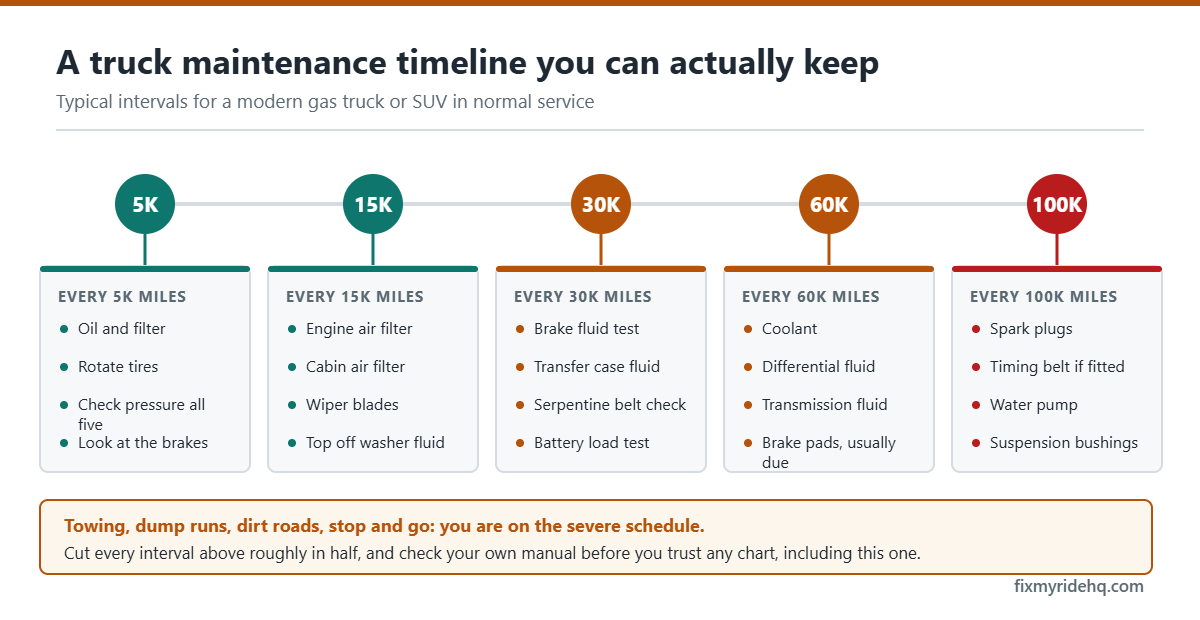
This is the hub schedule for the whole site. It covers what to service at every major mileage marker from 5,000 to 100,000 miles, and it flags the places where a working truck needs service sooner than the owner’s manual suggests.
Use it as a checklist, not gospel. Your manual has the final say on your specific engine and drivetrain, and the intervals below are the common ranges across modern half-ton and three-quarter-ton trucks and body-on-frame SUVs.
In this guide
- Normal service or severe service? Read this first
- Every 5,000 to 7,500 miles
- Every 15,000 to 30,000 miles
- Every 30,000 to 60,000 miles
- Every 60,000 to 100,000 miles
- Quick reference
- Tools worth owning
- What shops add that is not on this list
- Keeping records that are worth something
- Frequently asked questions
- The bottom line
Vince’s own photos and field notes for this guide are being added.
Normal service or severe service? Read this first
Almost every manufacturer publishes two schedules. Most owners assume they are on the normal one. Most are not.
Severe service typically means any of the following: frequent short trips under five miles, extended idling, stop-and-go traffic, towing or hauling heavy loads, dusty conditions, or sustained extreme heat or cold. Read that list again. A delivery route is severe service by almost every definition a manufacturer publishes, and so is most contractor and fleet use.
If you are on the severe schedule, take the short end of every range in this guide. That single decision does more for engine and transmission life than any additive, premium fluid, or shop upsell you will ever be offered.
Every 5,000 to 7,500 miles
- Engine oil and filter. Conventional and synthetic blend oils generally land at 5,000 miles. Full synthetic can stretch to 7,500 or even 10,000 on some engines — but only on the normal schedule. Synthetic oil does not extend the interval past what the manufacturer specifies for your driving conditions.
- Tire rotation. Same visit as the oil change, which is the easiest way to never forget it. Trucks and most SUVs use a rearward cross pattern.
- Tire pressure check. Cold, against the door-jamb placard, not the sidewall number.
- Visual inspection. Belts, hoses, fluid levels, and a quick look at brake pad thickness through the wheel.
More detail: how to check and change your truck’s engine oil and how often to rotate truck tires.
Every 15,000 to 30,000 miles
- Engine air filter. 15,000 to 30,000 miles, and toward the short end if you spend time on dirt or in heavy traffic. A clogged filter costs fuel economy before it costs anything else.
- Cabin air filter. 15,000 to 25,000 miles. Cheap, usually behind the glovebox, and a ten-minute job on most trucks.
- Brake fluid. Most manufacturers specify every two to three years regardless of mileage. Brake fluid absorbs moisture from the air, and wet fluid boils sooner under hard or loaded braking.
- Differential and transfer case fluid. If you tow, haul, or run four-wheel drive regularly, 30,000 miles is a reasonable checkpoint rather than a distant someday.
Every 30,000 to 60,000 miles
- Automatic transmission fluid. The most commonly skipped service on the list, and the most expensive one to skip. Manufacturers often advertise lifetime fluid; on a truck that tows or works, treat 60,000 miles as the outer limit and 30,000 to 45,000 as sensible under load.
- Serpentine belt inspection. Look for cracking, glazing, and missing ribs. Replacement usually lands closer to 90,000, but inspection starts here.
- Coolant. Long-life orange and gold coolants often run five years or 100,000 miles. Older green formulations are far shorter. Check what is actually in your truck before assuming.
- Battery. Most batteries last three to five years. Have it load-tested annually once it passes three years rather than waiting to be stranded.
Related: cleaning corroded battery terminals and the signs your brake pads need replacing.
Every 60,000 to 100,000 miles
- Spark plugs. Iridium and platinum plugs are commonly rated 100,000 miles. Copper plugs are closer to 30,000. Check which your engine uses — they are not interchangeable assumptions.
- Timing belt, if your engine has one. Typically 90,000 to 105,000 miles, and it is not optional: on an interference engine, a snapped belt destroys valves and pistons. Important caveat: most modern gasoline trucks and SUVs use a timing chain, which is not a scheduled replacement item. Confirm which you have before budgeting for it.
- Serpentine belt replacement. Around 90,000 miles, sooner if inspection found cracking.
- Water pump. Often replaced alongside the timing belt because the labor overlaps almost entirely. If the belt is coming off anyway, the pump is cheap to do at the same time.
- Suspension and steering inspection. Shocks, bushings, and ball joints wear quietly on loaded trucks, and the decline is slow enough that you stop noticing it.
Quick reference
| Mileage | Service |
|---|---|
| 5,000–7,500 | Oil and filter, tire rotation, pressure check, visual inspection |
| 15,000–30,000 | Engine air filter, cabin air filter, brake fluid (by time), diff and transfer case if working |
| 30,000–60,000 | Transmission fluid, coolant check, belt inspection, battery load test |
| 60,000–100,000 | Spark plugs, timing belt if equipped, belt replacement, water pump, suspension inspection |
Tools worth owning
You do not need a shop to stay on top of this schedule. Three inexpensive items cover most of it.
OBD-II scanner
Reads the code behind a check engine light so you walk into a shop knowing what you are talking about. See our dashboard warning light glossary for what each light means. Price tier: $ to $$.
OBD-II scanner — Amazon link pending program approval
Tire pressure gauge
Gas station gauges drift badly. A decent digital or pencil gauge is the cheapest accuracy available. Price tier: $.
tire pressure gauge — Amazon link pending program approval
Basic socket set
Air filters, battery terminals, and drain plugs are most of what a DIY schedule asks for, and a mid-range set covers all three for years. Price tier: $$.
socket set — Amazon link pending program approval
Safety note: This guide is general information, not a repair manual for your specific vehicle. Your owner’s manual takes precedence over anything written here — specifications and intervals vary between manufacturers and model years. Work involving jacking, lifting, brakes, batteries, or hot engine components carries real risk of injury. Never work under a vehicle supported only by a jack. If you are not confident, have a qualified mechanic do the work.
What shops add that is not on this list
Not every recommended service is a manufacturer requirement. Some are genuinely useful, some are situational, and some are margin. Knowing which is which saves real money over the life of a truck.
- Engine and fuel injection flushes. Rarely specified by manufacturers on a mileage schedule. Occasionally justified for a diagnosed problem; usually not preventive maintenance.
- Transmission flush versus fluid change. A drain-and-fill is what most manufacturers specify. A high-pressure flush on a high-mileage transmission that has never been serviced is controversial and sometimes best avoided entirely.
- Nitrogen tire fill. Air is already about 78 percent nitrogen. The benefits are marginal for road vehicles, and you still have to check pressures.
- Fuel additives at every service. Modern fuel already contains detergent. Occasional use is harmless; as a line item on every invoice it is a subscription.
- Wiper blades, cabin filters, and air filters are legitimate, and also the easiest things to buy and fit yourself in ten minutes for a fraction of the marked-up price.
None of this means shops are dishonest — most are not. It means the schedule in your manual is the baseline, and anything beyond it deserves the question: is this required, recommended, or optional?
Keeping records that are worth something
Service records do three jobs: they keep you honest about intervals, they support warranty claims on parts and tires, and they raise resale value on a truck with high mileage.
The format matters less than the consistency. A notebook in the glovebox, a note on your phone, or a folder of receipts all work. Record the date, the odometer reading, what was done, and what parts or fluids went in.
For a work truck, this also tells you your real cost per mile, which is genuinely useful information when deciding whether to keep a vehicle or replace it.
Frequently asked questions
Does synthetic oil let me skip an oil change?
No. Synthetic resists breakdown better, which is why some manufacturers allow longer intervals when they specify it. But the interval comes from the manufacturer for your conditions, not from the oil. On a severe-service truck, 5,000 miles remains the sensible floor regardless of what is in the sump.
My truck says the transmission has lifetime fluid. Is that real?
Lifetime generally means the design life of the transmission under normal use, which is not the same as the life of your truck under load. Transmission fluid degrades with heat, and towing generates heat. Changing it is far cheaper than rebuilding.
How do I know whether I have a timing belt or a timing chain?
Your owner’s manual will list a timing belt replacement interval if you have one. If no such interval appears, you almost certainly have a chain, which is lubricated by engine oil and generally lasts the life of the engine — another reason not to stretch oil changes.
The oil life monitor says 40 percent. Should I trust it?
Modern oil life monitors are genuinely useful — they track engine load, temperature, and trip length rather than just counting miles. Use it as a ceiling, not a target, and still change the oil at least once a year even if the monitor has not asked.
What if I bought the truck used with no service history?
Treat it as due for everything. Do oil, filters, and a transmission fluid service up front, then start the clock from that date. The cost of doing a service slightly early is trivial next to the cost of discovering it was never done.
The bottom line
Pick the severe schedule if your truck works for a living, put the oil change and tire rotation on the same visit, and do not let the transmission fluid become the one thing you never got around to. Those three habits cover most of the distance between a truck that reaches 250,000 miles and one that does not.
From here, start with the oil change guide, or browse all maintenance guides.
Written by Vince T, who runs a delivery and logistics business in Southern California — dump runs, heavy hauling, private delivery. The trucks and SUVs covered here work through the week and get loaded up for the desert on the weekend. More about the site.