Disclosure: some links in this post are affiliate links. If you buy through them, we may earn a commission at no extra cost to you. As an Amazon Associate, we earn from qualifying purchases. We only recommend gear we would put on our own trucks.
Truck suspension terms get used loosely enough that two people can have an argument while agreeing completely. Worse, several of the definitions that circulate most widely are flatly wrong, and a few of them will cost you parts if you act on them.
Where a term has a real engineering definition, we have used it — most of these come from SAE J670, the vehicle dynamics terminology standard. Where there is no standard, we say so instead of inventing one. The last section is five things people repeat that are not true.
In this guide
- Springs and rates
- Shock, strut, coilover
- The three alignment angles
- Steering, and what goes wrong with it
- Driveline angles
- Articulation and anti-roll
- Bushings and joints
- Five things people say that are not true
- Where the money goes
- The bottom line
Vince’s own build photos for this guide are being added.
Springs and rates
Spring rate. The change in load per unit of deflection, in pounds per inch. A 400 lb/in spring compresses one inch under 400 pounds. That is the whole definition.
Ride rate. The one that actually matters, and the one nobody quotes. SAE defines it as the change in wheel load, measured at the tire contact patch, per unit of vertical movement of the sprung mass. The spring rate gets modified on its way to the ground by the motion ratio of the linkage, roughly squared, then by the tire acting as a second spring in series, then by bushing compliance. What a person in the seat feels is ride frequency, which is ride rate against sprung mass.
That is why a heavier spring does not automatically mean a harsher truck, and why most post-lift harshness complaints trace to the shocks rather than the springs.
Linear. Constant rate through the whole travel. Load and deflection plot a straight line.
Progressive, or variable rate. Rate increases continuously as the spring compresses, achieved with varying coil pitch, varying wire diameter, or a conical shape. On a leaf pack, by leaves coming into contact progressively. The industry uses “progressive” and “variable rate” interchangeably and no standards body distinguishes them, so do not read anything into which word a catalog chose.
Dual rate. Two distinct linear rates with a handoff between them, usually two springs in series with a slider. Stepped rather than continuous, so it is not the same thing as progressive even though both are “not linear.”
Shock, strut, coilover
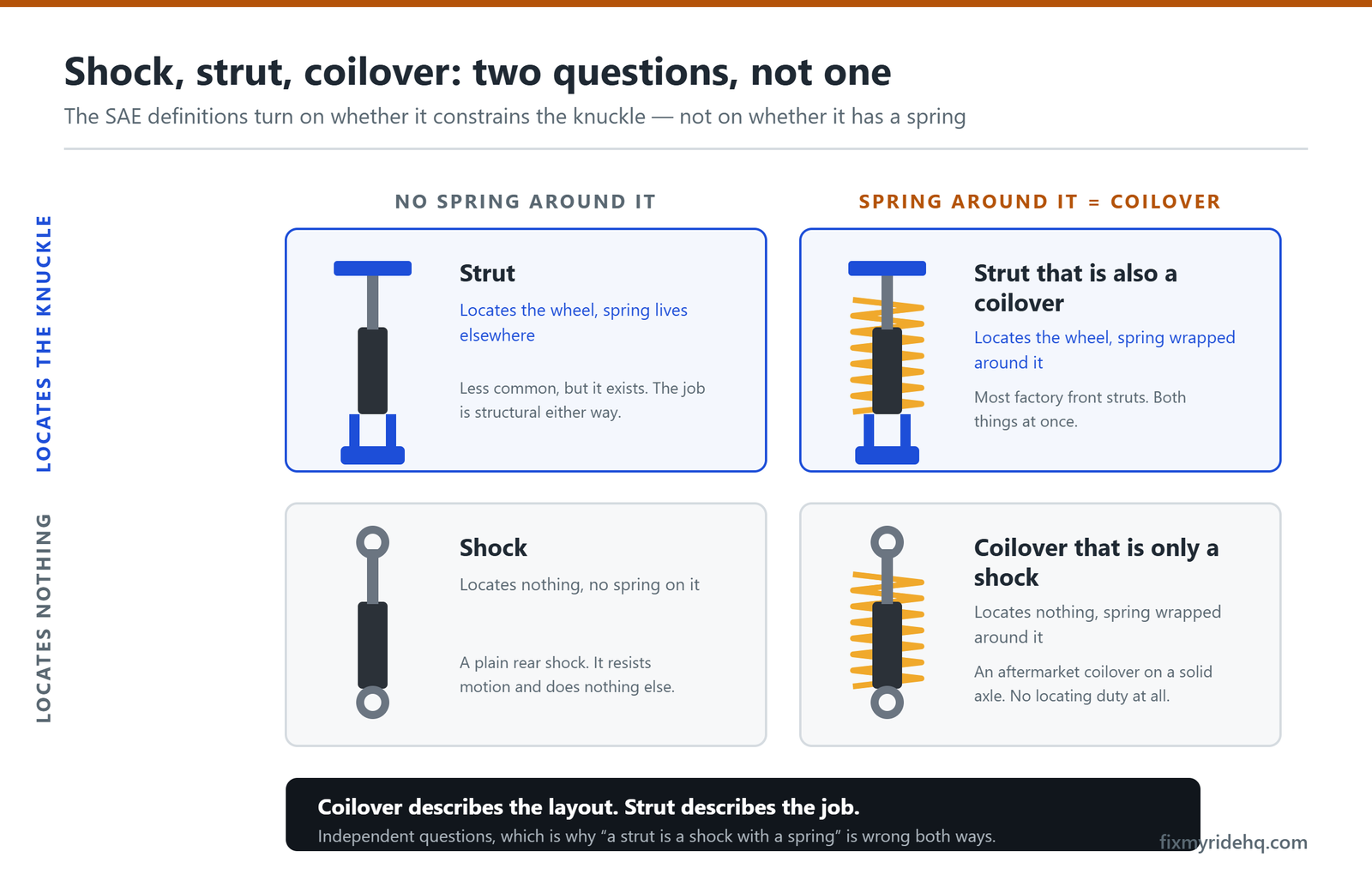
SAE separates these cleanly, and the distinction has nothing to do with springs.
Damper. The parent term: a suspension part used to provide damping.
Shock absorber. A damper that adds negligible kinematic constraint to the suspension. It resists motion. It does not hold the wheel anywhere.
Suspension strut. A damper that also contributes to rotational constraint of the knuckle in camber and caster. In plain terms, a strut is a structural member that locates the wheel. A shock is not.
Coilover. Not defined by SAE at all. In practice it describes packaging: a damper with the ride spring mounted concentrically around it, usually on a threaded body so ride height and preload are adjustable.
Those are two independent axes, and keeping them straight clears up most of the confusion. Shock versus strut is about function: does it locate the knuckle. Coilover is about layout: is the spring wrapped around it. A factory front strut with a coil around it is both at once. An aftermarket coilover for a solid front axle is a shock with a spring on it and carries no locating duty at all.
This matters practically: because a strut sets camber and caster, a strut-spacer lift on an independent front end changes your alignment, and worn struts can move it. A shock cannot do either.
The three alignment angles
Caster. The angle, viewed from the side, between the steering axis and vertical. Positive means the steering axis leans rearward at the top. Positive caster puts the contact patch behind where the steering axis meets the road, so tire side force acts behind the pivot and pushes the wheel back to center. That is your straight-line stability and your steering return, and it costs you steering effort.
Worth knowing: the governing quantity is really trail, which is caster angle together with how far the steering axis is offset at the wheel. And a good share of the self-centering you feel is pneumatic trail generated inside the tire, which no alignment setting controls.
Camber. The tilt of the wheel plane from vertical, positive when the top of the wheel leans outward. Too much either way wears one shoulder of the tire.
Toe. The angle between the vehicle’s longitudinal axis and the line where the wheel plane meets the road. Toe-in means the leading edges point slightly together. Toe is the setting that destroys tires fastest when it is wrong, and it is the one that moves most when you change ride height.
Why lifting moves caster, and when it does not
On a linked or radius-arm solid front axle, the links set the rotation of the housing. Lift the truck and the links swing through their arc, rotating the housing and tipping the knuckles with it, usually reducing positive caster. That is why lifts past two or three inches sell adjustable control arms and caster-correction brackets.
On an independent front end, a spacer moves the knuckle along the control arm arc. Camber changes a lot, caster changes some, and which direction depends on the relative lengths and mounting points of the upper and lower arms. It can go either way. On a leaf-sprung front axle with lift blocks, the spring perch angle does not change, so caster barely moves.
So “lifting always reduces caster” is wrong as a general statement. It is true for the architecture most people are picturing. Details on which parts a given lift height actually needs are in the lift kit guide.
Steering, and what goes wrong with it
Bump steer, or ride steer. The change in a wheel’s steer angle resulting from suspension ride travel. That is the definition — just the outcome, not a cause.
The cause differs by architecture, which is why most explanations you will read do not apply to a solid-axle truck. On an independent front end, the tie rod end sweeps an arc about its inner pivot while the steering arm sweeps an arc about the suspension’s instant center; mismatch between those arcs steers the knuckle. The zero-bump-steer condition is that the tie rod axis projects to the suspension instant center, which is not the same as the common shorthand about keeping the tie rod parallel to the lower arm.
On a solid front axle there are no control arms in that path at all. Bump steer comes from the drag link and the track bar sweeping different arcs as the axle moves. Track bar and drag link that are not parallel and of similar length is the classic case, and it is the one that bites lifted trucks.
Three related terms that are not the same thing: roll steer is steer resulting from suspension roll, compliance steer is steer from bushings and structure deflecting under load, and Ackermann is the intentional difference in steer angle between the inside and outside wheels.
Death wobble
A self-sustaining oscillation of the steered wheels about the steering axis. The pothole or expansion joint is only the trigger — the energy keeping it going comes from the truck’s forward motion, fed back through tire forces into the steering linkage. That is why it does not damp out and why it appears above a particular speed.
It is well documented. Ford issued a bulletin for 2017 through 2019 F-250 and F-350 four-wheel-drive trucks built on or before July 31, 2018, describing “a sustained steering wheel oscillation after driving over rough pavement or an expansion joint above 45 mph.” NHTSA has investigated it on Super Duties, and on 2018 to 2019 Jeep Wranglers, where a related recall involved a misaligned weld on the front track bar.
The causes are cumulative rather than singular: a worn track bar or bracket, worn tie rod and drag link ends, loose ball joints or wheel bearings, play in the steering box, out-of-round or unbalanced tires, a failed damper. Every bit of free play lowers the speed at which the oscillation can sustain itself.
Two corrections worth having. A heavy-duty steering stabilizer is not a fix; it raises the speed at which the problem appears and hides the free play that caused it. And it is not exclusive to solid axles — shimmy is a general steered-wheel phenomenon that appears in the engineering literature on independent suspension too. Solid axles are far more prone to it; they are not the only ones that can do it.
Driveline angles
Pinion angle is the angle of the differential’s pinion shaft. It is what you adjust. Operating angle is the angle between the driveshaft and the pinion, and separately between the driveshaft and the transfer case output. It is what matters.
A single universal joint running at an angle speeds up and slows down twice per revolution. Two joints at equal and opposite angles cancel that out. Leave the angles unequal and the fluctuation does not cancel, and you feel it as a vibration at twice driveshaft speed that gets worse with road speed.
Spicer publishes three rules for conventional driveshafts, and they are the clearest numbers in this whole article:
- Operating angles at each end should always be at least 1 degree.
- The angles at each end should be equal within 1 degree of each other.
- For vibration-free operation they should not exceed 3 degrees.
Spicer also publishes a maximum true operating angle against driveshaft speed: 11.5 degrees at 1500 rpm, 8.7 at 2000, 5.8 at 3000, 4.2 at 4000, 3.2 at 5000. Faster shaft, smaller allowable angle.
That first rule is the one people violate on purpose. Zeroing the operating angle sounds like the ideal and is not: with no angle the needle rollers in the joint stop oscillating in their races, which brinells them and kills the joint early. A universal joint needs a little angle to survive.
Note that a double-cardan or CV-style shaft, common at the transfer case on front driveshafts, is set up differently from a conventional shaft. If yours has one, follow the driveshaft manufacturer’s instructions for that configuration rather than the equal-and-opposite rule above.
Articulation and anti-roll
Sway bar, or anti-roll bar. SAE calls it a torsional spring loaded in suspension roll to provide additional roll stiffness. It connects the two sides, so it is twisted only when the wheels move differently. Lift both wheels together and it is not twisted at all and contributes essentially nothing — which is why it does not stiffen your ride over a speed bump.
It also does not reduce how much weight transfers in a corner. Steady-state load transfer is set by lateral acceleration, center of gravity height and track width. What the bar changes is the roll angle and the front-to-rear distribution of that transfer.
Off-road it works against you, because the differential wheel movement it resists is exactly what articulation requires. Ram documents the size of that effect for the Power Wagon: a ramp travel index of 429 with the front bar connected against 538 disconnected, which is one front wheel lifting 22 inches versus 27.5. Roughly a quarter more articulation from one switch.
Ramp travel index, or RTI. A flex score: drive one wheel up a ramp until another wheel lifts, divide the distance travelled up the ramp by the wheelbase, multiply by 1,000. A 20-degree ramp is the convention and Ram uses it in its own owner’s manual.
Two warnings. There is no standards body behind RTI — it is an enthusiast and magazine metric, not an SAE or federal measurement. And the formulas circulating online disagree because they measure different distances: distance up the ramp face, vertical lift height, and horizontal run all produce different answers. Ramps in the wild run anywhere from 15 to 30 degrees, so two scores are only comparable if they came off the same ramp.
Unsprung weight. Everything not carried on the springs: wheels, tires, hubs, bearings, rotors, knuckles, and on a solid axle the whole housing and differential. Sprung is everything the springs hold up. Several things are partly each — control arms and links attach at both ends, leaf springs are both spring and locating member, and half shafts on an independent front end run from a frame-mounted differential out to a moving hub.
Less unsprung weight is directionally good, because lower wheel inertia means the tire stays loaded more consistently over a rough surface. What does not exist is an exchange rate. See the next section.
Bushings and joints
The useful mental model, and it is backed by published suspension research rather than catalog copy: a bushing is a spring in six directions at once, and good design wants it compliant along one axis and stiff along another simultaneously. Any argument that runs “stiffer is better” or “softer is better” is wrong before it starts.
Rubber. Lowest stiffness, highest internal damping, so the best noise and vibration isolation. Bonded to its sleeves, so it works by deforming rather than sliding: no grease, no maintenance. Costs you some deflection under load, and it degrades with heat, ozone, oil and age.
Polyurethane. Stiffer with much less damping, so more road noise reaches you. Most aftermarket poly bushings are not bonded; they rotate on an inner sleeve, which means they rely on sliding and therefore need grease, can squeak and do wear. The grease fittings are a real maintenance item, not a myth. Better load control and better resistance to oil and ozone.
Spherical, heim or similar. Near-zero compliance and high misalignment capability, so links do not bind through long travel and the wheel is located precisely. Costs: it transmits essentially all noise and vibration straight into the cab, it is a wear item in dirt and water, and the play it eventually develops is exactly what feeds the shimmy and clunk problems above.
The bind point is the one that matters on a lifted truck. Rubber and poly can only accommodate link misalignment by deforming, so at large articulation they load up the links and limit travel. Spherical joints articulate instead. What you will not get from us is a durometer number or a percentage, because every one of those we found traced to someone selling bushings.
Five things people say that are not true
- “A strut is just a shock with a spring on it.” The difference has nothing to do with the spring. A strut structurally locates the knuckle; a shock does not. A strut can be a coilover and a coilover can be a plain shock.
- “One pound of unsprung weight equals eight pounds of sprung weight.” Or four, or ten, or fifteen — you will see all of them. There is no standard, textbook or engineering source for any such ratio, and there cannot be a single number, because sprung and unsprung mass appear in different terms of the equations and their relative importance depends on frequency, spring rate, damping and tire rate. Lighter wheels are good. The exchange rate is folklore.
- “Add caster to cure death wobble.” Ford’s documented repair does the opposite: after checking the steering damper, it calls for reducing front caster to the lower limit of specification. Caster trades straight-line stability against shimmy susceptibility, so more is not simply better.
- “Aim the pinion straight at the transfer case.” Zero operating angle violates the first rule the driveshaft manufacturer publishes and brinells the joint. A u-joint needs at least a degree to keep its needles working.
- “Sway bars stiffen the ride” and “sway bars reduce weight transfer.” Neither. The bar is untwisted when both wheels move together, so it does nothing over a bump taken square. And it changes roll angle and the front-to-rear split of load transfer, not the total.
Where the money goes
| Tier | What it gets you | The trade-off |
|---|---|---|
| $ | Replace worn bushings, tie rod ends and a tired steering damper. Alignment afterward. | Unglamorous and frequently the entire answer. Most trucks that “need suspension” need the free play taken out of the suspension they have. Do this before buying anything. |
| $$ | Matched springs and shocks sized for how the truck is actually loaded, plus an alignment. | Where the ride quality actually lives. The shocks matter more than the springs for how it feels, and buying a spring without a damper to match is how trucks end up bouncy and harsh at the same time. |
| $$$ | Adjustable control arms, corrected driveline angles, spherical joints where links need to articulate. | This is the tier that fixes geometry rather than symptoms, and it is the right one if the truck is lifted and fighting you. It also adds noise and maintenance, so buy it for a reason, not for the spec sheet. |
Our honest take: almost nobody needs the third tier and almost everybody skips the first. A truck with fresh bushings, tight steering components and a correct alignment drives better than the same truck with expensive parts bolted on top of worn ones.
The bottom line
Most of the confusion in this subject comes from terms that sound like they describe parts but actually describe functions. A strut is a job, not a shape. A coilover is a layout, not a capability. Spring rate is not ride quality. Once those separate out, catalog copy gets much easier to read and much harder to be sold by.
If you are planning a lift, the lift kit guide covers which of these parts actually come due at which height. If you are changing wheels at the same time, start with offset and backspacing. The rest of our build work lives in Exterior Mods.
— Vince T