Disclosure: some links in this post are affiliate links. If you buy through them, we may earn a commission at no extra cost to you. As an Amazon Associate, we earn from qualifying purchases. We only recommend gear we would put on our own trucks.
Aftermarket bumpers and rock sliders are the two armor parts most people buy first, and they are the two with the most confident misinformation attached. One of them involves your airbags. The other involves a part of the California Vehicle Code that almost certainly does not apply to your truck, even though half the internet says it does.
Here is what we could actually verify, what the manufacturers themselves say, and the several things that get repeated everywhere and have nothing behind them.
In this guide
- The airbag question, answered honestly
- Weight is the cost nobody quotes
- Sliders and step bars are not the same part
- Winch-ready, and what that phrase hides
- What California actually regulates
- Doing it on three budgets
- Frequently asked questions
- The bottom line
Vince’s own build photos for this guide are being added.
The airbag question, answered honestly
You will read that a steel bumper stops your airbags from deploying. You will read on the next forum that this is nonsense and the sensors are in the doors anyway. Neither position is supported, and the truth is more useful than either.
No regulator has found that aftermarket bumpers defeat airbags, and there is no published test data showing it. NHTSA was asked directly about guards on the front of a vehicle and answered: “It is not possible for NHTSA to provide an unequivocal opinion as to whether brush guards or grille guards will interfere with air bag performance.”
What the same letter does is lay out the three ways it could matter, which is the useful part. A guard hanging below the bumper line could trigger deployments that were not intended. One attached to the vehicle structure rather than the bumper could do the same. And third, in NHTSA’s words, adding something to the front bumper “in such a manner as to change the load path through the bumper” could mean “the crash impulse arriving at the crash sensor location might be different from the impulse that would be present without the guard.”
That third one is the real mechanism. A crash sensor does not measure damage, it measures deceleration. Change how force travels through the front of the truck and you have changed the signal the sensor sees, in a direction nobody has characterized for your specific combination.
The manufacturers put it in writing
Ford’s owner literature is unambiguous: “Modifying or adding equipment to the front end of the vehicle (including frame, bumper, front end body structure and tow hooks) may affect the performance of the airbag system, increasing the risk of injury. Do not modify the front end of the vehicle.” Kia says the same thing about changing “your vehicle’s frame, bumper system, front end, side sheet metal or ride height.”
So: no proof of harm, no proof of safety, and multiple manufacturers telling you in print not to do it. That is the actual state of knowledge, and anyone selling you certainty in either direction is selling something.
On that note, “airbag compatible” appears on plenty of bumper listings. There is no standard behind that phrase, no test it refers to, and no third party verifying it. Read it as a marketing claim, because that is what it is.
Who carries the legal exposure
Same structure as the TPMS rules. Federal law, 49 U.S.C. 30122(b), prohibits a manufacturer, distributor, dealer, rental company or motor vehicle repair business from knowingly making safety equipment inoperative. NHTSA confirmed the limit of it: “This provision does not apply to modifications vehicle owners make to their own vehicles.” The shop has exposure. You, in your own driveway, do not.
One piece of context that surprises people: there is no federal bumper standard for pickups or SUVs at all. The federal bumper rule covers passenger cars and explicitly excludes multipurpose passenger vehicles. So replacing the bumper on an F-150 or a 4Runner is not displacing any federally required bumper performance. The exposure runs through the airbag standard and the structure, not through a bumper standard.
Weight is the cost nobody quotes
A full steel winch bumper runs well over a hundred pounds before the winch goes in. ARB publishes 176 pounds for one of its Tacoma winch bumper kits. Aluminum roughly halves it: one manufacturer offering the same bumper in both materials lists 102 pounds in steel and 50 in aluminum.
We are deliberately not printing a factory bumper weight to subtract from that. The catalog figures available are for the face bar alone and leave out the reinforcement beam, energy absorber and brackets, so any comparison built on them would be wrong. Ask the bumper maker for installed weight, and ask what comes off. The number you want is the net.
Where that weight lands
All of it is ahead of the front axle, which makes the front gross axle weight rating the ceiling, not the GVWR. Ford states the principle plainly in its guidance for front-mounted snowplow equipment: the front GAWR is on the compliance label, it includes the vehicle plus any auxiliary equipment, and “Do not exceed FGAWR or Gross Vehicle Weight Rating.”
Ford also names the fix, and it is not more spring: “Rear ballast weight behind the rear axle may be required to prevent exceeding the FGAWR, and provide front-to-rear weight balance for proper braking and steering.”
The rest follows from arithmetic. Every pound of bumper and winch comes straight out of payload, because federal definitions count accessories against the loaded weight the truck is rated for. On a truck that already hauls for a living, that is the quiet cost of armor.
- Springs. Suspension makers will tell you to size the front spring for the accessory. ARB’s own guidance is that “the front spring should account for accessories such as a bumper and/or winch.” Fitting a heavy bumper to stock springs gets you nose sag and a used-up bump stop.
- Headlight aim. Ford says in the same snowplow guidance that “headlight aim may require adjustment.” We could find no regulation requiring you to reset aim after a front-end change, but California does require all lighting equipment to be “maintained in good working order,” and a nose that sits an inch lower is aiming your low beams into oncoming traffic.
- Sensors. Bumper makers admit this one themselves. One lists “parking sensors will not work with this bumper and will have to be deactivated”; another says its bumper “does not suit models with forward facing camera.” Check your specific trim before ordering, not after.
Worth knowing for anyone buying a newer truck: automatic emergency braking becomes a federal requirement for light vehicles manufactured on or after September 1, 2029. Forward-facing sensors stop being an option package and start being mandated equipment, which raises the stakes on anything that sits in front of them.
Sliders and step bars are not the same part
They look similar from ten feet away and they do completely different jobs.
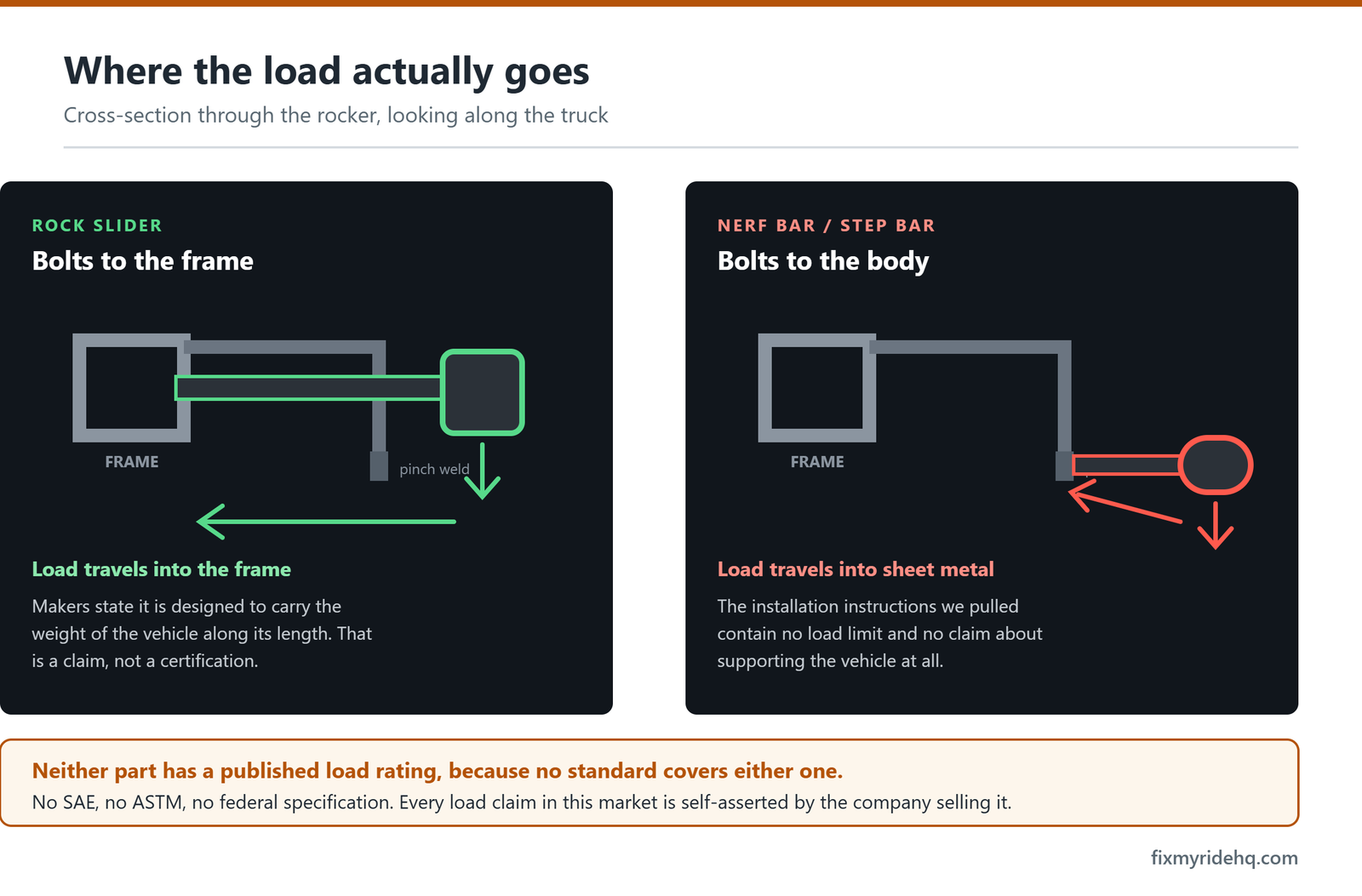
| Rock sliders | Nerf bars / step bars | |
|---|---|---|
| Mounts to | The frame, by plates or chassis-mounted brackets | Pinch weld or body, typically |
| Intended to | Support the vehicle’s weight along its length | Hold a person stepping up |
| Published load rating | None exists. No standard, no test | None published at all |
| Jack point | Makers claim yes; it is a claim, not a certification | No |
ARB describes sliders as attached to the chassis with “multiple mounting points… to ensure that the weight of the vehicle is supported along the length of the slider.” Another maker says its sliders are “easily capable of supporting the entire side of truck for lifting with hi-lift, or sliding on rocks.”
Here is the part worth printing in bold: there is no standard for any of this. We looked for an SAE, ASTM or federal specification covering rock sliders and found nothing. Nobody certifies a slider to anything. Every load claim in the market is self-asserted by the company selling it.
That cuts both ways, and the contrast with step bars is the real signal. We pulled installation instructions for a set of tubular nerf bars. The entire safety content is “ensure that the steps properly secured to vehicle” and a note to check fasteners periodically. No load limit, no mounting restriction, no statement about supporting anything. A part whose maker publishes nothing about load is not a part to put a jack under.
Also note that sliders differ among themselves. Some bolt to frame plates running the length of the rocker. Others mount to chassis-mounted body-mount brackets. Those are not equivalent, and the product photos will not tell you which you are looking at. Ask.
Winch-ready, and what that phrase hides
Winch sizing has a rule of thumb, and it belongs to WARN rather than to any standards body: take the gross vehicle weight rating and multiply by 1.5. On a 5,000-pound Wrangler that lands at 7,500 pounds of winch. It is a manufacturer recommendation, not a regulation, but it is the one the industry uses.
Now check it against the bumper. Winch-ready bumpers publish their own ceiling, and it is frequently lower than the number that rule of thumb produces. Across the listings we looked at, mounts were specified for winches up to 10,000 or 12,000 pounds. On a 7,000-pound GVWR half-ton, 1.5 times GVWR is 10,500 pounds, which already exceeds some of those mounts.
Read those specifications carefully too. Some are fitment statements about what physically bolts in, not load ratings, and none of them is tested to a published standard.
A tie-down is not a recovery point
This is the one in this article that actually hurts people. Factory hooks and slots under the front of a truck are often transport tie-downs, designed to hold the truck still on a trailer, not to be pulled against.
Ford’s wrecker towing documentation makes the distinction structurally: tie-downs use a T-hook in a designated tie-down slot, while winching points are listed separately as their own locations, and on one model Ford specifies that “only the winching holes in the front subframe of the vehicle may be used.” Different hardware, different holes, different purpose.
WARN’s recovery guidance is blunter: do not attach to “axles, control arms, tie-down points, or trailer balls,” because they “are simply not designed for that kind of energy,” and never recover off a trailer ball because they “can turn into lethal projectiles.” Use points attached directly to the frame, and check the owner’s manual for where yours are.
A real benefit of a good aftermarket bumper, and arguably the main one, is that it gives you properly engineered recovery points where the factory gave you tie-down slots.
What California actually regulates
Every bumper article tells California readers that Vehicle Code section 28071 requires front and rear bumpers. Follow the definitions and that is very likely wrong for the vehicle you are driving.
Section 28071 applies to a “passenger vehicle.” Section 28070 routes that term to section 34710. And section 34710 excludes, among others, motor vehicles equipped with four-wheel drive and motor vehicles constructed on a truck chassis. Separately, section 465 excludes motortrucks from the definition of passenger vehicle altogether.
So a pickup is out twice over, and a four-wheel-drive SUV is out as well. A two-wheel-drive unibody crossover that does qualify is then very likely exempt anyway, because the section does not apply to vehicles required to have an energy absorption system.
We verified the statutory text, not enforcement practice, and found no California case or CHP guidance applying 28071 to a modified truck. Take it as a reason to stop repeating the claim, not as a promise about a traffic stop. And note there is no bumper height section in the Vehicle Code at all; height is governed by frame height, which we cover in the lift kit guide.
The rules that do bite
- Blocked lights, and the federal rule names winches. FMVSS 108 says that if a required lamp is obstructed by equipment — the standard lists mirrors, snow plows, wrecker booms and winches by name — the vehicle must get an additional lamp of the same type that does meet the requirements. A winch or bull bar sitting in front of a turn signal is the scenario the rule was written for.
- The front license plate. California issues two plates and requires both to be mounted, one front and one rear, clearly visible and legible. A great many aftermarket bumpers delete the factory plate mount and ship without a replacement. This is the single most common citation attached to a bumper swap in this state.
- Auxiliary lamp heights. If lights are going on the bar: auxiliary driving lamps must sit between 16 and 42 inches, passing lamps between 24 and 42, fog lamps between 12 and 30. Up to eight additional off-highway lamps are permitted but must be covered or hooded and switched off on public roads. More on this in our auxiliary lighting guide.
One last thing worth knowing, because it is a genuine difference and nobody mentions it. The European Union effectively banned rigid metal bull bars in the mid-2000s under a pedestrian-protection directive, after British government testing concluded steel bull bars carried “a high risk of causing serious and life threatening injuries” while plastic alternatives were comparatively safe. The United States has no pedestrian protection standard and no restriction on them. That is not a law you have to follow. It is a thing to know about the part you are bolting to the front of a three-ton truck that gets driven in town.
Doing it on three budgets
| Tier | What it gets you | The trade-off |
|---|---|---|
| $ | Frame-mounted rock sliders only. Leave the bumpers alone. | Sliders are the better first purchase and almost nobody does them first. They protect the part of the truck that actually gets hit on a trail, add no weight ahead of the front axle, touch no sensors and raise no airbag question. |
| $$ | Sliders plus an aluminum front bumper with proper recovery points. No winch yet. | Roughly half the weight penalty of steel, and you get engineered recovery points, which is the real gain. Check parking sensors and camera fitment for your exact trim first. |
| $$$ | Steel front and rear, winch, matched front springs, alignment and headlight aim afterward. | You are adding well over two hundred pounds, most of it ahead of the front axle. Budget springs into the bumper price, not as a surprise six months later when the nose is sitting low. |
Our honest take: if the truck works during the week, sliders first and aluminum second. The steel winch bumper is the right answer for someone who actually gets stuck, actually pulls other people out, and has the payload to spare. For most of us it is a lot of money and a lot of weight for something that mostly gets looked at.
Frequently asked questions
Will a steel bumper void my warranty?
Not by itself. The FTC’s consumer guidance is that your warranty stays in effect when you use aftermarket parts, and that the manufacturer or dealer “must prove the aftermarket or recycled part caused the damage before they can deny warranty coverage.” The burden is on them. That said, if a front-end component fails on a truck carrying two hundred pounds of extra nose weight, expect that argument to happen.
Can I use my step bars as a jack point in an emergency?
No. Their manufacturers publish no load rating and make no claim that they support vehicle weight. Sliders are the part that claims that job. If you are not sure which you have, look at where it bolts: frame means slider, pinch weld or rocker panel means step.
Do I need a bigger winch than the rule of thumb says?
Usually the constraint runs the other way. Check your bumper’s published winch ceiling before you size up, because that number is often below GVWR times 1.5. A winch the mount is not specified for is not a stronger setup, it is a stronger pull into a weaker bracket.
Is exceeding the front axle rating illegal?
We could not find a California section making it a citable offense for a light truck, and we are not going to claim one exists. What is true is that you are over the manufacturer’s rating, which affects braking, steering, tire load and anything you later argue about with an insurer. That is enough reason without a statute.
The bottom line
Sliders are the underrated buy and bumpers are the overrated one. Sliders protect what actually gets damaged, weigh little, and raise none of the hard questions. A front bumper is worth it when you need real recovery points or you genuinely hit things, and it costs you payload, front axle margin, possibly your parking sensors, and an airbag question nobody can answer for you.
Whatever you fit, keep the front plate on it and keep your lights unobstructed. Those are the two things that will actually get you pulled over. The rest of our exterior work lives in Exterior Mods.
— Vince T