Disclosure: some links in this post are affiliate links. If you buy through them, we may earn a commission at no extra cost to you. As an Amazon Associate, we earn from qualifying purchases. We only recommend gear we would put in our own trucks.
Most guides to truck bed liners compare thickness and price. The more useful question is what happens to water and grit once they get under the liner, because that is where beds actually rot — and it is the reason a cheap drop-in liner can leave a bed in worse condition than no liner at all.
The other question that gets skipped is whether your load slides. A slick liner surface turns every stop into a shifting-load problem, which matters enormously if you haul anything that can tip, scratch, or break.
Here are the real options, what each protects against, and which failure mode each one introduces.
In this guide
- The drainage problem nobody mentions
- Spray-in bed liners
- Drop-in bed liners
- Bed mats
- Bed rugs and carpeted liners
- Roll-on and DIY coatings
- Side by side
- Matching the liner to what you actually haul
- Things people get wrong
- Preparation is most of the result
- Pulling a drop-in for the first time
- What this costs over a truck’s life
- Frequently asked questions
- The bottom line
Vince’s own photos and field notes for this guide are being added.
The drainage problem nobody mentions
A pickup bed is designed to get wet and drain. The factory finish is paint over steel or aluminum, and the bed has drainage paths built into it.
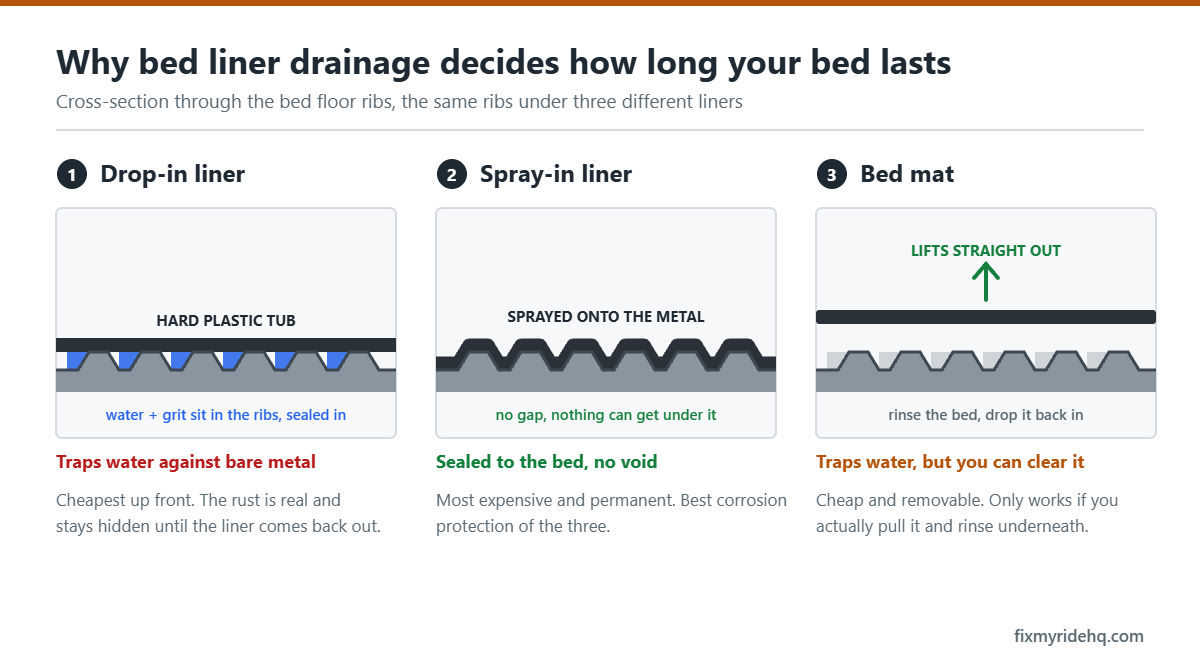
A drop-in plastic liner sits on top of that surface, held by clips or bolts, with a gap underneath. Water gets into that gap — from rain, from washing, from wet cargo — and it does not readily get out. Sand, road grit, and dirt work their way in alongside it and stay there.
Now add movement. The liner flexes slightly every time you load the bed or drive over a bump, and the trapped grit acts as an abrasive between the plastic and the paint. It wears through the paint film. Once bare steel is exposed and sitting in water that cannot evaporate, you have created ideal conditions for corrosion — in a place you cannot see, under a liner you assumed was protecting it.
This is not a rare failure. It is the standard outcome for drop-in liners left in place for years without removal, particularly on steel-bedded trucks in wet or salted environments.
The practical implication is simple. If you run a drop-in, take it out at least once a year, wash the bed and the liner, let both dry fully, and reinstall. If you will not do that, a drop-in is the wrong choice.
Spray-in bed liners
A polyurea or polyurethane coating sprayed directly onto the prepared bed surface, bonding to it permanently. Professional application involves sanding or abrading the factory finish, masking, and spraying to a specified thickness.
What it does well:
- No gap, so nothing gets trapped underneath — this eliminates the drainage failure mode entirely
- Bonded to the bed, so it cannot shift or rattle
- Textured surface provides real grip, which substantially reduces load sliding
- Covers the bed rails and tailgate for a continuous protected surface
- Generally considered a positive at resale
Trade-offs:
- Most expensive option, and it is permanent — you are not undoing this decision
- Quality depends heavily on surface preparation. A cheap application over an unprepared surface can delaminate, and when it lifts, moisture gets underneath and you are back to the same corrosion problem in a form you cannot remove
- UV exposure can fade the finish over years, though this is cosmetic
- The texture that stops loads sliding also makes sliding heavy items in and out harder — relevant if you load appliances or furniture by yourself
Price tier: $$$. If you buy one, buy the preparation quality rather than the brand name.
Drop-in bed liners
A molded high-density polyethylene shell that sits in the bed, secured with clips or fasteners.
What it does well:
- Excellent impact protection — this is the best option for genuinely abusive loads like rock, scrap metal, or heavy tools thrown in
- Removable, so the bed can be returned to stock
- Lower cost than spray-in
- Easy to install yourself
Trade-offs:
- The moisture and grit trapping problem described above, which is the dominant long-term concern
- Slick surface — cargo slides freely, which is the opposite of what you want with furniture or anything that can tip
- Can rattle and squeak over time
- May not fit precisely around bed features, leaving gaps that collect debris
Price tier: $$. A reasonable choice for impact-heavy work, provided you commit to pulling it out and cleaning underneath annually.
Bed mats
A heavy rubber mat covering the bed floor only, usually held in place by its own weight.
What it does well:
- Outstanding grip — heavy rubber is the best anti-slide surface of any option here
- Cushions the bed floor against dropped items
- Lifts out in seconds for cleaning, which makes the drainage problem manageable
- Least expensive real option
- Does not alter the truck permanently
Trade-offs:
- Floor only — bed sides, rails, and tailgate remain unprotected
- Heavy and awkward to remove single-handed on a full-size bed
- Can still trap moisture underneath, though because it lifts out easily this is far more manageable than with a bolted-in drop-in
Price tier: $ to $$. For hauling furniture and appliances, the grip alone makes this worth serious consideration — sometimes alongside a spray-in rather than instead of one.
heavy rubber truck bed mat — Amazon link pending program approval
Bed rugs and carpeted liners
A molded carpet-like liner, typically over a foam or composite backing.
Good for: protecting finished goods — furniture, cabinetry, anything with a surface you do not want marked. Good grip, comfortable to kneel on, quiet.
Trade-offs: absorbs water and takes a long time to dry, which is a real problem in a bed that gets rained in. Not suited to mud, gravel, or anything abrasive. Price tier: $$ to $$$.
Roll-on and DIY coatings
A brush or roll-applied coating sold in kits.
Good for: budget restoration of an already-damaged bed, or an older truck where the calculus is different.
Trade-offs: durability and finish depend almost entirely on your surface preparation, which is the part most people rush. A poorly prepped DIY coating lifts, and lifted coating traps moisture against bare metal. Price tier: $ to $$.
roll-on bed liner kit — Amazon link pending program approval
Side by side
| Option | Impact protection | Anti-slide | Traps moisture? | Price tier |
|---|---|---|---|---|
| Spray-in | Good | Good | No | $$$ |
| Drop-in | Excellent | Poor | Yes — the main concern | $$ |
| Bed mat | Good (floor only) | Excellent | Manageable — lifts out | $–$$ |
| Bed rug | Moderate | Good | Absorbs water | $$–$$$ |
| Roll-on DIY | Varies with prep | Moderate | Only if it lifts | $–$$ |
Matching the liner to what you actually haul
- Furniture, appliances, household goods. Grip is the priority, because a sliding load damages both the cargo and the bed. A spray-in with a bed mat over the floor is the strongest combination. Tie-downs matter as much as the liner.
- Construction material, gravel, scrap. Impact protection dominates. A drop-in earns its place here — just commit to pulling it annually.
- Mixed general use. Spray-in is the best all-round answer if the budget allows, because it solves drainage and grip together.
- Occasional light use. A bed mat is probably all you need, and it leaves the truck stock.
- Wet or salted climates. Avoid anything that traps water against the bed. This is where drop-ins do their worst work.
Things people get wrong
- Assuming any liner is better than none. A neglected drop-in accelerates corrosion rather than preventing it.
- Buying on thickness alone. For spray-in, adhesion and preparation matter more than millimeters. A thick coating that lifts is worse than a thinner one that is properly bonded.
- Ignoring grip. Liner choice is a load securement decision, not just a scratch-prevention one.
- Skipping tie-downs. No liner substitutes for straps. Even the grippiest surface will not hold a washing machine through a hard stop.
- Never looking underneath. If you have a drop-in and have not removed it in years, do it this weekend. What you find determines what you do next.
ratchet tie-down straps — Amazon link pending program approval
Safety note: This guide is general information, not a repair manual for your specific vehicle. Your owner’s manual takes precedence over anything written here — specifications and intervals vary between manufacturers and model years. Unsecured cargo can shift, fall from the vehicle, and cause serious injury. Always secure loads with rated tie-downs regardless of liner type, and observe your truck’s payload rating. If you are not confident, have a qualified mechanic do the work.
Preparation is most of the result
For spray-in and roll-on coatings, adhesion is everything, and adhesion comes from surface preparation rather than from the product.
A proper job involves thoroughly cleaning and degreasing the bed, abrading the factory finish so the coating has something mechanical to grip, masking carefully, and applying within the temperature and humidity range the product specifies. Any drill holes or existing rust need addressing first — coating over rust seals it in and lets it keep working underneath.
This is why quotes for spray-in liners vary so much. A shop that spends two hours prepping and a shop that spends twenty minutes are selling very different products under the same name. Ask what the preparation process is, and ask what the warranty covers if the coating lifts.
Pulling a drop-in for the first time
If your truck has a drop-in liner that has never been removed, this is the highest-value hour of maintenance available to you. Here is what you are looking for:
- Standing water or damp debris. Confirms the liner is trapping moisture. Clean it out and plan on annual removal from now on.
- Shiny or worn paint where the liner has been rubbing. Not yet rust, but it is the stage before rust. Touch-up paint here is cheap insurance.
- Surface rust. Treat it now — wire brush, rust converter, paint. It does not get better on its own under a liner.
- Perforation or bubbling. This has gone past maintenance and into repair. Get it assessed before it spreads through the bed floor.
Wash both the bed and the underside of the liner, let both dry completely — not damp, dry — and reinstall. Put a reminder in your calendar for twelve months out.
What this costs over a truck’s life
Worth framing as a decision rather than a purchase. A spray-in is a one-time cost that lasts the life of the truck and generally supports resale value. A drop-in is cheaper up front and carries an ongoing maintenance obligation that, if ignored, can cost you a bed. A mat is the cheapest and asks almost nothing of you.
For a truck that will be kept for years and worked hard, the spray-in usually wins on total cost. For a truck that will be sold soon, or a lease, a mat makes more sense. Price tiers: mat $ to $$, drop-in $$, spray-in $$$.
Frequently asked questions
Does a spray-in bed liner help or hurt resale value?
Generally it helps, particularly on a work truck, because buyers can see the bed is protected. A poor quality application that is peeling has the opposite effect, since the buyer knows removal is difficult and there may be corrosion underneath.
Can I put a bed mat on top of a spray-in liner?
Yes, and for anyone hauling furniture it is a genuinely good combination. The spray-in protects the whole bed and eliminates the drainage issue; the mat adds grip and impact cushioning on the floor and lifts out for cleaning.
How often should I remove a drop-in liner?
At least annually, and more often in wet or salted conditions. Remove it, wash both the bed and liner, let both dry completely, inspect for paint wear or rust, and reinstall. This single habit is the difference between a drop-in protecting the bed and destroying it.
Will a spray-in liner fade?
Most will lighten with UV exposure over several years. It is cosmetic rather than structural. Some products include UV inhibitors, and a bed cover reduces exposure considerably.
Is a DIY roll-on kit worth it?
On an older truck with an already-damaged bed, it can be a sensible way to stop deterioration cheaply. On a newer truck, a professional spray-in is a better long-term result. The deciding factor is honestly how much time you are willing to put into surface preparation, because that determines whether the coating lasts or lifts.
The bottom line
Ask where water and grit go before you ask about thickness. Spray-in solves the drainage problem permanently and grips reasonably well. A drop-in protects against impact better than anything but requires annual removal to avoid causing the corrosion it was bought to prevent. A bed mat is the cheapest way to solve sliding loads and lifts out in seconds.
If you run dump loads, debris, and mixed cargo, drainage and impact resistance matter more than any thickness figure on the box — and tie-downs matter more than the liner.
Next: tonneau covers compared, or browse all accessory roundups.
If the bed is also getting a rack, bed racks and rooftop tents covers what that weight does to your payload.
Written by Vince T, who runs a delivery and logistics business in Southern California — dump runs, heavy hauling, private delivery. The trucks and SUVs covered here work through the week and get loaded up for the desert on the weekend. More about the site.