Disclosure: some links in this post are affiliate links. If you buy through them, we may earn a commission at no extra cost to you. As an Amazon Associate, we earn from qualifying purchases. We only recommend gear we would put in our own trucks.
Brake pads are a wear item, which means the question is never whether they need replacing but when. Catch it early and you replace pads. Miss it and you replace pads, rotors, and sometimes a caliper — a job that can cost several times as much.
The warning signs your SUV brake pads need replacing are mostly things you can hear, feel, or see without removing a wheel. Here is what each one means and how urgent it is.
This matters more on an SUV than on a sedan. A heavier vehicle carries more kinetic energy into every stop, and brakes convert that energy into heat. Add cargo, passengers, or a trailer and pad life falls accordingly.
In this guide
- How disc brakes wear
- Sign 1: A high-pitched squeal when braking
- Sign 2: Grinding or a metallic scraping sound
- Sign 3: The pedal goes down further than it used to
- Sign 4: Pulsing or vibration through the pedal
- Sign 5: The vehicle pulls to one side when braking
- Sign 6: The brake warning light
- How to check pad thickness yourself
- How long should SUV brake pads last?
- Pads only, or pads and rotors?
- Tools for checking and doing the job
- Frequently asked questions
- The bottom line
Vince’s own photos and field notes for this guide are being added.
How disc brakes wear
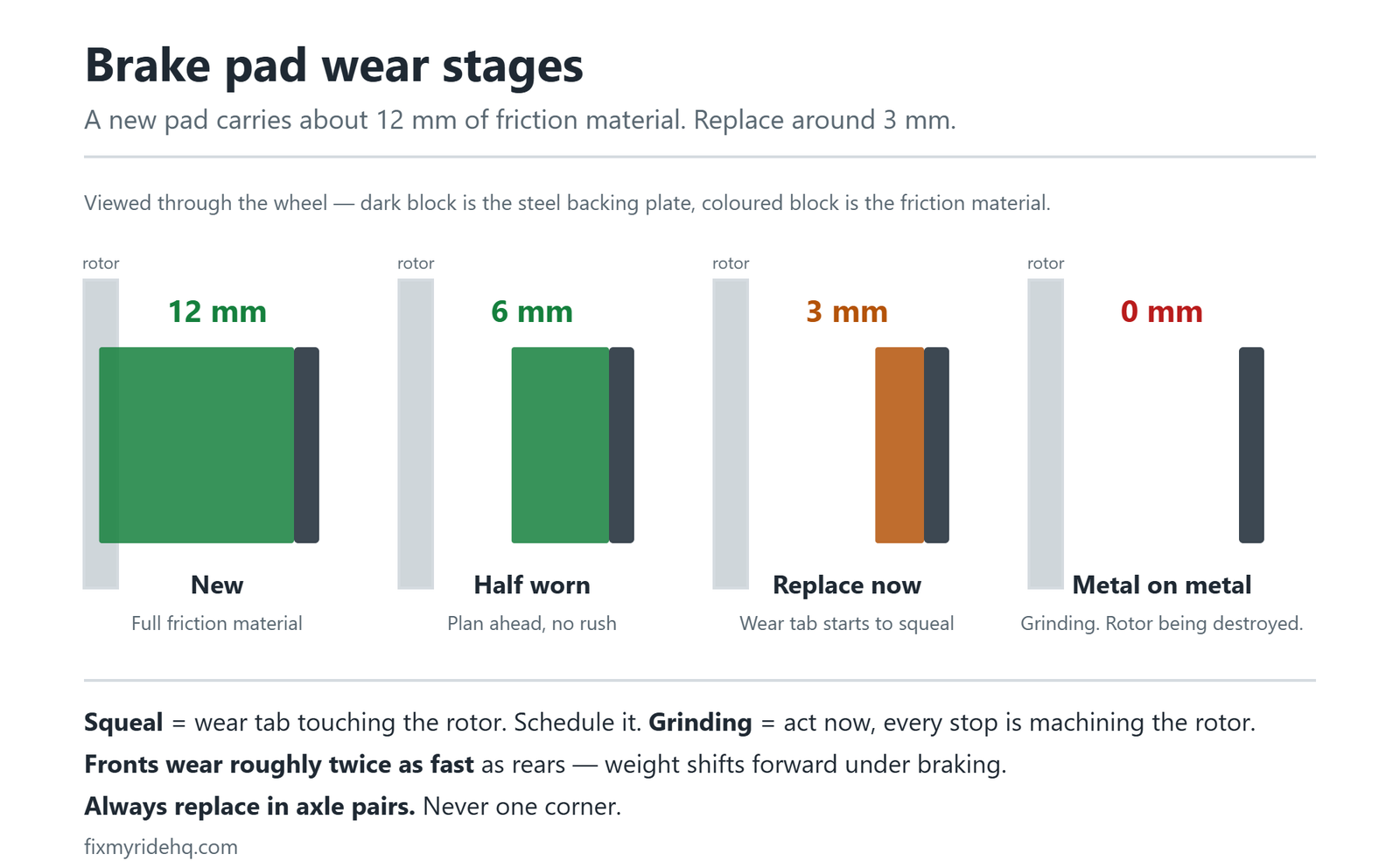
A caliper squeezes two pads against a spinning rotor. Friction converts motion into heat, and the pad material sacrifices itself in the process. That is the whole design — the pad is meant to wear so the expensive rotor does not.
A new pad carries roughly 10 to 12mm of friction material. Replacement is due at about 3mm. Below that, you are approaching the steel backing plate, and steel against a cast iron rotor destroys the rotor in a remarkably short time.
Front brakes do most of the work — typically 60 to 70 percent of stopping force, because weight transfers forward under braking. Expect fronts to wear roughly twice as fast as rears.
Sign 1: A high-pitched squeal when braking
Most pads include a small metal tab called a wear indicator, positioned to contact the rotor when the friction material gets down to around 3mm. The resulting squeal is deliberate. It is an engineered alarm, not a defect.
If you hear a consistent high squeal when you apply the brakes, and it goes away when you release them, you have roughly a few hundred to a couple thousand miles of margin. Schedule the work.
One caveat: a light squeal on the first few stops of a cold, damp morning is usually just surface rust flashing off the rotors, and it disappears after a stop or two. That is normal and not a warning.
Sign 2: Grinding or a metallic scraping sound
This is the one that costs money. Grinding means the friction material is gone and the steel backing plate is now riding directly on the rotor.
Every stop from this point machines grooves into the rotor. Stopping distance increases, and a rotor that could have been resurfaced becomes scrap. Stop driving it beyond what is necessary to get it in for service.
Sign 3: The pedal goes down further than it used to
As pads thin, the caliper pistons extend further to reach the rotor, and pedal travel grows. A gradual change is easy to miss because you adapt to it week by week.
A soft or spongy pedal is different and more serious — that usually points at air in the lines, a fluid leak, or moisture-contaminated brake fluid, not pad thickness. Brake fluid absorbs water over time, which is why manufacturers specify a fluid change every two to three years. A pedal that slowly sinks toward the floor while you hold steady pressure at a light suggests a failing master cylinder, and that is a tow.
Sign 4: Pulsing or vibration through the pedal
A rhythmic pulse that rises and falls with wheel speed generally means rotor thickness variation — commonly called warping, though the usual cause is uneven friction material deposited on the rotor face rather than literal bending.
It often follows a hard stop from speed, or riding the brakes down a long grade, or towing beyond what the brakes were sized for. Pads and rotors usually need to be addressed together at this point.
Sign 5: The vehicle pulls to one side when braking
Pulling under braking suggests one side is doing more work than the other. Likely causes are a seized caliper slide pin, a collapsed brake hose acting as a one-way valve, or pads worn unevenly side to side.
This is a safety issue rather than a convenience one. Uneven braking on a tall, heavy SUV is exactly the wrong characteristic in an emergency stop on a wet road.
Sign 6: The brake warning light
Some vehicles have pad wear sensors that trigger a dashboard warning. On many others, the red brake light means low fluid — and fluid level falls naturally as pads wear, because the caliper pistons extend and hold more fluid in the calipers.
So a brake light with no leak is often a pad wear signal in disguise. Our dashboard warning light glossary covers how to tell the red brake warning apart from the amber ABS light, which means something quite different.
How to check pad thickness yourself
You can usually do this without removing a wheel:
- Park on level ground with the wheels straight, engine off.
- Look through the wheel spokes at the caliper. You are looking for the pad — a block of friction material clamped against the shiny rotor face.
- Estimate the thickness of the material, not including the steel backing plate behind it. A new pad is about the thickness of a stack of four quarters; the replacement threshold is closer to a single quarter, which is roughly 2mm, meaning you want to act before that.
- Check both sides of the vehicle, and check the rears too. Uneven wear between sides is itself a finding.
If the wheel design blocks the view, the next tire rotation is the natural time to inspect properly. That is one of the reasons our rotation guide recommends pairing it with an inspection.
How long should SUV brake pads last?
A realistic range is 25,000 to 60,000 miles, and the spread is enormous because it depends almost entirely on how the vehicle is used.
| Use pattern | Typical front pad life |
|---|---|
| Highway miles, light load | 50,000–60,000+ |
| Mixed suburban driving | 35,000–50,000 |
| Stop-and-go city or delivery routes | 25,000–35,000 |
| Regular towing or heavy hauling | 20,000–30,000 |
| Steep grades, mountain driving | 20,000–30,000 |
Driving style matters as much as mileage. Coasting to a stop instead of braking late, and leaving following distance, extends pad life dramatically at no cost.
Pads only, or pads and rotors?
Pads alone are fine if the rotors are above the minimum thickness stamped on them, free of deep grooves, and not causing a pulse. Many rotors can be resurfaced once.
Replace rotors when they are below minimum thickness, grooved from a grinding set of pads, cracked, or causing a pulsing pedal. On many modern SUVs, rotors have become thin enough and cheap enough that replacing rather than resurfacing is the standard approach.
Always do brakes in axle pairs — both fronts or both rears together. Never one corner. Price tier for pads and rotors on one axle: $$ to $$$ depending on vehicle and parts quality.
brake pad and rotor kit — Amazon link pending program approval
Tools for checking and doing the job
Brake pad thickness gauge
Removes the guesswork from the eyeball estimate, and small enough to keep in the glovebox. Price tier: $.
brake pad thickness gauge — Amazon link pending program approval
Jack stands
Non-negotiable for any brake work. The jack lifts; the stands hold. Price tier: $$.
jack stands — Amazon link pending program approval
Caliper piston compression tool
New pads are thicker, so the caliper piston has to be pushed back into its bore. Rear calipers on many SUVs have an integrated parking brake and require a tool that turns while it presses. Price tier: $ to $$.
brake caliper tool set — Amazon link pending program approval
Safety note: This guide is general information, not a repair manual for your specific vehicle. Your owner’s manual takes precedence over anything written here — specifications and intervals vary between manufacturers and model years. Brakes are a primary safety system. Work involving lifting, brake fluid, and hot components carries real risk. If you are not fully confident, this is a good job to hand to a shop — and never drive a vehicle you suspect has a hydraulic brake fault. If you are not confident, have a qualified mechanic do the work.
Frequently asked questions
Can I drive with squeaking brakes?
For a short period, yes. A wear indicator squeal means you are near the replacement point, not past it. Grinding is different — that means metal on metal, and every additional stop is damaging the rotor.
Why do my rear pads look fine but the fronts are worn out?
That is normal. Fronts handle the majority of braking force because weight shifts forward when you slow down. Fronts commonly wear about twice as fast as rears.
Do I need to bed in new brake pads?
Yes, and most people skip it. Bedding transfers an even layer of friction material onto the rotor. The usual procedure is a series of moderate stops from moderate speed with cooling intervals between, following the pad manufacturer’s instructions. Skipping it is a leading cause of the pulsing pedal people later call warped rotors.
Are ceramic pads worth it on an SUV?
Ceramic pads generally run quieter and produce less visible dust, and they hold up well for everyday driving. For heavy towing, a semi-metallic pad often handles sustained heat better. Match the pad to the work the vehicle actually does rather than to the premium label.
How much brake fluid should I lose as pads wear?
The level drops gradually and that is expected, because extended caliper pistons hold more fluid. What is not expected is a rapid drop or a level below the minimum mark — that means a leak, and a leak in a hydraulic brake system is an immediate safety issue.
The bottom line
A squeal means schedule it. A grind means stop driving it. A pulse means rotors are involved. Measure to about 3mm as your replacement point, always do brakes in axle pairs, and expect a working SUV to go through fronts considerably faster than the brochure suggests.
Next: the full maintenance schedule by mileage, or all maintenance guides.
Written by Vince T, who runs a delivery and logistics business in Southern California — dump runs, heavy hauling, private delivery. The trucks and SUVs covered here work through the week and get loaded up for the desert on the weekend. More about the site.