Disclosure: some links in this post are affiliate links. If you buy through them, we may earn a commission at no extra cost to you. As an Amazon Associate, we earn from qualifying purchases. We only recommend gear we would put in our own trucks.
You should rotate truck tires every 5,000 to 8,000 miles, and the easiest way to never forget is to do it at every oil change. That is the short answer. The longer answer is that trucks wear tires unevenly in ways cars do not, which makes the rotation pattern matter as much as the interval.
A set of truck tires represents real money. Rotation is the cheapest thing you can do to make them last, and skipping it can cost you a third of their service life.
In this guide
- Why trucks wear tires unevenly
- The right interval
- Rotation patterns
- Include the spare, if you can
- What to check while the wheels are off
- Torque matters more than you think
- Signs you have skipped too many rotations
- Rotation records and your warranty
- Doing it yourself or paying for it
- Frequently asked questions
- The bottom line
Vince’s own photos and field notes for this guide are being added.
Why trucks wear tires unevenly
Three forces work against even wear on a pickup or body-on-frame SUV:
- Weight distribution. An unloaded pickup carries most of its weight over the front axle. Load the bed and it shifts hard to the rear. Neither state is balanced, and most trucks spend time in both.
- Steering. Front tires scrub through every turn, wearing shoulders that rear tires never touch.
- Drive configuration. On rear-wheel drive, the rear tires deliver power and wear the center tread. On four-wheel drive, wear patterns change again depending on how often the front axle is engaged.
Rotation moves each tire through these different jobs so the set wears down together rather than one axle at a time.
The right interval
Every 5,000 to 8,000 miles covers nearly every truck and SUV. Take the short end if you tow, haul, run four-wheel drive regularly, or drive a lot of stop-and-go.
The practical approach is to pair it with the oil change. Same interval, same visit, same lift — which is why our maintenance schedule lists them together.
Rotation patterns
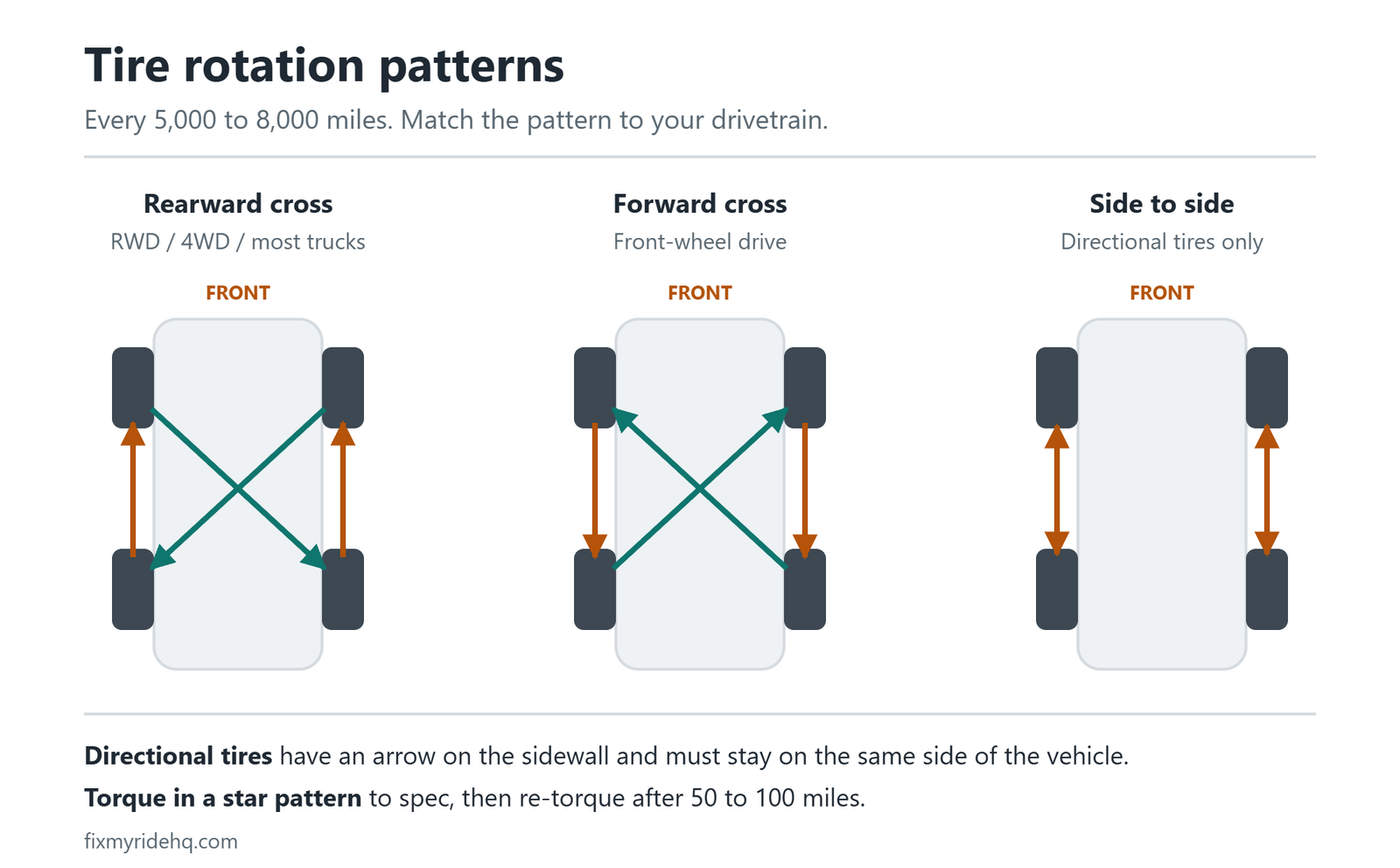
Rearward cross — the truck pattern
For rear-wheel drive, four-wheel drive, and most all-wheel drive trucks and SUVs with non-directional tires of the same size:
- Both rear tires move straight forward to the same side.
- Both front tires cross to the opposite side of the rear axle.
This is the pattern the Tire Industry Association specifies for rear-drive and four-wheel-drive vehicles, and it is the one most truck owners want.
Forward cross — front-wheel drive
For front-wheel drive crossovers: fronts move straight back, rears cross to the opposite side of the front axle. The mirror image of the truck pattern.
Side to side — directional tires
Directional tires have an arrow on the sidewall and are designed to rotate one way only. They must stay on the same side of the vehicle, so front and rear simply swap on each side. Mounting one backwards ruins its wet weather performance — the tread can no longer evacuate water properly.
Staggered or different-size tires
If your front and rear tires are different sizes, they cannot cross axles. Swap side to side only, and only if the tires are non-directional. Some staggered setups cannot be rotated at all.
Include the spare, if you can
If your spare is a full-size matching tire on a matching wheel, rotate it into the pattern as a fifth tire. All five wear together and you replace five at a time instead of discovering a decade-old spare when you need it most.
If your spare is a temporary or compact unit, leave it alone — but check its pressure a few times a year. Temporary spares usually require 60 PSI, far above your regular tires, and a flat spare is a very frustrating discovery on the shoulder.
What to check while the wheels are off
The tires are already off the ground, so use the opportunity:
- Tread depth across each tire. Wear on both shoulders but not the center points at underinflation. Center wear only points at overinflation. Wear on one shoulder points at alignment.
- Cupping or scalloping — a scooped, uneven pattern that usually means worn shocks or struts.
- Brake pad thickness through the caliper. New pads are around 12mm; replace near 3mm. See the brake pad warning signs.
- Sidewall condition — bulges, cuts, or cracking mean replacement, not rotation.
- DOT date codes, covered in how to read your tire sidewall.
Torque matters more than you think
Lug nuts need to go back on at the manufacturer’s torque spec, in a star pattern, in two or three passes. Impact-gunning them tight is how wheel studs stretch and brake rotors warp.
Then re-torque after roughly 50 to 100 miles. Wheels seat slightly after the first drive, and this one-minute check is the difference between a secure wheel and a genuinely dangerous one.
torque wrench — Amazon link pending program approval
Safety note: This guide is general information, not a repair manual for your specific vehicle. Your owner’s manual takes precedence over anything written here — specifications and intervals vary between manufacturers and model years. Never work under a vehicle supported only by a jack. Use jack stands on the manufacturer’s lift points, and chock the wheels remaining on the ground. If you are not confident, have a qualified mechanic do the work.
Signs you have skipped too many rotations
Uneven wear announces itself if you know the pattern to look for. Run your hand across the tread — front to back, then side to side — and compare the four tires.
- Front tires visibly shallower than rears on a rear-wheel-drive truck. Classic skipped-rotation signature.
- Feathering — tread blocks sharp on one edge and rounded on the other, so the tire feels smooth one direction and rough the other. Usually alignment, made worse by leaving tires in one position.
- Cupping or scalloping — scooped dips at intervals around the tire, often with a rhythmic hum that changes with speed. Worn shocks are the usual cause, and rotation will not fix it.
- One shoulder worn, the other fine. Camber or toe issue. Get an alignment before the new set goes on, or you will do this again.
If you find any of these, the rotation is not the fix — it is the diagnosis. Address the underlying cause first, because a fresh set of tires will wear the identical pattern otherwise.
Rotation records and your warranty
Treadwear warranties look generous until you read the conditions. Nearly all of them require documented rotations at specified intervals, and without records the manufacturer will decline the claim.
Documentation means a receipt or service record with the date and mileage on it. If you do the rotations yourself, keep a simple log — a note in your phone with date and odometer is enough, and it is the difference between a prorated credit and nothing at all on a set that wore early.
Doing it yourself or paying for it
A shop rotation is inexpensive, and many tire retailers include free rotations for the life of tires purchased from them. If you bought your tires that way, use it — it is already paid for, and it creates the paper trail your warranty needs.
Doing it yourself takes about 45 minutes and needs a jack, jack stands, and a torque wrench. The advantage is not really cost; it is that you get a close look at your brakes, suspension, and the inside faces of the tires, which is where problems hide. That inspection is worth more than the labor you saved.
Price tier for a shop rotation: $. For the tools to do it yourself indefinitely: $$.
Frequently asked questions
What happens if I never rotate my tires?
The loaded axle wears out first, often at roughly half the life of the other pair. You end up buying two tires at a time on a staggered schedule forever, which costs more and leaves you with mismatched grip front to rear — a real handling concern in the wet.
Can I rotate tires myself?
Yes, with a jack, jack stands, and a torque wrench. Budget about 45 minutes. The one thing not to improvise is the torque spec.
Does rotation fix uneven wear that already happened?
No. Rotation prevents uneven wear; it does not reverse it. If one tire is already badly worn, moving it elsewhere just relocates the problem. Find the cause — alignment, pressure, or worn suspension — before it eats the next set.
Should I rotate at 5,000 or 8,000 miles?
If the truck works, tows, or sees stop-and-go traffic, use 5,000. If it is a light-duty commuter on highway miles, 8,000 is fine. When unsure, match it to your oil change and stop thinking about it.
The bottom line
Every 5,000 to 8,000 miles, rearward cross for most trucks, same side only for directional tires, torque to spec and re-torque after the first drive. Do it with the oil change and it becomes automatic.
Next: the all-terrain tire roundup, or all maintenance guides.
Written by Vince T, who runs a delivery and logistics business in Southern California — dump runs, heavy hauling, private delivery. The trucks and SUVs covered here work through the week and get loaded up for the desert on the weekend. More about the site.