Disclosure: some links in this post are affiliate links. If you buy through them, we may earn a commission at no extra cost to you. As an Amazon Associate, we earn from qualifying purchases. We only recommend gear we would put on our own trucks.
Bed racks and rooftop tents are sold on one number: the rack’s load rating. It is almost always the wrong number to be looking at, and the arithmetic that actually governs whether your setup is sane takes about four minutes and nobody does it.
Here is the math, with manufacturer-published figures rather than estimates, plus the two legal limits that apply in California and the one roof-strength claim that gets repeated everywhere and means the opposite of what people think.
In this guide
- Dynamic and static are two different numbers
- The roof math, with real figures
- Why a bed rack changes the problem
- What a bed rack runs into instead
- The roof crush myth
- Living with it: height, mileage, noise
- The California details
- Doing it on three budgets
- Frequently asked questions
- The bottom line
Vince’s own build photos for this guide are being added.
Dynamic and static are two different numbers
This distinction is real and the manufacturers define it themselves. Thule’s rooftop tent guidelines put it simply: dynamic is “the weight capacity permitted while driving,” static is the “weight capacity of tent in use with people inside the tent when the vehicle is parked.” Thule also gives the relationship as a rule of thumb: static is roughly three times dynamic.
Some published pairs, so you can see the gap:
| Product | Dynamic (driving) | Static (parked) |
|---|---|---|
| Yakima crossbars, default guidance | 165 lb | up to 600 lb |
| Rivian R1 crossbars | 250 lb | 890 lb |
| Leitner ACS Forged bed rack | 800 lb on-road, 400 lb off-road | 1,400 lb |
Two things to take from that table. The driving number is the small one, and it is the one that has to clear a tent plus the rack plus whatever else is up there while the truck is moving. And none of these ratings is tested to a common standard. We looked for an SAE, ASTM or federal test procedure behind “dynamic” and “static” rack ratings and found none. They are self-declared, and at least one manufacturer admits the softness: RCI publishes up to 1,500 pounds static on a bed rack and then recommends “approximately 750lbs as a benchmark” in practice.
Thule states the governing principle, and it is the sentence this whole article hangs on: “The component with the lowest weight capacity determines the rack system’s maximum weight capacity.”
The roof math, with real figures
If the tent is going on the roof, your vehicle’s own roof rating is almost certainly the lowest component in the chain, and it is a smaller number than people expect.
Honda’s factory accessory instructions for the Ridgeline roof rails give a maximum of 165 pounds. Ford publishes the same 165-pound figure in owner literature for a roof rack application. That is not a rack limit. That is the roof.
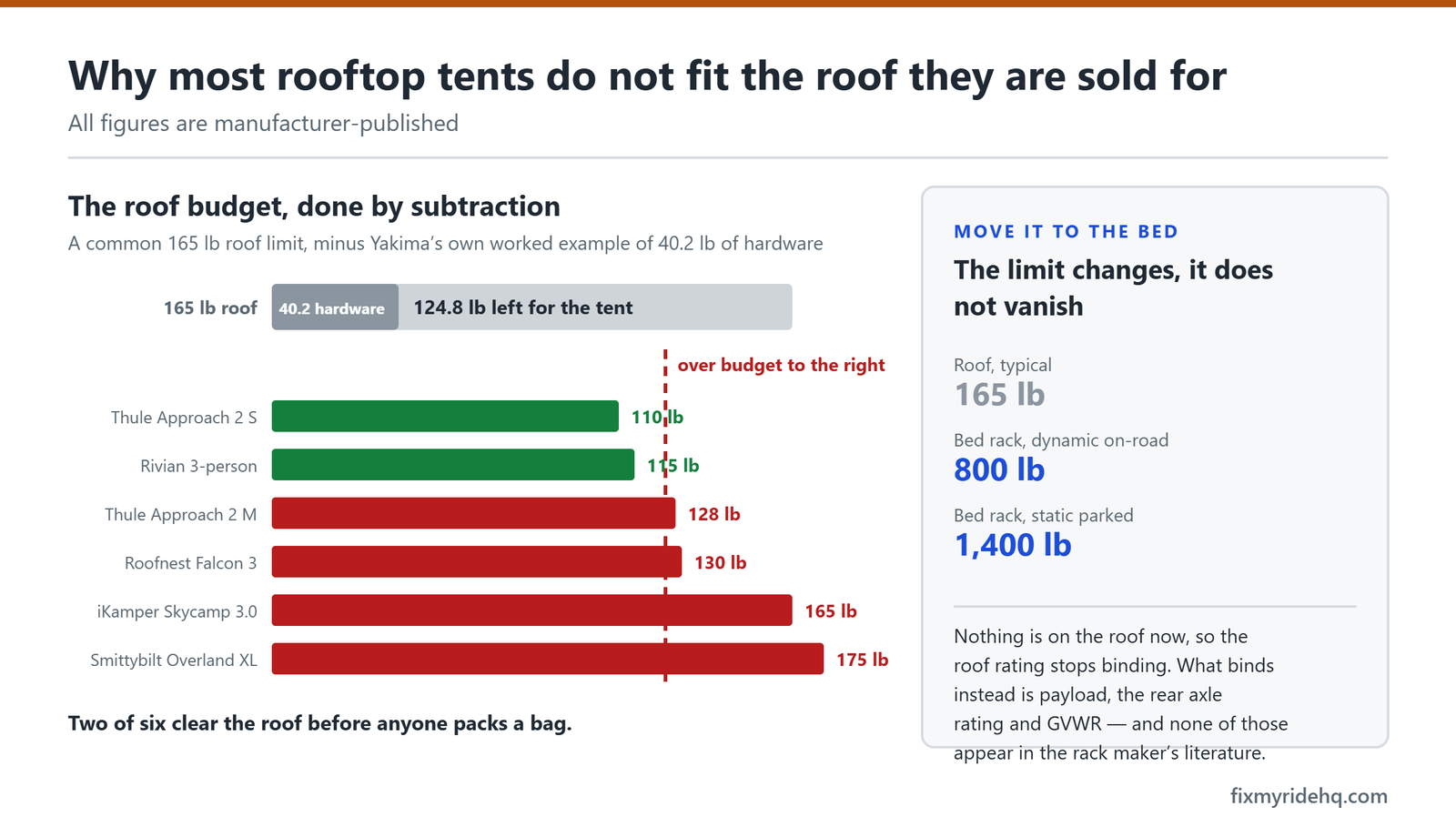
Yakima tells you how to work with it, and the method is subtraction rather than addition. Take the vehicle’s limit, subtract every pound of rack hardware, and what remains is your cargo allowance. Their own worked example: 165 pounds minus 40.2 pounds of towers, bars and accessories leaves 124.8 pounds.
Now put a tent in that 124.8 pounds
Manufacturer-published tent weights:
| Tent | Type | Weight |
|---|---|---|
| Thule Approach 2 S | Softshell | 110 lb |
| Rivian three-person tent | Softshell | 115 lb |
| Thule Approach 2 M | Softshell | 128 lb |
| Roofnest Falcon 3 EVO Air | Hardshell | 130 lb |
| iKamper Skycamp 3.0 | Hardshell | 165 lb |
| Smittybilt Overland XL | Hardshell | 175 lb |
Softshells run roughly 110 to 130 pounds, hardshells 130 to 175. Set a 128-pound tent on that 124.8 pounds of remaining allowance and you are over before anyone packs a duffel. A 165-pound hardshell is over by a third with nothing in it.
iKamper says the quiet part out loud on its own spec sheet: “Minimum Roof Rack Dynamic Load Requirement: 165 lbs (75 kg) or more.” That is a tent maker telling you to go check the dynamic number before you buy, because plenty of vehicles do not clear it.
This is where the fallacy lives. A platform rack rated at 330 pounds bolted to a 165-pound roof does not give you 330 pounds. Thule prints the reminder right on the product page: “Please also check the maximum roof load capacity of your vehicle.” A stronger rack does not strengthen the roof.
Why a bed rack changes the problem
A bed rack bolts to the bed rails or through to the frame. Nothing is mounted to the roof, so the roof rating stops being the binding limit. That is reasoning from where the load goes rather than a rule anybody publishes — we could find no OEM or regulator who states it in print — but the geometry is not really in dispute, and it is why the published bed rack numbers are so much larger than roof numbers.
Leitner publishes 800 pounds dynamic on-road and 1,400 pounds static for its bed rack. RCI publishes up to 1,500 pounds static. Against a 165-pound roof, that is a different universe, and for a pickup it is the obvious answer: the tent goes over the bed, not over the cab.
It also sits lower, which helps everything from center of gravity to garage clearance, and it leaves the roof free.
What a bed rack runs into instead
Solving the roof problem does not make the weight disappear. It moves the constraint to payload, rear axle rating and GVWR, and on a mid-size truck the rear axle is usually what binds first, because a bed rack load sits largely behind the rear axle line.
Federal definitions are unambiguous that accessories count. Unloaded vehicle weight is defined as the vehicle with fluids “but without cargo, occupants, or accessories that are ordinarily removed from the vehicle when they are not in use.” A permanently mounted bed rack is not ordinarily removed. It is simply weight, inside a GVWR that does not move. And GVWR must be at least unloaded weight plus rated cargo plus 150 pounds per seating position — so occupants and gear share one budget.
NHTSA has put this in the sharpest possible terms. The yellow placard on your door jamb reads “the combined weight of occupants and cargo should never exceed” a stated figure. NHTSA’s position is that when a dealer installs equipment that drops available capacity below that figure, “the dealer must replace the vehicle placard because the information required… will no longer be accurate.” Federal regulators treat bolted-on accessory weight as directly eating the number on that sticker.
Run it for a real setup. A hardshell tent at 165 pounds, a bed rack, two adults sleeping in it, plus water, fuel, recovery gear, a fridge and a week of food. On a mid-size truck with somewhere around 1,100 to 1,400 pounds of payload, you are not comfortably inside it, and the rack’s 800-pound rating never told you so.
That is not a hypothetical criticism. We read the most thorough bed-rack load-rating explainer any manufacturer publishes, and it does not mention payload, GVWR or axle ratings once. Neither does the product page. Buyers are handed an 800-pound number with no mention of the payload sticker it has to live inside.
The roof crush myth
Somebody in every campfire conversation says their roof is rated for three times the weight of the truck, so a tent is nothing.
That number is real and it means something else entirely. Federal standard FMVSS 216a is a rollover crush test: it applies force through a rigid plate to the roof structure of a vehicle at or under 6,000 pounds GVWR at up to three times the unloaded vehicle weight, to see how much the roof deforms in a rollover. It is a crashworthiness test of the structure. It is not a static load rating at four mounting feet, it says nothing about what your rails or crossbar towers can carry, and it is not permission to put anything on the roof.
The numbers that govern your tent are the ones in your owner’s manual and on the rack, not that one.
Living with it: height, mileage, noise
Fuel economy. The only hard numbers available are from the Department of Energy, and they are for rooftop cargo boxes rather than tents: roughly 2 to 8 percent in city driving, 6 to 17 percent on the highway, and 10 to 25 percent at 65 to 75 mph. Rear-mounted cargo loses far less, 1 to 5 percent.
Read that range carefully, because the penalty tracks the host vehicle. In the underlying testing a sedan lost 25 percent at 65 mph while an SUV lost 10 percent. A truck is closer to the SUV case, so do not quote yourself 25 percent. And again, that is a cargo box, not a tent.
Handling. Rivian is the one manufacturer we found that warns about it in print, and the warning is plain: “Vehicle handling, cornering, braking, and sensitivity to side winds change with rooftop loads.” Also, and this should not need saying but apparently does, “Never operate your vehicle with the Three-Person Tent open.”
Distribute it. Every rating above is a total, not a per-foot figure. Thule’s guidance is to distribute the load evenly and keep the center of gravity low; Ford’s is to never place loads directly on the roof surface. Concentrating a hardshell’s mounting feet over a short span is its own problem.
Height. Measure the finished truck and write the number on something. We are not going to quote a garage clearance figure because there is no authoritative one, but a bed rack with a hardshell will change which drive-throughs and parking structures you can use, and you will find out the hard way otherwise.
The California details
- Fourteen feet, vehicle and load. Vehicle Code section 35250 caps total height at 14 feet measured from the surface the vehicle stands on, and it covers the load, not just the truck. Nothing on a pickup gets close, but the section also says anything over 13 feet 6 inches travels only on routes the owner has determined to be safe.
- Long loads need marking. Section 24604: a load extending four feet or more past the rear needs, in darkness, two red lights visible from 500 feet, and in daylight a red or fluorescent orange flag at least 18 inches square. Relevant the moment you strap lumber or a kayak to the rack. Rear overhang itself is limited to two-thirds of the wheelbase past the rearmost support.
- Secure everything. Section 23114 requires a vehicle to be constructed, covered or loaded so nothing can drop, sift, leak, blow or spill out. An open rack full of gear is exactly the case it is written for.
- Keep the plate and the lights clear. The rear plate has to be clearly visible and legible, mounted between 12 and 60 inches off the ground, with nothing obstructing electronic reading. A swing-out tire carrier or a loaded rack that covers it is a straightforward citation.
On the third brake light: FMVSS 108 requires that an obstructed lamp be replaced by an additional lamp of the same type that does meet the visibility requirements, but like the other federal equipment rules it binds manufacturers, dealers and repair businesses rather than owners. NHTSA has said the prohibition “does not extend to vehicle owners.” California requires stoplamps to be plainly visible from 300 feet, though that section speaks to the two main stoplamps rather than the center high-mounted one specifically. We could not find clear authority on a rack blocking only the center lamp, so we are not going to tell you it is or is not a violation — but a brake light nobody behind you can see is worth fixing regardless of which section covers it.
Doing it on three budgets
| Tier | What it gets you | The trade-off |
|---|---|---|
| $ | Ground tent, a bed-rail cargo net, and the money stays in your pocket. Sleep in the bed if the weather is good. | Worth saying out loud: a ground tent costs a fraction, weighs nothing, and does not change your fuel economy, your handling or your payload. The rooftop tent buys you setup speed and getting off the dirt. |
| $$ | Bed rack plus a softshell tent in the 110 to 130 pound range. Weigh the truck loaded at a public scale before the first long trip. | The practical sweet spot for a pickup. Load path goes to the frame instead of the roof, the tent is light enough to stay well inside payload with two people and gear, and the rack earns its keep hauling other things. |
| $$$ | Bed rack, hardshell tent, awning, and the suspension to carry it. | You are now 300 pounds up before food and water, and the springs are not optional. Do the payload arithmetic with real numbers from a scale, not from the brochure. |
Our honest take: on a pickup, put it over the bed. The roof rating on most trucks and SUVs cannot carry a modern tent plus the hardware with any margin, and a bed rack solves that for less money than a roof platform that still would not be legal to load. If the vehicle is an SUV with no bed, then the roof number is your hard ceiling and a softshell is probably your only honest option.
Frequently asked questions
Does the weight of people sleeping up there count against my payload?
Honestly, nobody says. The static rating is explicitly the people-in-the-tent-while-parked case, and both Thule and Rivian structure their numbers that way. But we could find no OEM statement and no federal interpretation addressing whether occupant weight in a parked rooftop tent counts against GVWR or axle ratings. The regulatory definitions contain no parked exception, and no authority resolves it. Anyone who tells you confidently either way is guessing.
My rack is rated for 800 pounds. Why is 400 a problem?
Because the rack is not the limit, the truck is. The rating tells you the rack will not fail. It tells you nothing about your payload, your rear axle rating or your tire load. Those are set by the manufacturer and printed on the door jamb, and no accessory raises them.
Can I put a rooftop tent on a stock SUV roof?
Check the manual first, and expect a number around 165 pounds on many vehicles. Subtract your crossbars and feet, and compare what is left against the tent’s actual published weight. Some vehicles do clear it: Subaru publicly rates the Outback Wilderness rack at 700 pounds static and markets it for exactly this. Most do not, and the honest answer for a lot of SUVs is a softshell or nothing.
Will it kill my fuel economy?
It will cost you something, and more at freeway speed than around town. The DOE figures above are the only measured data we found and they are for cargo boxes, so treat them as a bracket rather than a prediction. If the truck runs the freeway five days a week, consider whether the tent needs to live up there between trips.
The bottom line
Four numbers decide this, and only one of them is on the rack: your vehicle’s roof rating if it is going up top, the rack’s dynamic rating, the tent’s actual weight, and your payload. Work the subtraction before you buy, then take the loaded truck across a public scale once and find out what you actually weigh.
If you are shopping crossbars for an SUV rather than a bed rack, our roof rack comparison covers the dynamic and static trade-off in more detail. If the truck is getting taller at the same time, read the lift kit guide first. The rest of our exterior work lives in Exterior Mods.
— Vince T