Disclosure: some links in this post are affiliate links. If you buy through them, we may earn a commission at no extra cost to you. As an Amazon Associate, we earn from qualifying purchases. We only recommend gear we would put in our own trucks.
Window tint on a work truck is not really a looks decision, even though that is how it gets sold. In Southern California it is a heat decision. A cab that sits in a job site parking lot all afternoon is meaningfully cooler with good film on it, the dash and seats take less UV damage, and the air conditioning stops fighting a losing battle every time you get back in.
It is also the one exterior mod with a hard legal line in front of it, and California’s rule is stricter and more specific than most people think.
Here is what is actually legal here, what the different films do, and where DIY makes sense versus paying somebody.
In this guide
- California’s tint law, specifically
- What the film is actually doing
- Film types
- DIY or pay somebody
- If you are doing it yourself
- Doing it on three budgets
- Frequently asked questions
- The bottom line
Vince’s own build photos for this guide are being added.
California’s tint law, specifically
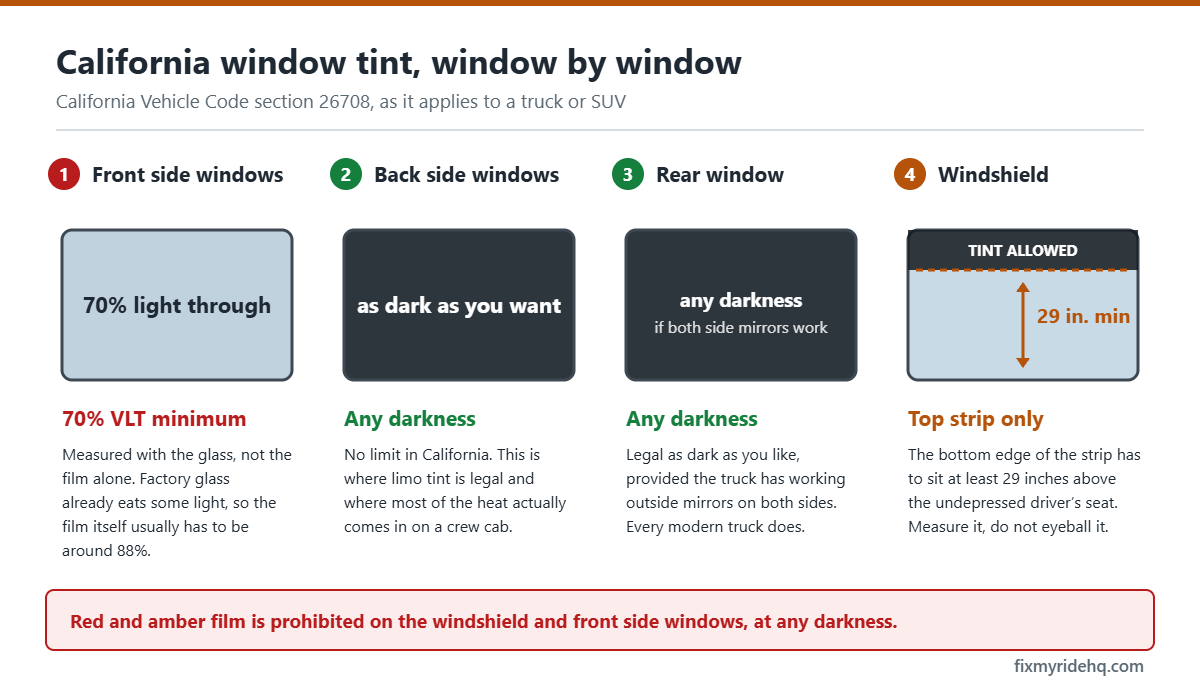
California Vehicle Code section 26708 governs this. The limits, as they stand:
| Window | Limit |
|---|---|
| Front side windows | 70% VLT minimum combined with the glass |
| Back side windows | Any darkness |
| Rear window | Any darkness, provided the vehicle has dual outside mirrors |
| Windshield | A strip across the top only — its bottom edge must sit at least 29 inches above the undepressed driver’s seat |
| Colors | Red and amber prohibited on the windshield strip |
| Reflectivity | The windshield strip may not reflect more glare than uncoated glass |
Two details that catch people out.
First, the 70% is combined, not the film. Factory glass already blocks roughly 30 percent of light on its own. To land at 70 percent combined, the film itself generally needs to be rated around 88% VLT. Somebody selling you a “70 percent legal film” for the fronts is selling you something that will not be legal once it is on the glass.
Second, California does not use the AS-1 line the way most states do. The rule here is a measurement — 29 inches above the seat — not the little AS-1 mark etched on the glass. Guides written for other states get this wrong constantly.
Laws change and enforcement varies. Confirm the current text of CVC 26708 before you buy film, and be aware that a fix-it ticket for illegal tint means paying to have it removed on top of the fine.
What the film is actually doing
VLT — visible light transmission — is the only number most shops talk about, and it is the number the law cares about. It is not the number that determines how cool your cab stays.
Total solar energy rejected is the heat number. A dark film with poor infrared rejection can be less effective at keeping a cab cool than a nearly clear film built for it. This is the entire reason high-end ceramic films exist — they reject heat at legal light levels.
For a truck in this climate, that distinction is the whole point. You can legally put a very effective heat-rejecting film on your front windows precisely because the good films do their work in the infrared range rather than by being dark.
Film types
| Type | Heat rejection | Notes | Cost tier |
|---|---|---|---|
| Dyed | Poor | Cheapest. Fades purple and bubbles, especially in this sun. | $ |
| Metalized | Good | Durable, but can interfere with radio, GPS, and tire pressure sensors. | $$ |
| Carbon | Good | No signal interference, does not fade purple. Solid middle ground. | $$ |
| Ceramic | Excellent | Best heat rejection at any given darkness. No signal interference. | $$$ |
In a hot climate, dyed film is a false economy. It is the one you will be scraping off in three years.
ceramic window tint film roll — Amazon link pending program approval
window tint application kit — Amazon link pending program approval
DIY or pay somebody
Honest answer: this is one of the few jobs on this site where we lean toward paying a shop, and it comes down to the back glass.
Flat side windows are genuinely DIY-able with patience, a clean space, and a spray bottle. The rear window is curved in two directions and has to be heat-shrunk to conform. Shrinking film properly is a real skill, and a botched rear window means peeling it all off and buying film twice.
The other factor is dust. Any particle trapped under film is a permanent speck. A driveway in Southern California is a dusty place, and shops tint indoors for a reason.
A reasonable middle path: do the front doors yourself to learn, and pay for the rear glass.
If you are doing it yourself
- Clean the glass obsessively, then clean it again. Most DIY failures are contamination, not technique.
- Work out of the sun and out of the wind. Film dries too fast in direct heat and picks up every airborne particle outdoors.
- Cut oversized and trim to fit on the glass rather than trying to cut exact from the start.
- Use plenty of slip solution. Too little and the film grabs before it is positioned.
- Squeegee from the center outward in overlapping passes, working water toward the edges.
- Lower the window slightly first to tuck the film into the top edge, then raise it to finish.
- Expect haze for several days while moisture evaporates. Do not roll the windows down for two to three days, longer in cool weather.
Safety note: This is general information, not legal advice, and tint law changes. Verify the current requirements for your state before applying film. Never tint the windshield below the legal strip or apply film that obstructs your view, and remember that very dark rear glass makes mirrors essential — California requires dual outside mirrors when the rear window is tinted.
Doing it on three budgets
| Tier | What you get | Trade-off |
|---|---|---|
| $ — Entry | DIY carbon film on the front doors only, legal VLT. Basic application kit. | No rear glass, limited overall heat benefit. Good way to learn the technique. |
| $$ — The sweet spot | Carbon or entry ceramic on all windows, shop-installed, legal on the fronts. | Real money, but done once and done right with a warranty. |
| $$$ — Premium | Full ceramic throughout plus a windshield strip, professionally installed. | Highest cost by a wide margin. The heat difference over mid-tier ceramic is real but not proportional to the price. |
Our honest take: spend on film quality rather than on darkness. A legal, high-infrared-rejection ceramic on the fronts does more for a truck that lives in the sun than limo tint on the back ever will — and it does not get you pulled over.
Frequently asked questions
Can I get a medical exemption in California?
California does provide for exemptions on documented medical grounds. The requirements and paperwork change, so check the current DMV and CVC guidance rather than relying on what a tint shop tells you.
Will tint interfere with my TPMS or GPS?
Metalized film can. Carbon and ceramic films do not, which is part of why they have largely replaced metalized film. If you run a dash cam, a GPS tracker, or aftermarket antennas, avoid metalized.
How long before I can roll my windows down?
Two to three days is the usual guidance, longer in cool or humid weather. The haze and small water pockets you see during that time are normal and clear as the moisture evaporates.
Does tint actually keep the truck cooler?
Good film does, noticeably. But the number that matters is total solar energy rejected, not how dark it looks. A quality ceramic at a legal light level will outperform cheap dark film on heat.
What happens if I get pulled over with illegal tint?
Typically a correctable violation — you remove the film, get it signed off, and pay a fee. The real cost is paying to install film twice. Get the fronts legal the first time.
The bottom line
Fronts need to land at 70 percent combined, which means roughly 88 percent film. The windshield strip is measured 29 inches off the seat, not from the AS-1 line. Buy for heat rejection rather than darkness, skip dyed film entirely in this climate, and let a shop do the rear glass.
Next: chrome delete, or browse all builds and mods.
Written by Vince T, who runs a delivery and logistics business in Southern California — dump runs, heavy hauling, private delivery. The trucks and SUVs covered here work through the week and get loaded up for the desert on the weekend. More about the site.