Disclosure: some links in this post are affiliate links. If you buy through them, we may earn a commission at no extra cost to you. As an Amazon Associate, we earn from qualifying purchases. We only recommend gear we would put in our own trucks.
Roof racks are the accessory most often bought on the wrong number. The rack has a load rating, the crossbars have a load rating, and your vehicle’s roof has a load rating — and the one that governs is whichever is lowest. It is usually the roof, and it is usually much lower than people assume.
Get that right and a roof rack transforms an SUV’s usable capacity. Get it wrong and you are overloading a structure that was never designed for it, with all the weight in the worst possible place for handling.
Here is how the ratings work, what the rack types actually suit, and the costs nobody mentions until after you have fitted one.
In this guide
- Dynamic versus static load: the two numbers
- Find your roof limit before you shop
- Mounting systems
- Carrier types
- What a roof rack actually costs you
- Loading it properly
- Roof rack or hitch carrier?
- Fitting, torque, and the first drive
- Bikes, kayaks, and ladders
- Removing it when you are not using it
- Frequently asked questions
- The bottom line
Vince’s own photos and field notes for this guide are being added.
Dynamic versus static load: the two numbers
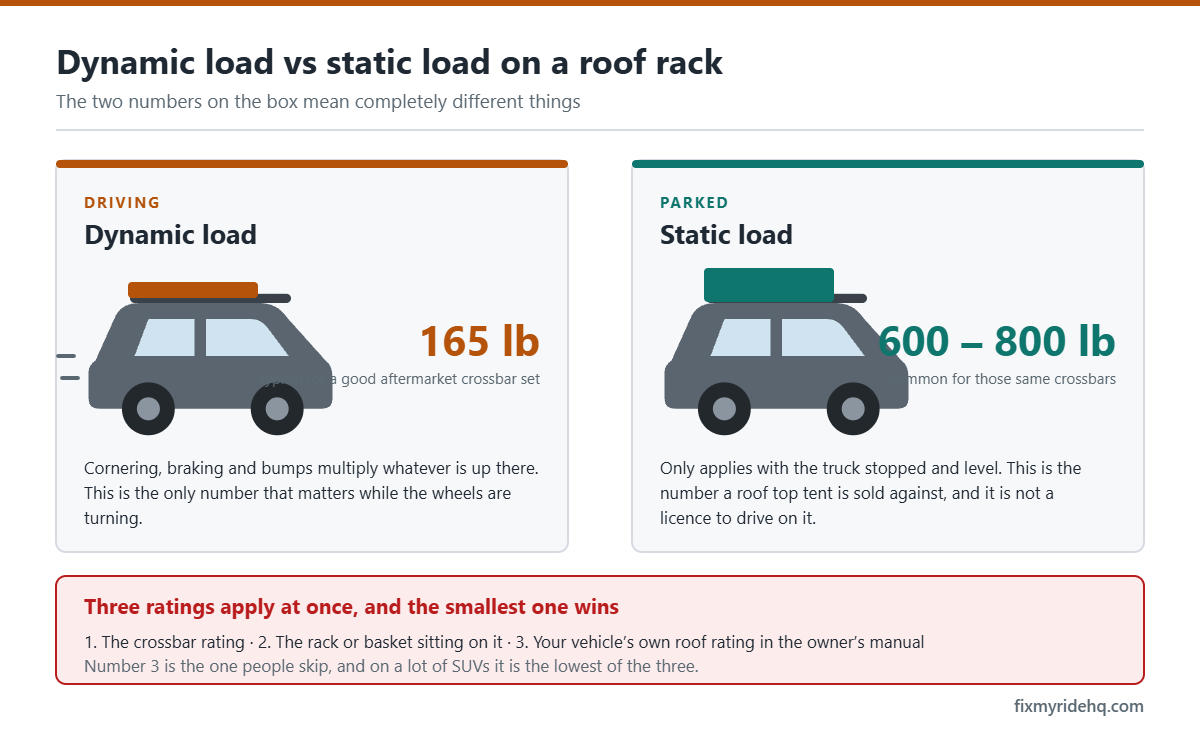
Every roof rating splits into two figures, and confusing them is the most common and most dangerous mistake in this category.
- Dynamic load is the maximum weight while the vehicle is moving. This is the number that governs cargo. It accounts for the forces of braking, cornering, and bumps, which multiply static weight considerably. Typical SUV dynamic limits fall around 100 to 165 pounds — and that figure includes the weight of the rack and carrier themselves.
- Static load is the maximum weight while parked. It is much higher, often several hundred pounds, because there are no dynamic forces. This is the figure relevant to roof top tents and to people sleeping up there.
The practical consequence: if your SUV has a 150 pound dynamic limit, and your crossbars and cargo box together weigh 60 pounds, you have 90 pounds left for contents. A cargo box filled with dense gear can exceed that easily without looking full.
Find your roof limit before you shop
Check your owner’s manual first — it is nearly always listed under roof rack or roof load. Some vehicles also carry a label on the rail itself or inside the door jamb.
If a rack manufacturer advertises a 220 pound capacity and your roof is rated for 150, your limit is 150. The rack rating describes what the rack can hold, not what your vehicle can carry. Racks are engineered to fit many vehicles; your roof is engineered for one.
Mounting systems
- Raised side rails. Rails running front to back with a visible gap beneath. The easiest and usually strongest mounting situation — crossbar feet clamp directly around the rail.
- Flush rails. Rails sitting flat against the roof with no gap. Require a specific flush-rail foot kit.
- Fixed points. Covered threaded mounting points in the roof. Excellent load transfer into the structure, but requires the vehicle-specific fit kit.
- Naked roof. No rails or fixed points. Requires a clamp system that grips the door frames. Works well but generally carries the lowest capacity and demands careful torque checks.
- Gutter mount. Mostly older trucks and vans with rain gutters.
Buy the fit kit specified for your exact vehicle, year, and roof type. Universal in this category usually means compromised.
Carrier types
Cargo box
A rigid, lockable, aerodynamic shell.
Good for: weather protection, security, and predictable aerodynamics. The most refined option for regular long-distance use, and lockable — which matters if the vehicle gets left loaded.
Trade-offs: most expensive, adds significant weight against your dynamic limit before you put anything in it, and requires somewhere to store it when not in use. Adds real height — garage clearance becomes a live concern. Price tier: $$$.
rooftop cargo box — Amazon link pending program approval
Cargo basket
An open metal tray, usually with a mesh or slatted floor.
Good for: awkward, dirty, or oversized items that would never fit a box. Nothing to store — it lives on the roof. Straightforward to strap to.
Trade-offs: no weather protection, no security, and considerably noisier than a box because it presents an open frame to the airflow. A cargo net or bag helps with both noise and retention. Price tier: $$.
roof cargo basket — Amazon link pending program approval
Cargo bag
A soft, usually waterproof bag strapped to crossbars or a basket.
Good for: occasional use, low cost, and packing flat in a closet between trips. The lightest option, which preserves more of your dynamic limit for contents.
Trade-offs: no security whatsoever, water resistance varies widely by quality, and a poorly packed bag flaps and wears. Price tier: $ to $$.
waterproof rooftop cargo bag — Amazon link pending program approval
Specialty carriers
Bike, kayak, ski, and ladder carriers mount to crossbars for specific loads. They are generally the safest way to carry those items, because the load is properly restrained rather than strapped down and hoped for. Each still counts against your dynamic limit.
What a roof rack actually costs you
Three ongoing costs that are rarely mentioned at the point of sale:
- Fuel economy. Roof loads sit in clean, fast-moving air, so the aerodynamic penalty is disproportionate. Expect a noticeable drop with a box fitted and a larger one with an open basket, most pronounced at highway speed. Removing the carrier when you are not using it recovers most of it — crossbars alone cost far less than a loaded box.
- Noise. Wind noise from crossbars and carriers is the most common owner complaint. Aerodynamic crossbar profiles are much better than square bars, and many bars accept a wind fairing that helps further.
- Height. This is the expensive one. A cargo box adds roughly a foot and a half to overall height. Parking structures, drive-throughs, and home garages become hazards. Measure your loaded height and write it somewhere you will see it from the driver’s seat.
Loading it properly
- Heaviest items low and centered, between the crossbars rather than at the ends. Weight high and to one side degrades handling exactly when you least want it to.
- Remember the center of gravity. A tall SUV with a loaded roof rack handles differently — slower steering inputs, more braking distance, and real caution in crosswinds.
- Use rated straps, not bungee cords. Bungees stretch and degrade in UV. Ratchet or cam straps rated for the load are the correct tool.
- Check tightness after the first 15 to 30 minutes, then at every stop. Loads settle and straps relax.
- Verify crossbar torque to the manufacturer’s spec on installation and re-check periodically, particularly on clamp-on naked-roof systems.
cam buckle tie-down straps — Amazon link pending program approval
Roof rack or hitch carrier?
Worth asking before you commit. A hitch-mounted cargo carrier loads at waist height rather than overhead, does not affect vehicle height, costs less in aerodynamic drag, and typically allows far more weight — because the hitch rating is usually much higher than the roof rating.
The downsides are that it blocks rear access unless it swings away, it extends vehicle length in parking, and it needs a hitch. For heavy or frequent loads, a hitch carrier is often the better engineering answer. For long items, bikes, or when the hitch is already in use towing, the roof wins.
Safety note: This guide is general information, not a repair manual for your specific vehicle. Your owner’s manual takes precedence over anything written here — specifications and intervals vary between manufacturers and model years. An overloaded or improperly secured roof load can shift or detach at speed with severe consequences. Never exceed the lowest applicable rating among vehicle roof, rack, and crossbars, use rated straps, and re-check tightness during any trip. If you are not confident, have a qualified mechanic do the work.
Fitting, torque, and the first drive
Roof rack hardware carries your load at highway speed above other people’s vehicles, which makes it one of the few DIY installations where following the torque spec is genuinely non-negotiable.
- Use the vehicle-specific fit kit. The foot pads and clamps are shaped for your roof. A near-enough fit concentrates load in the wrong places.
- Set crossbar spacing to the manufacturer’s specification, not to whatever looks balanced. Spacing determines how load is distributed into the roof structure.
- Torque to spec with a torque wrench. Clamp-on systems for naked roofs are especially sensitive — too loose and they slip, too tight and they deform the door frame.
- Re-check after the first 15 to 30 minutes of driving, then again after the first full trip. Everything settles.
- Re-check periodically thereafter, particularly after any trip on rough roads.
Take a photo of the installed rack with the crossbar positions visible. When you remove and refit it months later, you will not remember the spacing.
Bikes, kayaks, and ladders
Specialty carriers are generally the right answer for these loads, because they restrain the item properly rather than relying on straps and optimism.
- Bikes. Roof-mounted carriers hold either by the fork or by the wheels. Fork mounts are very secure but require removing the front wheel and are harder to load on a tall SUV. Wheel-on trays are easier to use. Both put the bike in clean air, which is also why they cost fuel economy.
- Kayaks and canoes. J-cradles, saddles, or stackers depending on how many boats. Bow and stern tie-downs to the vehicle are strongly recommended in addition to the cradle straps — they stop the boat lifting in a crosswind or under a passing truck.
- Ladders and long material. Needs support at both ends and secure restraint against sliding forward under braking. A red flag is required for overhang in most jurisdictions, and overhang limits vary — check your state’s rule rather than assuming.
Every one of these counts against your dynamic roof limit, carrier included. A pair of bikes plus a carrier can consume most of a modest SUV allowance before you have loaded anything else.
Removing it when you are not using it
This is the single most effective thing you can do to reduce the running costs of a roof rack, and almost nobody does it.
An empty cargo box left on the roof year round costs fuel and noise on every trip for the handful of trips it is actually needed. Crossbars alone cost far less than a box, so a reasonable compromise is to leave the bars and store the carrier.
Store a cargo box on its side or on a wall hoist rather than flat on a garage floor, where it takes up space and collects things. Keep the fit kit hardware in a labelled bag inside the box, because the one thing guaranteed to derail a trip is discovering the clamps are missing.
Frequently asked questions
How much weight can I really put on my SUV roof?
Check your owner’s manual for the dynamic load limit — commonly 100 to 165 pounds on an SUV. Subtract the weight of your crossbars and carrier. What remains is your actual cargo allowance, and it is usually less than people expect.
Why is the rack rated higher than my roof?
Because the rack is engineered to fit many vehicles, including some with stronger roofs. Your vehicle’s rating always governs. When the two disagree, use the lower number without exception.
How much fuel economy will I lose?
Enough to notice at highway speed, particularly with a loaded box or an open basket. The single most effective step is removing the carrier when you are not using it — many owners leave a box on year round and quietly pay for it every mile.
Can I sleep in a roof top tent on a rack rated for 150 pounds?
That is the static load question, and static ratings are much higher than dynamic ones — often several hundred pounds. Confirm the static figure for your specific vehicle, and confirm the tent plus rack weight stays within the dynamic limit while driving.
Are factory crossbars good enough?
Often yes for light loads. Check their individual rating, which is sometimes lower than the roof rating and occasionally quite low. Aftermarket aerodynamic bars are usually quieter and sometimes stronger, but factory bars that meet your needs are perfectly legitimate.
The bottom line
Find your vehicle’s dynamic roof limit first, subtract the weight of the hardware, and shop within what is left. Choose a box for weather and security, a basket for awkward loads, a bag for occasional use. Remove the carrier when you are not using it, and write your loaded height somewhere you will actually see it before you drive into a parking structure.
Next: dash cams compared, or all accessory roundups.
Putting a tent up there rather than cargo? Bed racks and rooftop tents works the weight math, and on a pickup the answer is usually to move it off the roof entirely.
Written by Vince T, who runs a delivery and logistics business in Southern California — dump runs, heavy hauling, private delivery. The trucks and SUVs covered here work through the week and get loaded up for the desert on the weekend. More about the site.