Disclosure: some links in this post are affiliate links. If you buy through them, we may earn a commission at no extra cost to you. As an Amazon Associate, we earn from qualifying purchases. We only recommend gear we would put in our own trucks.
Tonneau covers get sold on two promises: security and fuel economy. Both deserve scrutiny. A cover genuinely changes how you use a truck bed, but the marketing consistently overstates what it protects and what it saves.
What a cover reliably does is keep weather off your load, keep contents out of sight, and stop loose items blowing out of the bed. What no cover does is turn your bed into a safe.
Here are the five types, what each actually delivers, and the specification that surprises most buyers.
In this guide
- The security question, answered honestly
- The specification nobody mentions: bed space lost
- The fuel economy claim
- The five types
- Side by side
- What to check before you buy
- Living with a cover
- Installing one yourself
- Weather sealing in the real world
- What you get at each price tier
- Living with it long term
- Frequently asked questions
- The bottom line
Vince’s own photos and field notes for this guide are being added.
The security question, answered honestly
A soft roll-up cover is a visual barrier. It stops opportunistic theft — the person who walks past, sees a toolbox, and grabs it. It does not stop anyone carrying a blade, because a vinyl cover opens in seconds and silently.
A hard folding or one-piece cover with a proper latching mechanism is meaningfully better. It requires force, force makes noise, and noise deters. But it is still a panel over an open box, mounted to a truck, and it is not a safe.
This matters more than usual if you are hauling other people’s property. A cover reduces risk and is worth having, but it is not a substitute for not leaving valuable cargo in a parked truck overnight. For anything genuinely valuable, a lockable in-bed toolbox bolted to the bed is a different class of protection, and insurance is the actual answer for high-value loads.
Worth checking: most covers can only be locked when the tailgate is locked, because the tailgate is what blocks access to the latch mechanism from behind. If your tailgate does not lock, the cover’s security claim largely evaporates.
The specification nobody mentions: bed space lost
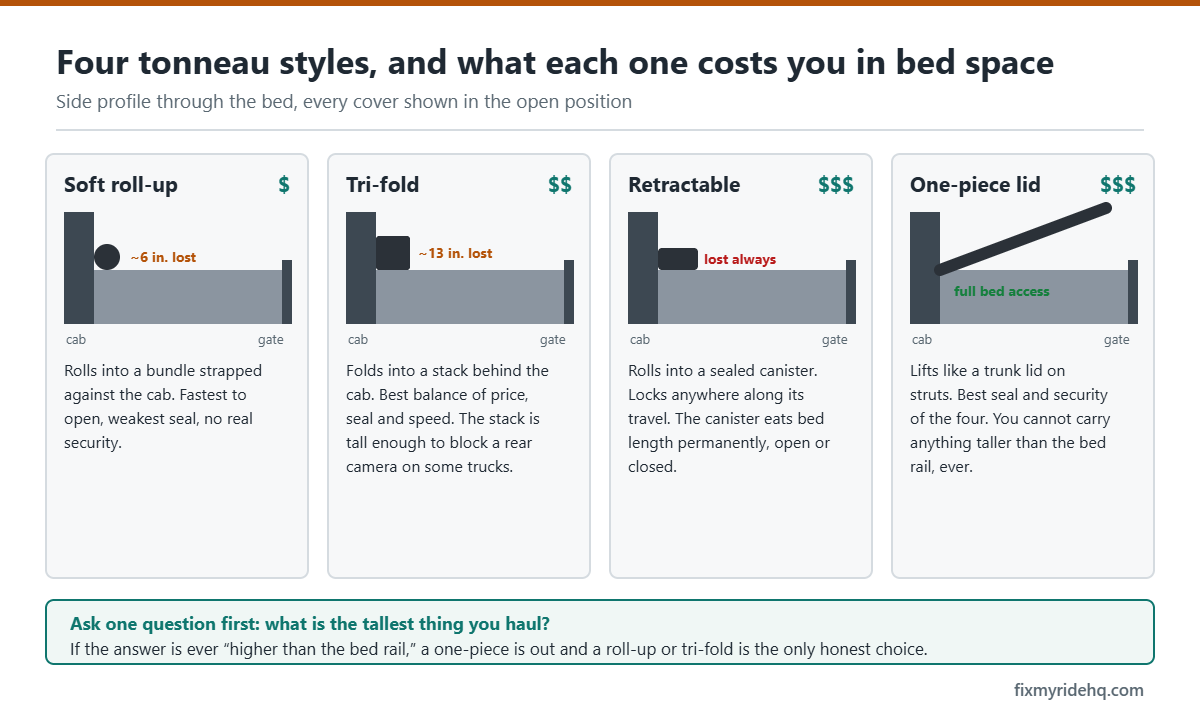
Retractable covers roll into a canister mounted at the front of the bed. That canister is physically in the bed, and it typically consumes 8 to 14 inches of usable bed length.
On a five-and-a-half-foot bed, losing a foot is a substantial fraction of what you had. If you regularly carry anything that fits your bed exactly — sheet goods, long boxes, appliances — measure before you buy, not after.
Folding and roll-up covers do not have this problem when fully opened, though folding covers stack at the front of the bed and occupy some vertical space above the rails.
The fuel economy claim
Manufacturers frequently advertise MPG gains. Independent testing over the years has generally found the effect to be small — often within the margin of error of the test itself, and in some studies a covered bed performs no better than an open one.
The honest position: buy a tonneau cover for weather protection, cargo security, and keeping your load out of sight. If a fuel economy improvement materializes, treat it as a bonus rather than as the reason for the purchase. Anyone quoting you a specific MPG figure as a selling point is overselling.
The five types
Soft roll-up
Vinyl over a frame, rolling toward the cab and securing with straps or clamps.
Good for: the lowest-cost entry into covering a bed. Fast to open fully, leaves the entire bed accessible, and most install without drilling. Lightest option.
Trade-offs: weakest security by a clear margin. Weather sealing is adequate rather than good — expect some water intrusion in heavy rain. Vinyl degrades under sustained UV, which in a hot climate is a real lifespan factor. Price tier: $ to $$.
soft roll-up tonneau cover — Amazon link pending program approval
Soft folding
Vinyl over hinged panels, folding forward in sections.
Good for: a step up in convenience over roll-up, with partial-open positions that let you reach the bed without removing the whole cover. Still inexpensive.
Trade-offs: same fundamental security limits as any soft cover. Hinge seals are a common wear point. Price tier: $$.
Hard folding
Rigid panels — aluminum, composite, or fiberglass-reinforced — hinged in three or four sections.
Good for: the best overall balance for most owners. Meaningfully better security than soft covers, good weather sealing, and it folds forward for full bed access or removes entirely on most models. Many can support a modest distributed load on top.
Trade-offs: heavier, more expensive than soft options, and the folded stack sits above the bed rails limiting what you can carry tall at the front. Price tier: $$ to $$$.
hard folding tonneau cover — Amazon link pending program approval
Retractable
A slatted panel that rolls into a canister at the cab end, often with locking positions along its travel.
Good for: convenience and clean appearance. Opens to any position, locks at intervals, and nothing has to be removed and stored.
Trade-offs: the canister costs you 8 to 14 inches of bed length permanently. Most complex mechanism here, which means more to go wrong, and typically the most expensive. Price tier: $$$.
One-piece hard cover
A single rigid lid, usually hinged at the cab end, often paintable to match the truck.
Good for: the best security and weather sealing of the group, and the most finished appearance.
Trade-offs: cannot be partially opened, so tall cargo means removing the cover entirely — which generally requires two people. Heaviest and often the most expensive. Price tier: $$$.
Side by side
| Type | Security | Weather | Bed space lost | Price tier |
|---|---|---|---|---|
| Soft roll-up | Low | Fair | None when open | $–$$ |
| Soft folding | Low | Fair | None when open | $$ |
| Hard folding | Good | Good | Stacks at front | $$–$$$ |
| Retractable | Good | Good | 8–14 inches | $$$ |
| One-piece hard | Best | Best | None, but all-or-nothing access | $$$ |
What to check before you buy
- Measure your bed length and your typical load. Especially important if you are considering retractable.
- Confirm exact fitment. Bed length, model year, and whether your truck has a factory bed rail system or cargo management track — many covers conflict with them.
- Check tailgate lock interaction. Most covers depend on a locked tailgate for their own security.
- Drilling or clamp-on. Clamp-on preserves resale flexibility and is usually reversible. Check before you commit.
- Weight rating, if you plan to put anything on top. Many hard covers accept a modest distributed load; almost none accept a point load.
- Warranty terms and UV rating, particularly for vinyl in a hot, sunny climate.
Living with a cover
A few practical notes that rarely make it into product descriptions:
- Drainage matters. Most covers channel water to tubes that drain through the bed. Those tubes clog with leaves and grit, and a clogged drain puts water where you did not want it.
- Seals need occasional cleaning and conditioning to stay pliable, particularly in the sun.
- A cover changes how you load. Sliding things in from the tailgate becomes the default, which pairs with the grip question covered in our bed liner guide.
- Anything left in a covered bed is out of sight but still outdoors. Temperature and humidity under a cover in summer can be considerably higher than ambient.
Safety note: This guide is general information, not a repair manual for your specific vehicle. Your owner’s manual takes precedence over anything written here — specifications and intervals vary between manufacturers and model years. Covers add weight and change bed access. Do not exceed the manufacturer’s load rating for the cover, secure all cargo with rated tie-downs regardless of the cover, and confirm the cover does not obstruct your view or your license plate lighting. If you are not confident, have a qualified mechanic do the work.
Installing one yourself
Most soft roll-up and hard folding covers are a genuine DIY job, typically 30 to 90 minutes with basic hand tools. The steps are broadly the same across brands:
- Clean the bed rails thoroughly. Clamps grip better on clean surfaces, and grit trapped under a clamp will scratch the rail.
- Test fit the rails before tightening anything. Check the cover closes and latches properly, and that the tailgate still opens and closes freely.
- Set the gap at the cab end to the manufacturer’s specification. Getting this wrong is the most common cause of a cover that will not seal or will not latch.
- Tighten clamps evenly and only to the specified torque. Overtightening deforms bed rails, which is expensive and visible.
- Attach and route the drain tubes, if the cover has them, so water exits through the existing bed drains rather than pooling inside the bed.
Retractable and one-piece covers are heavier and often need a second pair of hands. One-piece covers in particular are awkward to lift alone and easy to damage against the cab if they get away from you.
Weather sealing in the real world
Manufacturers rarely claim waterproof, and the ones that do are usually describing ideal conditions. Water resistant is the accurate description for the category.
In practice, water finds its way in around the tailgate, at the corners near the cab, and through drain tubes that have clogged with leaves and grit. Hard one-piece covers seal best; soft covers will let some water through in sustained heavy rain or at speed.
Two habits keep it as dry as it can be: clear the drain tubes a couple of times a year, and clean and condition the rubber seals so they stay pliable. In a hot, sunny climate seals dry out and shrink faster than most owners expect, and a hardened seal is the usual reason a cover that used to keep water out no longer does.
Anything that genuinely must stay dry belongs in its own sealed container inside the bed, not simply under the cover.
What you get at each price tier
Rather than quoting figures that change, here is what generally separates the tiers:
- $ — entry. Vinyl soft covers with basic frames. They cover the bed and hide the contents. Expect shorter UV life, modest sealing, and hardware that may need replacing before the cover does.
- $$ — mid. Better soft covers and entry hard folding covers. Meaningfully better latching, better seals, better hardware, and warranties that mean something.
- $$$ — premium. Quality hard folding, retractable, and one-piece covers. Aluminum or composite panels, refined latching, good weather sealing, and often a load rating. This is also where paint-matched and fully integrated options live.
The biggest jump in real capability is from soft to hard. Above that, you are mostly buying convenience, finish, and longevity rather than a fundamentally different level of protection.
Living with it long term
A few things owners notice after the first year:
- Hinges and latches benefit from occasional lubrication, particularly on folding covers used daily.
- Vinyl covers need UV protectant to avoid going chalky and brittle, and this matters far more in sun-heavy climates than the product page suggests.
- Clamps loosen. Check them a few times a year — a cover that departs at highway speed is a serious hazard to everyone behind you.
- Removing a hard folding cover for a tall load takes a few minutes and usually two people. Factor that in if you regularly carry things that will not fit under it.
Frequently asked questions
Will a tonneau cover actually improve my gas mileage?
Possibly slightly, and independent testing has generally found the effect small enough to be hard to measure reliably. Buy it for weather and security; do not build a payback calculation around fuel savings.
Can I put a roof rack or load on top of a tonneau cover?
Only if the manufacturer specifies a load rating, and only within it. Most hard covers accept a modest evenly distributed load. Point loads — a ladder resting on two spots, for instance — will damage panels not designed for them.
Does a tonneau cover make my bed waterproof?
No. Water resistant is the honest description for nearly all of them. Hard one-piece covers come closest; soft covers will let some water in during a heavy storm. Anything that must stay dry needs its own waterproof container.
Which type is best if I haul furniture?
Hard folding is usually the best compromise: solid weather protection, decent security, and it folds fully forward or removes when you need the whole bed for something tall. Avoid retractable if bed length is ever tight, because the canister is permanent.
Can I install a tonneau cover myself?
Most clamp-on soft and hard folding covers are a straightforward job with basic hand tools. Retractable and one-piece covers are heavier, sometimes require drilling, and are considerably easier with a second person.
The bottom line
Choose on security level, weather sealing, and how much bed space you can afford to lose — in that order. Hard folding suits most owners best. Retractable is the most convenient but costs you real bed length. And no cover, of any type, is a safe: for other people’s property, a locking in-bed box and not leaving the truck loaded overnight do more than any cover will.
Next: truck bed liners compared, or all accessory roundups.
Written by Vince T, who runs a delivery and logistics business in Southern California — dump runs, heavy hauling, private delivery. The trucks and SUVs covered here work through the week and get loaded up for the desert on the weekend. More about the site.