Disclosure: some links in this post are affiliate links. If you buy through them, we may earn a commission at no extra cost to you. As an Amazon Associate, we earn from qualifying purchases. We only recommend gear we would put in our own trucks.
Auxiliary lighting is where the work side and the weekend side of a truck overlap most directly. The same pods that light a job site at 5am light a camp setup at a trailhead, and a bed light you added for loading turns out to be the most used accessory on the truck.
It is also the mod with the most actual law attached to it, and the one people most often install in a way that will not pass an inspection or a traffic stop.
Here is what each type is genuinely for, how to wire it so it survives, and what the rules are about using it on a public road.
In this guide
- Know what each light is actually for
- The legal side, and it is real
- Wiring it so it lasts
- Mounting that survives a working truck
- Doing it on three budgets
- Frequently asked questions
- The bottom line
Vince’s own build photos for this guide are being added.
Know what each light is actually for
| Type | Beam | Real use |
|---|---|---|
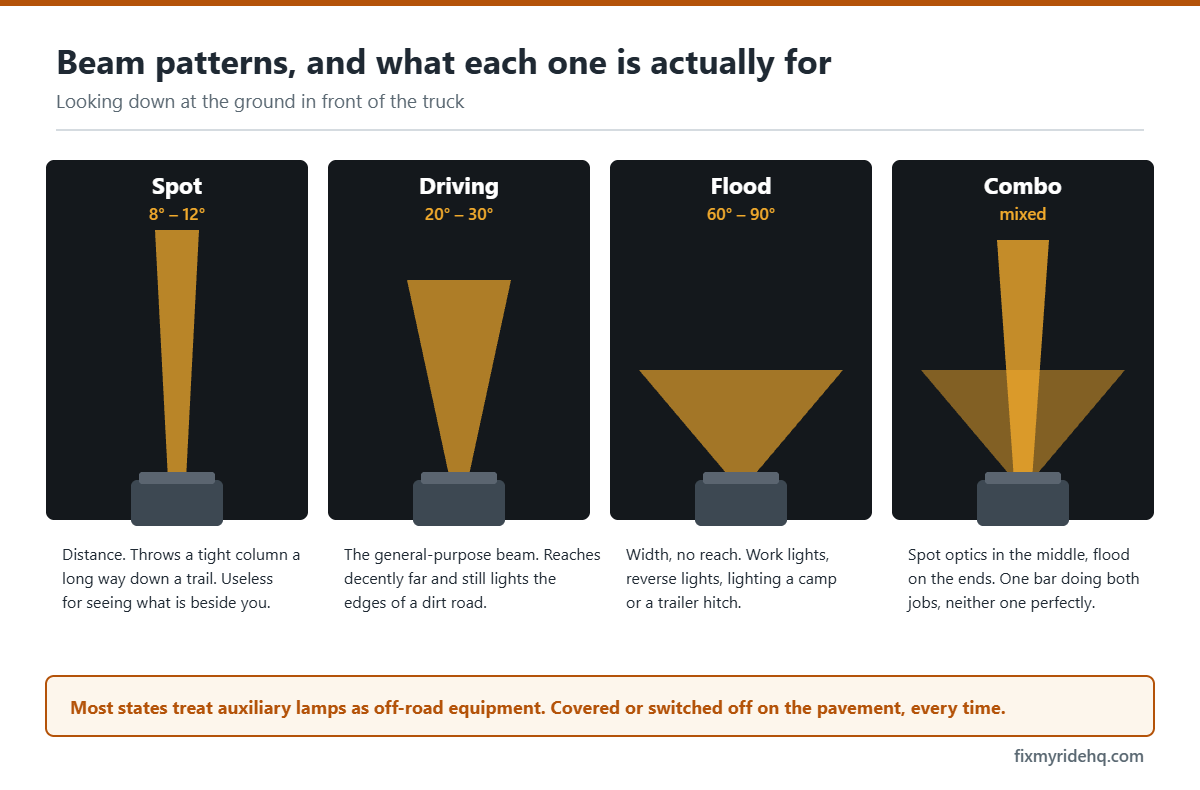
| Spot | Narrow, long throw | Distance on open trail at speed |
| Flood | Wide, short throw | Work area, camp, backing up, loading |
| Combo bar | Spot center, flood edges | General purpose off-road |
| Ditch lights | Wide, angled outward | Corners and shoulders on tight trail |
| Rock lights | Downward, under body | Wheel placement at crawl speed, camp ambience |
| Bed and cargo lights | Flood, downward | The one you will use most, honestly |
Most people buy a big combo bar first and a bed light last, then find they use the bed light every week and the bar three times a year. If your truck works, start with cargo and bed lighting.
The legal side, and it is real
Rules on auxiliary lighting vary by state and change, so verify your current state law rather than relying on a forum post or this page. The consistent themes across jurisdictions are worth knowing:
- Off-road lighting generally must be covered or switched off on public roads. This is why light bars ship with covers, and why those covers are not decorative.
- Limits on how many forward-facing auxiliary lamps may be lit at once.
- Colors matter. Red and blue to the front are associated with emergency vehicles and are the fastest way to get pulled over. Amber is broadly accepted; white is standard.
- Height and mounting position are often regulated for forward lighting.
- Nothing may obstruct the driver’s view, which is worth considering before a windshield-height bar.
The practical version: wire auxiliary lighting so it cannot be switched on accidentally while driving, keep covers on when you are on pavement, and use it where it is intended to be used. A light bar blinding oncoming traffic on a freeway is how restrictions get tighter for everyone.
Wiring it so it lasts
Auxiliary lights draw far more current than interior accessories, and that changes what the wiring needs to be.
- Use a relay. Switches are not rated to carry the current a light bar pulls. The relay carries the load; the switch only triggers the relay.
- Fuse close to the battery. The fuse protects the wire, not the light. It belongs at the power source end of the run.
- Size the wire to the draw and the length of the run. Undersized wire heats up and drops voltage, so your expensive lights run dim and your wiring runs warm.
- Use a proper switch panel or a dedicated auxiliary fuse block if you are adding more than one circuit. This is the difference between one tidy install and a growing nest behind the dash.
- Ground to bare chassis metal. Scrape paint back and use a proper ring terminal. Bad grounds cause most mysterious lighting faults.
- Loom and secure every run. Anything crossing the engine bay needs protecting from heat and vibration, and nothing should sit near the exhaust or a moving part.
- Use weatherproof connectors anywhere outside the cabin.
automotive relay and wiring harness kit — Amazon link pending program approval
auxiliary switch panel — Amazon link pending program approval
LED bed and cargo light kit — Amazon link pending program approval
Safety note: This is general guidance, not a wiring diagram for your vehicle. Disconnect the battery before working on the electrical system, fuse every circuit at the source, never tap into airbag or safety system wiring, keep wiring clear of exhaust, moving parts and pedals, and confirm your state’s current lighting laws before use on public roads. If you are not confident with higher-current 12V work, have an installer handle it. Our battery terminal guide covers the correct disconnect order.
Mounting that survives a working truck
- Vibration is the real enemy. A loaded truck on a washboard road shakes brackets apart that looked fine in a parking lot. Use thread locker and check fasteners periodically.
- Avoid drilling where you cannot see the back side. Fuel lines, wiring, and brake lines live in places that look empty from outside.
- Anywhere you drill sheet metal, treat the bare edge so it does not corrode.
- Cheap aluminum housings and plastic lenses yellow and haze in our sun. Sealed housings with polycarbonate lenses last considerably longer.
- Check that a bar or pod does not block airflow to the radiator or A/C condenser. That trade-off is real on a truck that tows in summer heat.
Doing it on three budgets
| Tier | What you get | Trade-off |
|---|---|---|
| $ — Entry | Bed or cargo lighting on a switched circuit, properly fused and relayed. | No trail lighting, but the most genuinely useful lighting per dollar on a work truck. |
| $$ — The sweet spot | Bed lighting plus a quality combo bar or pod pair, relay harness, switch panel, covers included. | A day of careful wiring. Covers the work use and the weekend use. |
| $$$ — Premium | Multiple zones — ditch lights, rock lights, bar, bed — on a dedicated auxiliary fuse block with a proper switch panel. | Real money and real install time. Worth it if you actually run at night regularly. |
Our honest take: buy fewer, better lights on properly sized wiring. A quality pod pair on a relay harness beats a bargain bin light bar that dims at the ends within a year, and it draws less doing it.
Frequently asked questions
Do I really need a relay?
For anything beyond a small bed light, yes. Running a light bar’s current through a dash switch not rated for it is how switches melt. The relay is an inexpensive part that carries the load properly.
Can I run a light bar on the road?
Generally no, not lit. Off-road lighting is typically required to be covered or off on public roads, and the specifics vary by state. Check your current state law. Covers exist for exactly this reason.
Why do my lights flicker or run dim?
Almost always a bad ground or undersized wire. Check the ground connection is on bare metal first — it is the cause far more often than the lights themselves being faulty.
Will auxiliary lights drain my battery?
Only if wired to constant power or left on with the engine off. On a switched, relayed circuit they draw nothing when the truck is shut down. Running them at camp with the engine off will absolutely flatten a battery, which is a good reason to keep a jump pack in the truck.
Amber or white?
White throws further and shows detail better. Amber cuts through dust and fog noticeably better, which matters on a desert trail behind another vehicle. Many people run white for distance and amber for conditions, and some pods offer both.
The bottom line
Start with the bed and cargo lighting you will use weekly, not the bar you will use three times a year. Relay everything, fuse at the source, size the wire to the run, and ground to bare metal. Keep covers on for the road and check your state law before you switch anything on.
Next: roof racks and cargo carriers, or browse all builds and mods.
Mounting those lights on a bar or a bumper? Aftermarket bumpers and rock sliders covers what that hardware costs you in weight, sensors and lamp clearance.
Written by Vince T, who runs a delivery and logistics business in Southern California — dump runs, heavy hauling, private delivery. The trucks and SUVs covered here work through the week and get loaded up for the desert on the weekend. More about the site.