Disclosure: some links in this post are affiliate links. If you buy through them, we may earn a commission at no extra cost to you. As an Amazon Associate, we earn from qualifying purchases. We only recommend gear we would put in our own trucks.
Chrome delete is the fastest way to modernize an older truck. Factory chrome grilles, mirror caps, badges, and window surrounds date a vehicle more than anything else on it, and blacking them out costs a fraction of any other exterior change.
It is also completely achievable in a driveway, and unlike most exterior work, a careful amateur result is genuinely hard to tell from a shop result.
Here are the three methods, which parts suit each one, and how to avoid the two failures that make a chrome delete look cheap.
In this guide
- The three methods
- Film: where it works and where it fights you
- Preparation decides everything
- Badge removal
- Doing it on three budgets
- Living with it in Southern California sun
- Frequently asked questions
- The bottom line
Vince’s own build photos for this guide are being added.
The three methods
| Method | Best for | Reversible? | Cost tier |
|---|---|---|---|
| Vinyl wrap film | Grilles, mirror caps, window trim, badges | Yes | $ to $$ |
| Plastic and trim dye | Textured plastic trim, bumper plastic, grille surrounds | No | $ |
| Removal and replacement | Badges, emblems, chrome inserts | Yes, if kept | $ to $$$ |
For most people, vinyl film on chrome and dye on faded plastic is the right combination. They solve different problems: film covers shiny surfaces cleanly, dye restores grained plastic that has gone chalky.
Film: where it works and where it fights you
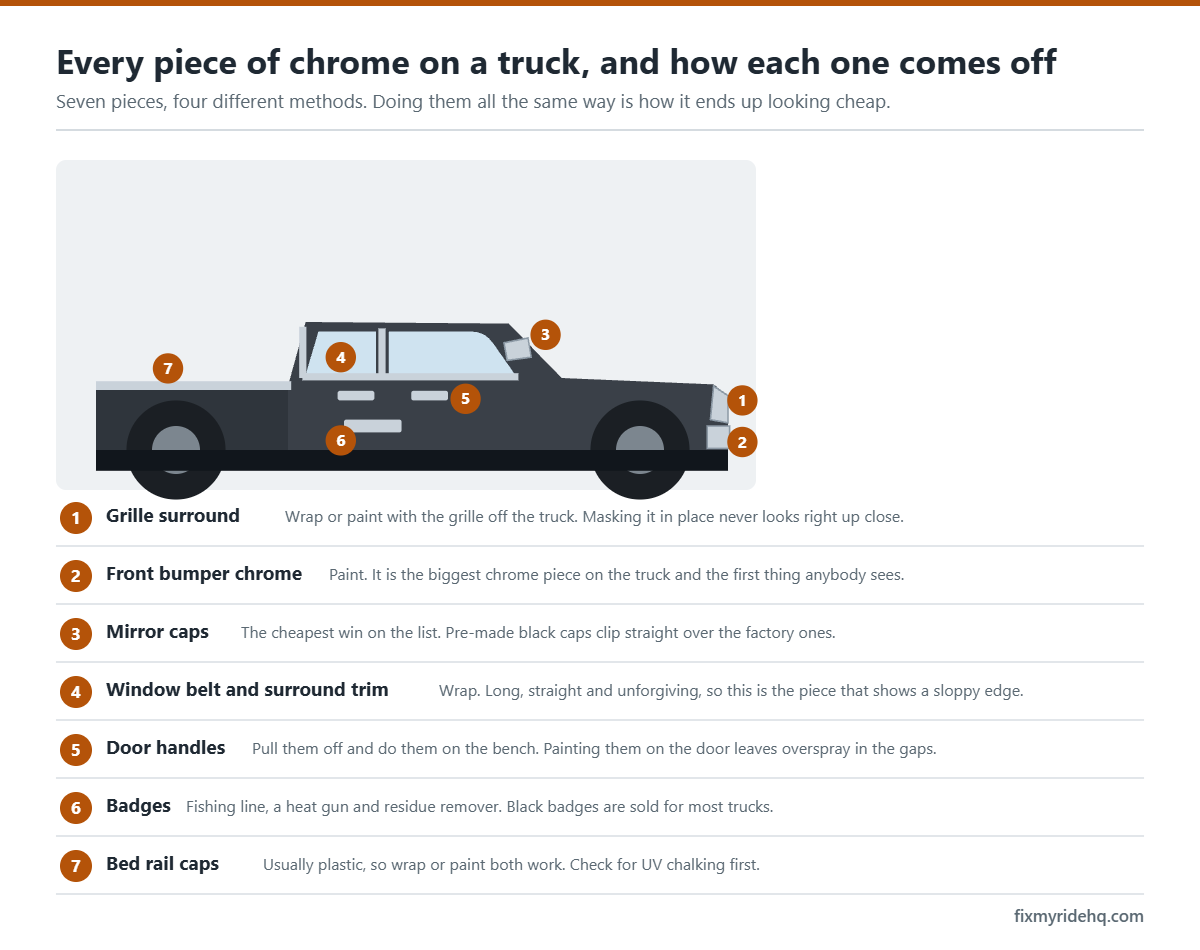
Vinyl film conforms beautifully to flat and gently curved surfaces. Mirror caps, window surrounds, flat grille bars, and badges are all straightforward.
Where it fights you is deep compound curves and sharp recesses. Aggressive grille meshes and heavily sculpted bumpers will test your patience, and film that has been over-stretched into a recess will lift there first. If a shape looks like it needs three hands, it probably needs dye instead.
Buy cast vinyl rather than calendered for anything curved. Calendered film is cheaper and shrinks back toward its original flat shape over time, which is exactly how edges lift.
cast vinyl wrap film for chrome delete — Amazon link pending program approval
vinyl wrap tool kit with squeegee — Amazon link pending program approval
heat gun for vinyl wrap — Amazon link pending program approval
Preparation decides everything
- Wash thoroughly, then clay the surface if it feels rough. Contamination under film shows as bumps and becomes a lift point.
- Degrease with isopropyl alcohol and keep going until a fresh cloth comes away clean. Wax and detailing spray residue is the number one cause of film failing at the edges.
- Remove the part where you can. A mirror cap off the vehicle can have film wrapped properly around its back edge. Wrapped in place, you are left with a cut line where dirt and water will work in.
- Work in shade at moderate temperature. Film in direct Southern California sun becomes unmanageable — it stretches when you do not want it to and the adhesive grabs before you have positioned it.
- Let it fully outgas before washing the vehicle.
That third point is the difference between amateur and professional results. Wrapping edges around the back of a removed part means there is no exposed film edge for a pressure washer or a car wash brush to catch.
Badge removal
Debadging is the cheapest chrome delete of all, and it is mostly patience.
- Warm the badge gently with a heat gun or hair dryer to soften the adhesive. Warm, not hot — you are softening tape, not stripping paint.
- Work fishing line or dental floss behind the badge and saw through the foam tape.
- Remove leftover adhesive with an adhesive remover and a plastic razor, never a metal one.
- Polish the area afterward. Paint under a badge has been shaded for years and often sits slightly different from the surrounding panel.
- Keep the badges in a bag. A future buyer may want them, and that is worth real money at resale.
adhesive remover for automotive trim — Amazon link pending program approval
Safety note: This is general guidance, not a procedure for your specific vehicle. Heat guns can damage paint and plastic if held too close or too long, adhesive removers require ventilation and eye protection, and some trim pieces are fastened from behind a panel. Check your owner’s manual or factory service information before prying anything you are unsure about.
Doing it on three budgets
| Tier | What you get | Trade-off |
|---|---|---|
| $ — Entry | Debadge plus dye on faded plastic trim. Basic tools. | Leaves chrome grille and mirrors untouched, but removes most of the dated look. |
| $$ — The sweet spot | Cast film on grille, mirror caps and window surrounds, dye on plastic, full debadge. Parts removed where practical. | A full weekend. This is the tier that changes how the whole truck reads. |
| $$$ — Premium | Everything above plus a shop handling complex grille meshes, or replacement blacked-out parts instead of film. | Replacement parts look best and cost the most. Film gets you 90 percent for a fraction. |
Our honest take: film the mirror caps and window trim yourself, and pay somebody or use dye for a complicated grille. That combination gets a factory-looking result without three ruined attempts at a mesh.
Living with it in Southern California sun
- UV is the enemy of cheap film. Quality cast vinyl with a UV-stable topcoat holds color for years; bargain film fades toward purple or brown.
- Hand wash where you can. Automatic car wash brushes find every film edge.
- Keep pressure washers off edges and seams entirely.
- Expect to redo film eventually. It is a wear item, not a permanent finish, and that is also its advantage.
Frequently asked questions
Will wrapping damage my paint?
Quality film on factory paint in good condition removes cleanly and can protect the paint underneath. Risk rises on repainted panels, on paint that is already failing, and with cheap film left on for years past its life.
Can I wrap over chrome?
Yes, and chrome is one of the easier surfaces because it is smooth and non-porous. Degrease it thoroughly — chrome polish residue defeats adhesive completely.
How long does vinyl last on a truck that lives outside?
Quality cast film typically gives several years in strong sun. Cheap calendered film can start lifting and discoloring within a year in our climate. This is a case where the cheap option genuinely costs more.
Should I dye or wrap my grille?
If it is smooth and flat, wrap it. If it is textured plastic or a complex mesh, dye it — and dye it off the vehicle. Trying to wrap a complicated mesh is where most first attempts get abandoned.
Does debadging hurt resale?
Usually not, and it is reversible if you keep the badges. Some buyers prefer a clean panel. Just be aware the paint underneath has aged differently, so removal is best done alongside a polish.
The bottom line
Degrease far more than you think you need to. Remove parts and wrap the edges around the back. Use cast film, not calendered, because of the sun here. Film the smooth stuff, dye the textured stuff, and keep your badges in a bag.
Next: black out your interior plastic to match, or browse all builds and mods.
Written by Vince T, who runs a delivery and logistics business in Southern California — dump runs, heavy hauling, private delivery. The trucks and SUVs covered here work through the week and get loaded up for the desert on the weekend. More about the site.